Search This Blog

Showing posts with label circumstantial. Show all posts

Thursday, October 13, 2011

Amanda Knox, DNA and Circumstances

Amanda Knox, as most know, recently suffered the same fate as Casey Anthony: she was set free.
The culprit here was DNA and probably to some extent the CSI effect.

DNA identification is not the simple cut and dried thing you see on TV.

DNA is made up of a string of "values" labeled C, G, T, and A (we are talking logically here and not about the underlying chemicals and biology).  Every person has a unique string of these four values about four billion characters long that makes them unique in the DNA sense.  (Think of one giant text file full of nothing but those four letters.)

Your DNA also has structure, that is, sequences that are common to all humans as well as sub-structures within those structures.

In the case of DNA testing the model is not to compare your entire DNA what that found at the crime scene.

Instead the CSI-types look for certain markers.  A marker is a sequence of the four letters that is understood to be part of all humans.  Take D8S1179 - this marker is a series of seven to twenty TCTA sequences.

Now these sequences are individual molecules and therefore hard to detect.  What the CSI-types use is something call PCR to amplify the DNA - no all the DNA - just some pieces - like D8S1179.

D8S1179 is surrounded by markers (other unique DNA sequences).  So, in order to amplify it, first we have to find it.

So PCR is given D8S1179 plus two flanking DNA values - one for each end of the D8S1179.

PCR then searches the DNA provided from the crime scene.  When it finds a match, that is D8S1179 plus the two flankers together, it replicates what it finds doubling the amount of matched DNA.

However, the DNA from the crime scene might only be 10 ^ -12 grams (.000000000001 g) of DNA.  So you have to do the PCR process at least 28 times (in the USA) to a usable result (basically increasing the matched DNA by 2 ^ 28 for doubling 28 times or 268,435,456) which gives about 250 micrograms of matched DNA.

Now using just D8S1179 is not enough because there are only thirteen unique values for it.

So the same process has to be done for a large number of markers like D8S1179 - let's say fifty - to ensure that the markers that are unique to you are not going to match someone else.

But, as always, there are problems with this.

First and foremost is the question of the purity of the DNA collected in the first place.  In the case of hair, for example, everything fed into the PCR process for amplification might come from the hair.  But what does that mean?

First off, its why people doing this wear gloves.  If I touch a piece of someones hair with my finger my DNA might mix with the DNA in the hair.  So what would PCR be amplifying?  My DNA or the hair DNA?

PCR does not "know" what its doing - it amplifies whatever matches - whether its your DNA or mine.  PCR can just as easily amplify the wrong thing.

So as the source of the DNA becomes questionable so do the results of the test.

The longer DNA lays around the more it degrades, i.e., the base pairs break apart due to chemical reactions with the air and so on.

So given a swab of two peoples DNA and a whole slew of possible markers in the US court system at least 50 (with today's equipment) markers have to have a significant match between the person and the "crime scene" DNA for their to be a true "criminal" match made, i.e., its your DNA and not someone elses.

But, as I railed about in other recent posts, this is just a statistical result.  No one has tested all the humans on the planet and their DNA.  This is what science, through statistics, thinks is unique.  And it does not mean there wouldn't be anomalies such as someone matching you even though you are not related (or at least do not appear to be).

DNA does not provide a "timescale."

While I might find your DNA in my apartment the fact that its there at all says nothing about when it was put there, as in before or after the crime.  So there's a knife on my counter with your blood on it.  The DNA-tech goes around the house collecting up my DNA - say on a comb in the bathroom - and then touches the knife.

Did the tech get some of my DNA on the knife handle?

Was my DNA on the handle in the first place?

And on and on...

In the case of Amanda Knox there was her boyfriend's DNA on the bra clasp of the dead girl and some of her DNA on a knife handle.

The bra was not collected until six weeks after the crime.  Knox's involvement at the crime scene was linked through the supposed presence of the bra clasp DNA of her boyfriend.

Her DNA on the knife handle was minimal.

The initial Italian inquest considered that 41markers had matched for the boyfriend and Knox - not the USA required 50.  But in her first go around in the Italian justice system this convicted her.

On the second go around 41 was deemed not enough by the appeals court.

And she was set free.

Just like Casey Anthony.

Did Knox kill the girl?

No one knows.

Her African boss was also convicted of murder and remains in jail.

The problem with all of this is its not a "hard" science.  We are not blasting particles into a chamber and measuring neutron dispersion within .0001% of some mathematical model.

We have, like archeology I suppose, a bunch of fallible humans running around doing things which technology will amplify by some 2 ^ 28 in order to create a result.  A result which we could not get any other way.

Then we are doing this a few hundred times and check to see if at least 50 markers match.

Okay if nothing is screwed up along the way (and now you can see why the "chain of evidence" is so important).  If someone mixes up articles being tested for DNA, or touches them, or combines them, the whole house of cards falls apart - and there isn't even a way to tell.

Which to me is the most troubling.

PCR amplifies whatever DNA it finds - right or wrong.

It relies on people to handle 10 ^ -12 grams of material in a reliable way - something you cannot see or touch.

If you can't see or touch it, how do you know its "right"?

How do you know there wasn't contamination?

The point is you don't know.  You have to rely on statistics.  Its only the probability that its right - not that it is right.

The same kind of statistics that the Casey Anthony jury felt were insufficient to convict Anthony.

Saturday, July 16, 2011

More Damning of Circumstantial Evidence

The "Monty Hall Problem"
I have discussed circumstantial evidence and why I believe its wrong to use it in a court case previously in the posts "Through the Keyhole" and "Casey Anthony and Circumstantial Evidence".

This post is about yet another reason to distrust "circumstantial evidence" in a court room situation.

There is a tendency in the human mind to impress upon situations what we "think" is probable.  As an example imagine that I ask a large audience to sit facing me.  I flip a coin five times and, while not letting the audience see the result, I claim to broadcast the results psychically to the audience.  I ask them to write down the heads/tails sequence they believe I am sending them.

I next explain that its very unlikely anyone will have received my psychic transmissions correctly because, well, that would require psychic transmissions to be real.  So I reveal the actual coin sequence, for example, THHTH (T = Tails, H = Heads) and, surprisingly, a number of people raise their hands and show that they have in fact written down the correct sequence of heads and tails.

(This example is summarized from this.)

At issue here is the audiences expectation of randomness (and presuming also that no actual psychic transmissions are occurring).  Any non-mathematician audience member is likely to write down something that to them does not appear to be random, i.e., they will likely not write down HHHHH,  TTTTT or THHHH, even though these outcomes for five coin flips are just as likely as any others.  Instead they are likely to write down something like HTHHT which to their mind's experience appears to be more "random" and hence more likely.

Should I actually flip HHHHH or TTTTT then probably no one will get it right.  But more often than not I will flip something that appears to match our expectations of "randomness" and someone will have made up a random sequence to match.

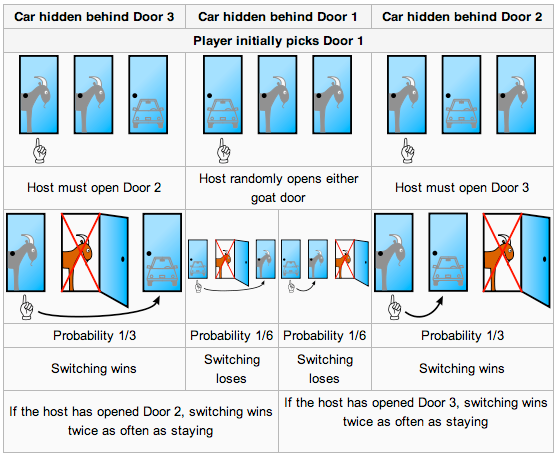
Another example of this type of confusions is called "The Monty Hall Problem" (see this video for a clear explanation).  This is another example of a counter-intuitive result based on what looks like a simple probability problem.

Given these types of examples I am going to now claim that by using circumstantial evidence is a court room situation there is much more than the prosecutor trying to claim that A implies B implies C where there is no direct evidence in the chain of events.

So imagine that the prosecutor, knowingly or not, assumes the roll of me in the first example above.  The jurors are the "audience members".  Now by presenting the facts in such a way as to control the outcome the jury expects to see the prosecutor has a distinct advantage over the defense.

The first advantage is the mere fact that the court case has gone to trial at all.  The jury must, even subliminally, believe that there is at least some merit to the charges otherwise there would not be a trial at all.  In my example this is the role of "psychic transmission" (some 70-80 percent of the population believes in the paranormal according to this).

Next the prosecutor divulges a "theory of the crime".  This involves demonstrating a logical chain of deduction going from the crime backward (or forward) through some chain of reasoning to the defendant.  Something like:

E: "Joe killed Sally."

D: "Sally is dead of a gunshot wound."

C: "Joe was at Sally's house the day she died."

B: "The day before Sally is found dead Joe bought a gun."

A: "The week before Sally told Joe their relationship was over."

So the prosecutor tells the jury that A implies B implies C implies D implies E.  The desire is that the jury converts each of the "implies" steps along the way to "causes", essentially like writing down the expected result of the coin toss.

In cases with all or mostly circumstantial evidence, as with Casey Anthony, this is the only real chance for the prosecution: to convince enough of the jurors that they guessed at or concluded the same implications between each of the steps as the prosecutions theory put forth.

To convict someone of a crime you actually need a causal link between the events, e.g. A caused B, that leaves no room for doubt.  Yet, like the coin toss example, if you have a propensity to believe something (paranormal or that no mother would kill her own child) to begin with your mind is going to fabricate the "causal" implications for you.

The problem, of course, is that there isn't necessarily any link at all between each of  the events, just as there is no link between the results of one coin toss and the next.

So, based on circumstances and without causal links between events your predisposition to believe something is going to be what drives your conclusions.

Yet people, due to reasons they may not even know, create these implications out of whole cloth.  They literally make up links between events just like they make up "random" coin toss results.

Most people, and even many mathematicians, have a hard time excepting the "Monty Hall Problem" because it is so counter-intuitive.  And given a jury of lay people, more than likely without even basic mathematical training in probability, its a good bet no one will see beyond the theory of the prosecution to the weak logical foundation upon which it must rest (if there was real evidence people would expect to have seen it - again just like the Casey Anthony trail).

When there is a discussion of the apparently non-existent "CSI Effect" among prosecutors it is much more likely they are seeing the results of education over the centuries.  In the 1600's people believed in witchcraft as an actual "cause" for things and few had any education at all.  Today most people have at least heard that paranormal events are not real and have probably had to sit through at least one year of mathematics education where probability is presented.

Its little wonder today's juror is going to expect more than the A, B, C, D, E I presented above as the reason to convict Joe.

And this is not what the shrieking female talking head prosecutors want to hear - because causally linking A to B and so on is hard.  Much harder than they are perhaps used to.

Friday, July 8, 2011

Casey Anthony and Circumstantial Evidence

A "Rube Goldberg" Machine
I posted "Through the Keyhole" several weeks back which I think is apropo to revisit regarding the Casey Anthony trial.

I discussed the "keyhole dilemma" which asks how do I know if I have enough information to correctly diagnose or solve a given problem.  The analogy I used was to look at some process (say a Rube Goldberg machine like the one pictured with this post) through a keyhole - which limits what and/or how much you can see of the entire machine.  Given you cannot see all the parts of the machine how can you know if what you think is wrong based on your view through the keyhole is enough to correctly diagnose and fix the problem.

(For example, if I could only see the left half of the picture I might conclude that there is a very simple mechanism engaged between "D" (the ball rolling down the ramp) and "P" (the rock squeezing the toothpaste onto the brush) - which would be incorrect.)

In the worlds of physical science, computer science and mathematics humans use techniques to address this dilemma - at least to a degree.  For example, determining how a cell divides through biological investigation, using a proof to demonstrate something like the Pythagorean Theorem, or debugging a program.

The same is true to a large degree with the US Justice system and juries.

We see an initial situation, in the case of Casey Anthony her with her child alive, and a final situation, her child is dead.  But we are forced to look "through the keyhole" at the process of how things got that way (so we might see "A" in the picture above - throwing the switch, and the toothpaste on the tooth brush - but none of the steps in between).  Therefore we do not know how the result follows from the initial circumstances.

Someone like a prosecutor creates a "theory" about how the missing events happened which is provided to the jury.  (Now, if the prosecutor knows (has direct knowledge) how it happened, i.e., with some sort of concrete evidence, say a video or a confession, that's a different case.  Here we are interested in when only a "theory" is offered the jury.)

So the prosecutor describes a series of events to fill in what happens between "A" and the final result.  Of course, in real life there may be several "keyholes" in which case the theory must account for what is visible through each.

What is interesting to me is while their may be any number (perhaps an infinite number) of "theories" about how we get from "A" to the final result how do we find the correct one?  Is it even possible?

In many cases it is in fact impossible to determine what is "not seen" through the keyhole - there simply does not exist a record of the missing events or process.  To address this type of case prosecutors use what's call "circumstantial evidence" to attempt to fill in the gaps.

"Circumstantial evidence" works like this.  If I see Joe shot Ann with a gun - that is direct evidence.  However, if I see Joe and Ann go into another room after which I hear, but do not see, a gun shot and I later enter the room to find Ann dead - that is circumstantial evidence that Joe killed Ann.

This process of inference about what happens that I do not have direct evidence for is often used in criminal trials to convict people of crimes.

The problem with inference, particularly in a criminal trial like that of Casey Anthony, is that the process used is neither scientific nor objective.  Scientific inference, e.g., I find Joe's finger prints on the gun, may lead me to conclude that Joe in fact held the gun at a given point.  But the same is not true for concluding that Joe shot Ann with the gun.

In the later case I am inferring something for which there is no possibility of actual proof.  Two people went into a room, one is dead, the other one must have killed them.  But this is simply not a fact, nor a provably correct inference.

Now let's imagine a slightly different scenario.  We have two keyholes - through one we see Joe fire the gun in the direction of Ann, who we can see through the second keyhole.  Now, when we see the gun fire and and drop dead, we can also make a similar inference.

Most people would agree that the first inference (where we only hear a sound) and the second where we see two different but apparently related events are not quite the same.  There are various other scenarios we can imagine as well - for example seeing a hand with a gun and the gun killing Ann - but not the holder of the gun, and so on.

I argue that the difference in value as evidence between two events where inferences is used to "fill in" what happens between them is based on probability.  For example, seeing Joe and Ann enter a room and hearing a shot leaving Joe as the killer has a 50% probability that Joe killed Ann versus seeing Joe fire the gun through one keyhole and Ann drop dead through another has a 75% probability.

Note that this is an illustration and the point is that different people might assign probabilities differently when weighing two scenarios.  Objectively it would be easy to argue about which scenario I provide is more or less likely to make Joe a killer and even though this is essentially a trivially simple case its easy to see how their might be strong disagreement.

Now, as in the case of Casey Anthony, we mix in heated emotion:  Ann is my wife or Joe is my husband.  Ann is a cute child and Joe is an ugly brute.

Would the assessments still be the same?

This is the first problem with "circumstantial evidence" - not being scientific or objective it is easy to sway those involved such as a jury with emotion.  Such emotion also sways the observers of such a trial.

So this is my first problem with "circumstantial evidence."

Is it fair to allow emotion to drive or infiltrate inference?  Clearly it does and this trial is a perfect example.

Finger print evidence is "scientific inference" - but inference not swayed by emotion, i.e., they are still my fingerprints whether or not I or you are angry.  This is a fact because anyone can inspect my fingers and the fingerprints and decide if they are mine (though if they are, for example, not clear then this may fall into the realm below).

The injection of emotion into the process of inference colors the inference.  It makes determining the probabilities of which scenario is more likely harder and unfair because it becomes driven by external factors instead of what ever direct evidence there actually is.

A jury must decide the probabilities of both the defenses or prosecutions scenarios.  Since the actual facts are unknowable the result comes down to non-scientific inference.

Which airplane would you want to fly on: the one where the designers "felt really good" about the design or the one designed on "scientific evidence".

Or how about the one where designers where told "they were the greatest designers on earth" or "the biggest idiots on the planet" as they were working through the final details?

No, circumstantial evidence (the result of inference) are only valid if the inference process is objective, i.e., my thinking of how A implies B implies C is done objectively.

Since this in virtually never the case where emotion is concerned or involved I must conclude the circumstantial evidence is unsuitable for logical conclusions.

I think this was the case by the jurors in the Casey Anthony trial.

This is troubling particularly when I see prosecutors in an emotional frenzy: are they really after true justice or are they really just trying to trick jurors into making objectively invalid inferences based on their emotions and feelings - which is not a fair trial.

Thursday, July 7, 2011

Casey Anthony and the "CSI Effect"

Did the rabbit "done die?"
The "CSI Effect" is the name given by prosecutors to the actions of juries who expect TV-like detectives, crime scene investigators (CSI), judges and prosecutors to provide they, the jurors, with simple, neatly explained "theories" of crimes.

The hysterical, shrieking female talking heads (primarily prosecutors and former prosecutors) on cable bemoaned the Anthony verdict as a possible result of this effect.

Interestingly, though, according at least to this study, the 'CSI Effect' itself is not real.  Its a very interesting read.  The authors agree that there is a "tech effect" present - one that gives the jurors the expectation that various "high tech" elements, such as DNA, are required for convictions, such as in rape.

These same shriekers also decried the fact that the jurors "could not connect the dots" in the Anthony case - some declaring that the juries expected "too much" in the way of neat, organized presentations and facts and that a burden of proof "beyond reasonable doubt" was too high of a standard.

All I can say to these shriekers is wake up, spend a little more time on your job, and take some technology refresher courses at the local U.

Since the dawn of the United States technology available to criminals, prosecutors and the "average joe" has advanced beyond expectation or imagination.

Long gone are the days when "Joe the woodcutter" comes to town from his remote, isolated hand-hewn wooden cabin on the back of some ox-drawn turnip cart, shit still clinging to his boots, to sit on a jury to decide if Sam the butcher stole Sally's mule.  Imagine this case: no computers, photography (how do we even know its Sally's mule), no DNA, no forensic analysis, no tens of thousands of applicable mule-hate laws to apply.

How was it decided?

With a quill pen, some India ink, some parchment, great oration, logic and guts.

(Of course, there was a much lesser propensity to lie about things (yes, its my mule) in the olden days... or was there???)

Do these female shriekers expect today's jury to function in the same way it did then?  To accept the same arguments and prosecutorial techniques used in the late 1700's?

Are you kidding?

(One might also note that only the dreaded "old ass white man" was involved and employed in the justice system at that point in time (as prosecutor, judge, jury, police, etc.)  Women did not yet have the right to vote, much less be employed as a prosecutor...  It can't be too long ago because Alaska's first woman prosecutor just died this year.)

Between the late 1700's and my childhood in the 1960's little things like photography were invented.

The concept of "blood type" was developed (A, B, O, etc.) developed.

Finger printing as a means to uniquely identify people.

Vehicular homicide made an appearance.

In my lifetime alone law enforcement discovered computers, DNA evidence, a huge collection of forensic testing (blood, drug, health, disease, parasites, etc. etc. etc.), video, and many, many other technologies.

But these technologies, such as photography, did not come just to law enforcement - but also to the common "Joe" as well - who in the late 1800's could by a Kodak camera and take his own pictures just as well as any detective or prosecutor.

So by 1900, say, would it be wrong of Joe to sit on a jury and expect that, say a photograph, be introduced as evidence in a case of, say, forgery?  "Here is a photograph of Mrs. White's tiara in 1895."  Please compare it to the one taken in 1900 after it was retrieved from the vault at the jewelers.

"Do you notice any differences?"

No, of course not.

So a TV show like CSI, or the "tech effect", or whatever is a part of the natural progression of technology, crime, evidence and prosecutorial "keeping up with the joneses."

In my teenagerhood there was a common expression: "did the rabbit die?"  This was in reference to an old time test for pregnancy where the urine of the female was injected into the rabbit.  The urine of pregnant women caused a visible reaction in the ovaries of the rabbit.

Today I doubt there is a male under 25 (nor a single mom under 25) alive that is not familiar with the standard "home pregnancy tests."  And I also bet, to a man (and woman), they all know what a "DNA test" is for and what it means for them.  A paternity DNA test is a common occurrence these days - one conducted under the imprimatur of, surprise, the local county court house.

Given that, as a matter of course for young men and women, a "court ordered" paternity test is a common occurrence (one involving DNA, of course) - why wouldn't there be an expectation that the same sort of tests be applied where ever DNA would "close the deal" in a criminal case?  Certainly in the daily life of youngsters today this is common technology - used by their peers to extract "child support payments" or as a lever to engage in holy matrimony.

No, my guess is that the average "joe" on jury duty, even with today's substandard education, expects more from his prosecutor than some tenuous, unsubstantiated links from A to B to C.

My guess is also that these female prosecutors, at least like those on cable news shows, deal almost exclusively with career public defenders and juries with little interest in believing anything beyond what the prosecutor tells them to believe.  I would also guess that "career public defender" and "energetic, inventive defense" are not synonymous.

Indeed the CSI Effect probably had little to do with the verdict in the Casey Anthony case.

I think, the prosecutors reached for a verdict well beyond what they could actually reasonably prove and the jury simply confirmed that that reach was too far.

These shrieking female prosecutors will have to man up and accept that today's juries are much more likely to contain folks that expect to be presented with logical consistency and statistical likelihood instead of histrionic whining and flogging incendiary pictures of partying.

Wednesday, July 6, 2011

Twelve Angry Men and Casey Anthony

From the movie "Twelve Angry Men"
Avenging Caylee's Anthony's death seems to have been more important, at least to some like Nancy Grace and the other talking heads, than the law, justice, or just about anything else that you could imagine.  Up until the very end I had paid little attention to this case - dismissing Casey Anthony as an idiot, stupid slut who killed her child in order to party - just as the media portrait of her suggested.

My mother and others had commented on the trial over the previous weeks - but until the last week or so I had simply assumed what the media had said was true.

She was guilty...

By the long July 4th weekend, however, I started to pay more attention - I started to wonder how a woman so obviously guilty of a crime needed such a long trial - I wondered what the evidence was.

Since the trial was nearing its end various cable news channels started to replay portions of the trial - closing arguments, testimony, etc.

I watched closely. I paid more attention.

Where was the prosecution's evidence, I started to wondered...?

I did not see any, none at all.  No linking of fact A to fact B.  No indication that only Casey Anthony could have been in location A at time B doing act C associated with the crime.  Nothing.  I say the Gawker version of a "media conviction" - but nothing I would call "judicial."

I know a couple of people with close family members who were murdered in cold blood.  In every case the authorities were extremely, extremely careful to link facts together in a proper chain showing how no one else could have been involved at crucial points (thus cementing their guilt) before going to trial.  If these points could not be proven then the cases waited to go to trial until they were proven.

Of course the prosecution in this case wanted people to hate Casey Anthony for "partying" while the child was missing or dead - that's what the female news talking heads hated the most.  This "evil slut" went out dancing while little Caylee rotted in her grave.  In fact, they even proved this point in court - showing dated pictures of Casey partying juxtaposed against the probable time of death for Caylee.

This is the only thing the media, the female talking heads, and some of my own family members all focused on - "evil bitch" they cried - convict her - she's guilty.

But in listening to the testimony of the prosecution's own witnesses - the forensic experts, anthropologists, and others - there was simply no chain of facts linking Casey to the death of her child.

When you expect a jury to condemn someone to death they must be provided concrete facts and a scenario that shows how no one but the defendant could have done it.  Jurors are required, in criminal cases, to find that the defendant did it "beyond reasonable doubt" and "with moral certainty."

Now one would imagine that someone like a Nancy Grace or a Judge Jeanine Pirro would have noticed this distinct lack of concrete evidence.  After all, the present themselves as "experts" in these matters.  But apparently, despite actually being in the court room, this total lack of evidence escaped them.

By Sunday night the news had arrays of talking heads discussing, or I should say ranting about, the Casey Anthony jury and its certainty of returning a conviction - all at least what I call the "old ass white men" - old, white haired forensic pathologists and the like.  These folks pointed out how there was simply no forensic evidence presented and that the prosecution's case was basically laughable.  Needless to say they did not last in the "hot rotation" from anchor to anchor over the prime news times.

Instead we were presented with a collection of smurking women experts decrying the "evil slut" and her actions.  How Caylee's death must be "avenged."  Convicting Casey in the press.

Tuesday's news, however, told a far different story - the jury found Casey "not guilty" on all the counts related to Caylee's death (and yes, she was found guilty of lying to the police because that exactly what the evidence showed).

And how did these women talking head experts take their complete failure to predict the outcome?

Outrage.

Anger at the stupid jury.

Shock.

What's much scarier than Casey Anthony's "not guilty" is how these talking head women "experts" have perverted justice, the Constitution, and society.

Is it a total outrage that Caylee Anthony is dead?

Yes - if, and only if, someone actually killed her.  She could, for example, have died accidentally.

Must an accidental death be "avenged?"

The talking head news idiots I believe drive the thankless public servants in places like the Orlando County Courthouse to "rush" in cases like this.  Their shrieks of "Oh my God! Caylee must be avenged!" cloud facts, reality, the judicial procss and good judgement.  The create hysteria and blood lust for vengeance where slow and plodding are called for.

As I said, no murder I know directly of was handle this way - mostly because, I imagine, folks like Jeanine Pirro and Nancy Grace don't know about the case nor take them up as "causes".  Instead the detectives merely plod along, sometimes for years or decades, until they get a break - at which point they convict their man.

The jury in this case, returning a verdict in only 10 hours or so, clearly were all on the same page (this being confirmed by the comments of one of the alternate jurors).  There was likely no "Twelve Angry Men" scenario where only one thought she was innocent and the rest guilty - there simply wasn't time in that ten hours to got through all of that.

The scariest thing of all - from my perspective - is that Grace, Pirro, and others were busy in the nations court rooms in previous years.  Apparently using the zest to "avenge the death..." to push the judicial process along in directions that believe are best for everyone based on their own fervent beliefs rather than on due process.

(Not every death is a crime.  Not every action is a crime.  Unfortunately today when there is a problem apparently "someone has to pay."  Sounds like a police state to me...)

You have to hand it to Casey Anothey - she has balls - she did not take a plea and stuck to her guns to the end.

Is she guilty of being a killer?

The court says no, but then so did the 1995 OJ court (at least those prosecutors managed to produce the Bruno Magli shoes).

God will judge Casey Anthony in the end.

The good state of Florida has judged her and found her not to be a murderer.

Thankfully the jury took their job seriously and rendered a judgement based on the evidence presented instead of the media hype provided by Grace and others.

But I fear the Pirro's, Grace's and others before them have already and forever polluted justice with media.

To them I say there are good reasons the founding fathers created our justice system.  One of them being to ensure a "fair trial" for anyone accused of a crime.

How wonderful that they foresaw a day when the likes of the Pirro's and Grace's would be busy convicting defendants in the press before and during their trials.  How wonderful that they foresaw only a Constitutionally protected system of fair trials would allow the country to evade becoming a police state, to grow and prosper despite their creation of corresponding "free press" to open talk about said trials.

Maybe Pirro and Grace can create a foundation to sue Casey Anthony in civil court to extract damages for Caylee's death - relying instead on the "preponderance of evidence" to convict her.  Maybe they can spend their own millions of dollars to prosecute this stupid young mother in order to avenge Caylee's death.

Perhaps they could sue the Orando Country Prosecutor's for presenting such an incompetent case?

The coverage of this case by news outlet's has totally sickened me.  These people are not "experts" - their predictions are failures and wrong.  Their Nazi-esque zeal to ensure that there is always someone "responsible" for an unfortunate or tragic event is downright scary.

They pervert justice.

They pervert the notion of a "free press" and "fair trial".

What I write here are my own opinions - read them if you like - don't if you don't.  But I don't push them on you.  I don't write about things like Casey Anthony (I am writing about her trial here - not her) before all the facts are in (which, in this case, they are not - there will be years of books, made for TV movies, documentaries, counter suits, etc.).

If I were some of those talking heads I would sincerely think about reexamining my own motivations and credibility rather than pouncing on the next victim who needs "avenging".