Search This Blog

Showing posts with label frac. Show all posts

Tuesday, December 6, 2011

Marcellus Shale Shake Down

Over at MedPageToday.com I found this very troubling article: "Special Report: Health Impacts of Shale Gas Boom Still Unproven."  Apparently the result of a conference at the University of Pittsburgh last month sponsored by the Graduate School of Public Health.

Now before I launch into an "analysis" of this article let me disclose that I have two gas wells on property that I own.  When they drilled the wells I was involved on a daily basis with the process - on the drilling platform, inspecting the materials brought in and out, speaking with the folks running the equipment as well as those in the management of the drilling company.

I live close to these wells and, being concerned about what they might do to my own environment, I watched over this all activity very carefully.

The wells were put in place many years ago now - long before the Marcellus Shale boom in the region.

These are relatively shallow wells - some 3,500 ft deep - drilled straight down.

My first problem with the article is that it makes it sound as if the Marcellus fracturing is somehow different than regular fracturing because the "joints" of the shale are oriented vertically.  Shallower wells, like I have, are also frac'd - but since the "joints" run horizontally the frac'ing occurs in the vertical pipe.

Though horizontal drilling is use for Marcellus its no different that any other frac'ing.  Horizontal drilling also allows the gas industry to use a smaller number of platforms to drill what would effectively require multiple separate wells all from one place.  By this I mean that a single drilling platform, with horizontal drilling, can do the work of many without the environmental impact.  The drilling runs parallel with the ground up to 10km or more away allowing one well head access to a gas in a wide area.

Next there is concern about the frac'ing fluid - which is basically water.

All the drilling I have observed over the last many years including that done on my property kept all of the waste water in a plastic-lined waste water pond set up by the drilling crew.  There was no spillage into water ways, mess, mud or anything else.  It was surprisingly neat and organized.

Secondly the frac'ing itself does not involve liquid spraying all over.  The whole point is that its pumped through a sealed steel drill pipe down into the ground at tremendous pressure.  If it was leaking into the ground water then you couldn't frac the well in the first place because you could not build up the required pressure.

Once the frac'ing is completed the water is collected so that gas can flow out of the well.  If the water stayed in there there would be no gas.  Since Marcellus Shale gas is at a fairly high pressures, say 400 psi or more, the frac'ing liquid will come out of the well under pressure.

If you've ever seen water pushed by 400 psi you would not believe that it was staying in the ground.

Now we have many thousands of people employed in the region in Marcellus Shale operations.  The conference indicates that about a half dozen people had been injured.

The implication was that this was a concern.

Yet as many die from medical errors in the region, or from car wrecks.  Perhaps even medical errors at the UPMC facilities where the conference was held.

But there is no concern about that for some reason.

Then there is concern that some are suffering sprains, broken arms, and so on....????

Perhaps its healthier to sit around on unemployment watching TV all day, under stress from having no job, and eating chips made of unhealthy oils that destroy your health.

Then the drilling operation is supported by evil diesel motors - spewing death and poison into the atmosphere - killing adults and children alike...

Oh wait...

If I look out my window, Oh My, What's That!

Why diesel trucks - running by pulling huge loads of paper or whatever...

Where's the concern????

So what's the real point of this article?

Its so the "public health monopoly" can shake down the Marcellus folks for money.

See look!  The number of sprains and broken arms in our emergency rooms are increasing...

Oh no, someone might spill some dirty water on the ground....

Wake up out there - ever look into the "Three Rivers" at the actual water?

If I brought a bucket of river water and dumped it on my property my guess is that there would be far, far more supposed "danger" to the environment.

No, this is about building up fuel for a "tax" so that we don't have to pay the horrible price of progress.

I think its a shame that this kind of article is what passes for "thoughtful discourse" on the matter of Marcellus Shale.

I think that a field trip to a drilling site would be in order rather than sitting around talking about what might be going on.  Its pretty clear from all this that no one "on the inside" at the Public Health school has been on site.

I think they should be - they should find out who works there and why.

Isn't that important?

Firemen do dangerous work too.

No is trying to prevent them from being firemen.


Thursday, July 28, 2011

The Fracking Debate

What is "fracking"?

This is the process when drilling a gas well of fracturing the underlying rock in order to all the gas trapped inside the rock to flow freely to the well pipe.

A few years ago they were drilling gas wells near my home.  I knew nothing about this process so it was quite interesting to watch.  The wells being drilled were called "shallow" wells because they did not penetrate very far into the earth (about 3,500 feet).

Basically the crew flattened what I would guess to be about 1/2 of an acre of ground with bulldozers.  Next they dug a shallow pond and lined it with plastic.  Then they brought in the drilling equipment.  In the case of shallow wells this is basically a semi-trailer with a large hydraulic drill, some diesel, and some drilling pipe.

The drill itself is just a big hydraulic system that spins the drill tip.  The drill tip starts on a section of pipe (about 25 feet long).  The pipe is spun by the drill into the ground using water from the pond as a lubricant.  Once about 20 feet of the pipe is in the ground the next pipe section is attached.  Each section is threaded so the drill stops turning the section in the ground.  Then a new section of pipe is taken from a rotating set of available pipes, positioned over the pipe in the ground, and then spun on until it locks tight.  The drill then continues until the new pip is mostly in the ground and another section is to be added.

(Actually three concentric holes are drilled - the actual well bore hole and two outer holes - one a few hundred feet and one fairly short.  This are filled with concrete in order to stabilize the hole and keep ground water from leaking into the well.)

Drilling to 3,500 feet took about 5 days or so.

When the drilling stops you have a chunk of pipe sticking out of the ground 5 feet or so.  The drilling pipe is thick and has hexagonal walls (I think so the drill has something to grab on to to spin the pipe).

But once the drilling stops no gas comes out...

Why not?

Well, for one thing the pipe is sealed - so no gas leaks into it.  For another there may not even be gas because no one really knows what's below the ground that far.  They can guess but they are not always right.

The next step was for the drilling company to send out a specialized rig with thousands of feet of heavy cable and a winch.  At the end of the cable was some sort of radioactive box with some sensors.  The idea is that the box is lowered into the pipe and the sensors are recorded.  The composition of the bore hole surroundings tells the geologist running the device whether or not a given section of pipe spans a likely gas source. (Gas is often found in shale.)

Now what?  There still isn't any gas...

So how do I get gas to flow into a pipe 3,500 feet away from where I am above ground?

Explosives.

The next step, once we know where the pipe spans the likely gas formations below ground, is to "open up" the pipe so gas can flow into it.  A large shrapnel bomb is constructed with a core of high explosives and a wrapper of shrapnel.  This is lowered into the pipe to the span were the gas is likely to be and then detonated.  The shrapnel pierces the pipe so the gas can flow in.

But even after this only a small amount of gas comes out.

Now what?

Now its time to "frack".  With gas trapped in shale its necessary to create cracks in the shale so the gas can flow to the well pipe.  To do this water (and other chemicals) is pumped into the well hole at very high pressure.  The water flows out the holes blown into the pipe and enters the shale.   Because its under such high pressure the shale fractures (hence "frac'ing") leaving room for the gas to flow.

So why is this so controversial?

First off people are ignorant of geology and physics.  The outer well casings are put in place so that between the steel bore pipe and the ground there is about 2-4 inches of concrete down several hundred feet.  The exact depth of this being determined among other things by the depth of the local ground water.

For some reason people believe that gas would flow either A) through the sides of the well bore pipe and through the concrete casing or B) up from 3,500 feet below to contaminate "ground water".  Neither of which is physically possible (unless something goes drastically wrong which can happen).

(For example, if the casing and pipe broke at the level of 100 feet down were there was groundwater then, if the well were capped, there would be gas being forced into the water table.  However the pipes are 1/2 or thicker steel surrounded by concrete - so they are not likely to break unless something like an earthquake hits.)

The bottom line is that under any groundwater source (which tends to be between about 50 to 400 feet below ground) is shale containing gas - anywhere in the world.  If the gas could flow up to the surface it would have to do it through the local ground water.

But it doesn't.

And between the lower end of where groundwater is and the gas shale is about 3,000 feet of mostly solid rock.  Which is why there is no gas in the groundwater to begin with.

Secondly all the water and chemicals pumped into the bore hole are drawn back out after the fracking.  Otherwise there would be no way for the gas to reach the surface save bubbling through all that water.  The gas pressure is typically 75 psi or higher so have that much pressure under the fracking liquid will only do one thing - make a heck of a fountain.

(All the water used for drilling and all the waste water generated by the well itself are saved in trucks or the pond built at the start.  Nothing spills over onto the ground.)

The bottom line is that there is always danger of something going wrong but its very unlikely a gas well will ruin a water supply.  Fracking has been used for many decades without issue for tens of thousands of gas wells.

Gas well drillers have no right to drill on any property for which they do not have permission by the owner (of either the property, the mineral rights, or both).  So if there is a concern don't give them the right to drill or write a contract that ensures fresh water even if they make a mistake.  If the risk is too high then the well won't get drilled.

If you're "green" you have to follow this line of reasoning:

1) Coal is killing 10,000 people per year.

2) Gas from wells does not kill 10,000 people per year.

3) Gas from wells could replace coal.

4) Are the deaths of 10,000 people worth the very low risk of groundwater contamination from "fracking"?

Newer Marcellus shale wells are 7,500 feet deep - do they pose a threat?

Do they pose a bigger threat because they are deeper?

Do they pose a threat (even a financial one) if they are on your neighbors property but not yours?

Tuesday, July 19, 2011

Access to Your Own Health Data

Marcellus Shale - Like the Wild West
I saw an article over in Information Week about accessing your health care data.  Basically right now you can't.  You can't see test results, doctors notes, assessments, treatment history, anything.

Of course the information is all there - usually in thick files hanging on the wall somewhere - but you can't use it.

Imagine if car repair worked the same way.

You take the car in, the mechanic looks it over, "hmmmm" he says, take it over to Bob's Auto Yest and have him do this.

He hands you a cryptic sheet.

You go to Bob's.

Bob hooks up wires and tubes to the car, runs some machine and says "Oh no."

"What's the matter?" you ask.

"Nothing you would understand," says Bob.

He scribbles on more paper, hands it back and says you'd better have your mechanic look check this right away.

"Oh," he says, "and here's a bill for $350.00."

Back at the garage the mechanic takes the paper from Bob's and looks it over.

"No, no," he says, "that's not right."

"Here," he says to you, "take it Frans and this time have Fran check this the way I wrote it down..."

You get another cryptic piece of paper...

And on it goes.

How long would you put up with this?

No information about what's going on, unable to see what their talking about, not knowing what's wrong, being shunted from specialist to specialist only to get no useful result.

Now even if your not a doctor you know how long its been since your last test, what the doctor told you about it and your problems, what drugs you might be taking, and so on.

Why does the medical establishment think you have nothing to contribute?

Its your body after all...

But the internet is changing all of this and soon you may have access to it all.

But that won't come without some danger and some responsibility for you.

As I wrote in "Surgical Ritual or Ritual Surgery" a while back the medical establishment is not real big on modern conveyances.   For example, check lists, a recent addition to the surgical process at VA hospitals, used to ensure that the right surgical procedure are used on the the correct patient produce remarkable results (remarkable in the sense of an 18% drop in surgical deaths).

That's right - just use a simple check list like grandma had for going to the grocery store to ensure your doing the right thing to the right patient - and 20% fewer people die (imagine how many surgeries the VA does in a year).

Now I would imagine that you wouldn't need a medical to degree to see that the test results were yours if you had access to your health records - and that alone might save your life.

Of course, all this is not really why the medical folks don't want you (and your lawyer) to have access to your records.

If you read this book you will be offered a glimpse into what really goes on on the world of medicine:

"Jauhar feels responsible when he botches the blood pressure check on a patient who later dies during an aortic dissection and when he misses the high blood sodium level of a man who then suffers irreversible brain damage."

The Information Week article misses this crucial reason why medical records are private - lawsuits.

Imagine what a skilled trial lawyer would do with the information in the book I quote above from "Intern: A Doctor's Initiation" by Sandeep Jauhar.  Jauhar goes into much more detail than this - about how deaths are handled and reviewed, about how deaths are looked at as "teaching moments" for interns.  If this book does not make your skin crawl I don't think anything will.

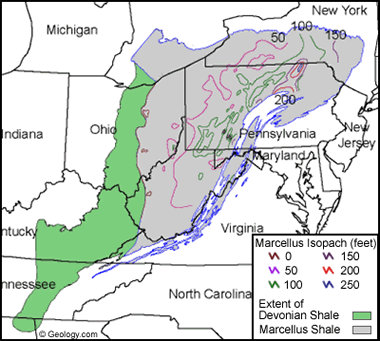
Right now I own a large piece of property over what's called the Marcellus Shale - an area full of natural gas deposits.  Hucksters call constantly looking to drill wells, purchase rights, run pipe lines, dig lakes, you name it - and that's with gas at around $4.00 (natural gas MMBTU's - its been as high as $15 per MMBTU).  They are all looking for that big natural gas payday.

It's kind of like the wild west.

In the case of health records the raw data itself will be like the bonanza of gas deposits for the lawyers.  I can seem them now hiring droves of interns to send out letters:

Dear Sir/Madame:


Please assign your patient lawsuit rights to Hackem, Chopem, and Suem.  We promise to get you the highest return for your lawsuit dollar and we only take 60%!

We will use our automatic healthcare trolling system to scour your records for mistakes, misdeeds, unfortunate circumstances, etc. - all at no cost to you.

Call today at 1-800-SUE-DOC


Sincerely

No doubt this will ensure medical costs stay low in the future...