Search This Blog

Showing posts with label Law: Spirit. Show all posts

Friday, September 30, 2011

Law: Spirit, Letter and Intent (Part III)

As a business owner its mind boggling to see the number of stupifying rules, regulations and nonsense spewed out of the government each year.

New FCC rules, rules exchanging video rental information, privacy rules.

For me its always best to find a place to conduct business that's away from this sort of activity.  Something that doesn't cross paths with all of this nonsense.

The "spirit of the law" is really what its all about.  In an actual sense (though in the "real" world this is dwindling) as well as in the spiritual world.

People no longer have a sense of the "spirit of the law" - they only see the "letter."

For example, laws exist that prevent companies from disclosing information about movies you rent unless you explicitly say its okay on a rental-by-rental basis.   The Video Privacy and Protection Act was created to prevent reports from uncovering you rented "Debbies does the Muppets" at the local video store during your Senate confirmation hearing.

This is a federal law that says if you hand the rental clerk (though soon there will probably be no more video rental stores - if there are any left around at all) a twenty and he prints out your neighbors rental history he, the clerk, is on the hook for a big fine ($2,500 USD according to the Wikipedia).

This law was passed in 1988.

Today Netflix wants to allow you, via Facebook, to share what you are watching.  So some setting in Netflix lets Facebook grab information about what you are watching at any given moment and put it out on your profile somewhere.

But, because you'd have to explicitly tell Netflix this was okay about each show or movie due to this 1998 law Netflix does not allow it in the USA.

Apparently the law requires "written consent" (see this) - though I would imagine that since email and electronic communications have been elevated to "offical" status a simple "check box" on the Netflix site would be sufficient.

But here it seems the "letter of the law" has triumphed.

It reminds me of an Orthodox Jewish office-mate I once had thirty some years ago.  Being Orthodox he once explained how "no work" was allowed on the Sabbath.

For example, you could leave the fan on before sundown (when Sabbath started - though it wasn't actually sundown either, apparently three specific stars had to be visible to mark its start).  But, since operating a on/off switch was considered "work" you were not allowed to turn it on and off until the Sabbath was over.

So I wondered about this.

What about lighting I wondered...?  Do you all sit around in the dark or light the entire Sabbath - not being allowed to operate the light switch?

Well, no, he explained.  That was taken care of in Talmudic law eons ago.  Learned Rabbi's decided that the model was a candle in front of the window.  You could have a candle, already lit, in front of the window for lighting (but you could not light the candle on the Sabbath - that was considered work).  But if the wind blew in and put the candle out that might be a problem so, they decided, it was not work (or whatever doing something on the Sabbath that's allowed is called) to close the window to prevent it going out.

In modern times this amounted to switches that had a light that was always on and a photocell.

Between them was a small model of a window that moved up and down.  In the down position the window blocked the operation of the photocell and switched the current off.  Open the current was allowed to flow.

The Orthodox folks, needing lights turned on and off, thereby simply operated the model of the window in  place of a light switch.  Doing this no one had to "work" on the Sabbath.

(Actually its far more complicated - especially these days - see this.)

So here we have centuries of learned writing (the Talmud) about how to get around the "letter of the law."

And we see this today with the complexities of old laws (and their "letter") designed for one thing being hijacked into problems for new things (like tracking Netflix viewing).

Sadly all of this complicates the "spirit" of the law. 

What was actually intended by the original Sabbath law (an original Mosaic law)?

Does all this contrivance to "work around it" itself not constitute work? 

Doesn't my appliance "work for me" on the Sabbath? 

Isn't picking up the spoon to eat food involve "work"...?

Soon it will be impossible to tell what the "spirit" of our laws are here in the US.  It will have been totally corrupted by conflicting legal nonsense.  And the "letter," with its inconsistency and overly broad reach, will create, as I posted before, a citizenry of felons and criminals.

In the case of Orthodox Judaism the arrival of Christ put an end to most of this "legalistic behavior."

Christ points out, in Matthew 5:20-44, the difference between following the letter of the law and following its spirit.  Christians are asked to follow the "high road" instead; in terms of understanding that the letter of the law is meant as a guide and that you should be living the "spirit" of what that law meant instead.  The Jews not following Christ are left to their old, legalistic devices.

So the issue of "legalism vs. the spirit" is actually quite old, at least 2,000 some years.

Today lawyers and courts are cast in the role of Talmudic scholars adding commentary to the "original laws."

But their hearts, I am afraid, are neither pure nor religious.

They use the "letter of the law" to find excuses for those that are criminals or for those who have broken the "spirit" of the law with a legalistic escape.

And the today law is not simple - its intention not clear or conflicted.  My office-mates Talmud was a small book he carried around (I am sure there's more too it - but the point is its not like the Federal Register where things made up by any number of people just accumulate).

How could someone even follow the "spirit" of today's US laws?

Wednesday, September 28, 2011

Law: Spirit, Letter and Intent (Part II)

Before our very eyes we are watching US law go from a spirit-based affair to rigid rules.

Originally the concept of law was straight forward: did you intend to commit a crime and did you know it was a crime?  If so you could be tried.  If not then it was not a crime.  Theft was, well, theft.  Whether you took a pig or a fence post the law said it was theft.

However, as time marched on things became less clear for a number of reasons.

As lawyers and court systems grew questions and opinions were written about situations to clarify them: I gave you a pig for a year and you did not give it back.  Is that theft or contract law?  A crime or a misunderstanding.  When common misunderstandings became repeated over and over new laws appears - either at the behest of the court or legislatures.

Technology changed things.  There were no electronic means of communication in 1776.  There were no large monopolies, like the "the phone company" that handled all the these types of communications - more laws ensued.

Drugs like heroin and cocaine became a problem and were outlawed in 1913.

New government enforcement bodies were added: the DEA, the ATF, and so on.

There were conflicts about who should enforce laws: was it local, state, or federal.

Laws, like drug laws, enacted at the federal level ended up being enforced by local agencies - so more budget and other laws were created to support that.

So where does all this leave things today?

With theft the idea is clear: do not take something that is not yours.

But what about a RICO statute to attack some sort of polluter?  What's the basic concept here?  There is the RICO notion: a criminal enterprise linking various elements with conspiracy, criminal acts and a business-like operation.  Then are polluters.  But the polluters are not criminal organizations...  So how does it all work?

What's the spirit of this law...?

The "criminals" in the case of RICO are doing things like organized theft or murder.  Isn't organized theft still just theft?  Of course. Aren't there already laws against theft?  Yes. 

Again, what's the spirit of the RICO law?

I think the "spirit" is to make the life of law enforcement easier.

Criminals and their lawyers can read statutes as well as legislators, cops and the DA.  So they can devise systems to circumvent law, i.e., by not directly committing a theft by, say, breaking the theft up into parts that only together make up a theft (say convincing little old ladies to get cash from the bank and then setting up fake roof repair businesses to overcharge them for work not done).  Each individual act in and of itself is not a crime - hence law enforcement is thwarted.  Only the over all scheme is "crime" per se - and then only if proven to be done with intent.

So government undermines everyone else rights by reducing the "universal" burden of intent with something like a RICO law - which lowers the burden of proof across the individual activities and expands the "spirit" of theft into their own definition of criminal enterprise.

So RICO basically manufactures a "virtual" mens rea.  Now in the case of, say, the mafia, this in fact may not be manufactured.

But what about RICO being applied elsewhere?

Since RICO can create mens rea out of nothing and allows disparate actions to be stitched together to make something a criminal act its application to someone like, for example, a polluter, makes it far easier to show that a crime was committed - even if there never was a crime in the first place.

Of course, the real problem is that today there is far less morality in play than, say one hundred years ago.

In the 1800's questions of people's character were still routinely solved with duels.

Were there still criminals, of course.

But, instead of the letter of the law to hold them in check there was punishment.

And punishment could be severe in those days.  Hanging, being "shot on sight," that sort of thing.

Now over time, and particularly since the 1800's, punishment was deemed to be "too cruel" so it was reduced.  Which, in turn, improved what criminal's saw as their "chance" to get away with a particular crime.

If I stole a horse I might get shot dead.  But as the law changed I now might only be in jail for 30 days (with food and shelter which I needed in the first place and hence why I stole the horse).  Suddenly the prospect and odds of stealing the horse don't look so bad.

In response, the government expanded the "letter" of the law, for example to address horse thieves.  Adding more pages of criminal law at the state, local and federal level.

So all of this leaves us with an "arms race" of the "letter of the law" against whatever an imaginative criminal might invent.  (This is why drug dealers collect the money on one street corner and deliver the drugs on another - the law says that you have to receive money in exchange for drugs if you deal - so if you only do one or the other there is less chance of being caught.)

Punishment often is not much worse (jail time) than life is to begin with - so the consequences of breaking the law are very minimal.

Meanwhile the government at all levels is expanding the "letter of the law" to include new and ever more specific crimes.  For example, identity theft.  Theft is theft.  But now its somehow different if its an "identity" that's stolen - as opposed to say stealing an actual person (isn't that also stealing an "identity")?

In any case, because actual punishment, relative to lifestyle, has been minimized the "cost" of that punishment is diminished.

With a lower cost of punishment there is more crime.

With the advent of lawyers aiding criminals by finding "work arounds" so criminal activities don't break laws directly, there is more crime.

So government, in response to this, create ever more detailed laws with less and less clear concepts of mens rea while trying to stop this crime - and hence creating more crime.

So all of this is really a vicious circle which spirals out of control creating more and more possibilities that "the rest of us" are criminals without even knowing it (just Google "three crimes a day" - see this as an example).

And since mens rea is diminished you can be a criminal without intent.

Tuesday, September 27, 2011

Law: Spirit, Letter and Intent (Part I)

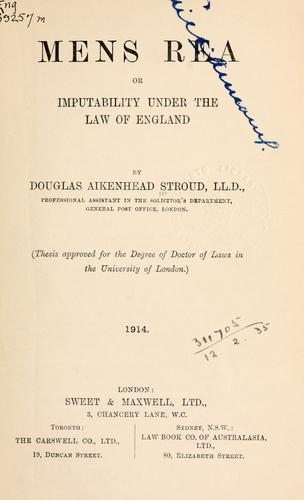
1914 English Law (see Chapter 2)
(I happened upon this WSJ article today.  However, I had planned to write a discourse on "spirit" versus "intent" do to an interesting discussion with Mrs. Wolf the other day...)

When our country was founded in the 1700's one of the core legal principles in place was mens rea, or from Latin "guilty mind."

Our founders believed that we had to know what we were doing was wrong in order to commit a crime.

This is important because it ensures that the law, in order to be broken, must be "willfully" disobeyed.

If the law is not willfully disobeyed then no crime is committed.

From the earliest Biblical principles the "letter of the law" has been simple and clear: "Though shall not kill," and so on.  Concepts and laws that were easily understood by people of the time.

From the Biblical perspective things change in the New Testament where following the "spirit of the law" becomes necessary for salvation.

So what's the difference between the spirit and the letter?

Let's take "Though shall not kill" as a first example.  Pretty clear on its face.  If you are standing in the cattle pen and I walk in and strike you on the head with an ax and you die I killed you and I broke the "letter" of the law.  Now, what if you're standing in that same cattle pen and I, who am in the barn and cannot see you, release the bull who enters the pen, sees you, goes nuts and gores you to death?

If I knew you were there and had the intent to kill you?  I in fact did not kill you, the bull did.

I could argue the letter of the law as not broken - since "I" did not kill you.  But did I violate the spirit of the law?  I did if I knew you were in the cattle pen and I willfully released the bull in order to harm you.  In this case I violated the spirit of the law - I killed you but not directly.

On the other hand, had I not known you were there or had no intention of harming you then I did not break the law because the bull killed you through an unfortunate accident.

Before the last twenty or so years mens rea was used to distinguish between a crime and and accident.

When my children were small (thirty or so years ago) you could leave them in the car to enter a store or business for a couple of minutes, say to pick up a gallon of milk, to walk another child into a lesson, that sort of thing.  Typically you hand multiple kids with you and you could leave two or more at a time as long as you took the keys and made sure they were safe (windows down in summer, etc.)  Generally they were visible from where ever you were and "I've got kids in the car" was good enough to get you in and out quickly.

No one violated the law with this.  The children were not abandoned.  They were in my conveyance - a car - and therefore under my control - just as if they were upstairs in bed and I was outside on the back porch.

(About the only crimes in this regard were people who left kids in the car for hours with the windows up in the summer.)

Twenty years ago Mrs. Wolf sold a dog to a woman who had done something similar and was arrested.

The reasoning, I suppose, was that wacko's were everywhere and the children were not safe in the car alone (there were two) and, the dog woman had therefore willfully endangered her children.  Mind you the children were NOT harmed in anyway and probably more traumatized by the arrest than anything else.

I am certain the "letter of the law" had not changed in those ten years.

What had changed is that the mens rea was significantly reduced (from "willfully" down to "probably should have known better given the state of the world") and the "spirit of the laws" surrounding endangering children were expanded.  (Endangering children had a pretty high standard - children worked farms with bulls and other dangerous animals - and no one was arrested.  Mens rea required that you had a specific wish and willfully created a dangerous situation for your child - something that was extremely rare as mentioned above.)

Twenty years forward today and mens rea is basically equivalent to the sloppiest interpretation of the title of the law: "Endangering a child" now means that the child was place in a potential for danger where potential could mean anything that a prosecutor or cop or do-gooder might want to think up - and irrespective of any specific bad outcome.

The "spirit of the law" has become whatever the accuser might imagine it to be.

I myself observed this a few years ago with my dog.  Mugs goes most places with me except in the summer when its to hot to leave the windows down.  My truck has no air-conditioning (nor did my house at the time) so "windows down" was all there was as far as cooling.  (Mugs also works the farm with my by following the tractor - we work together with whistles and calls while I run dangerous equipment - dangerous for both of us.) Normally I would not take Mugs near the University (for the reason below) but in this case I was purchasing a bicycle and figured he could come along (it was a hot summer day).

I parked the truck in the shade at the side of the street, left the windows down as far as I could so he couldn't get out, and crossed the street to meet the guy with the bicycle.  I was in full view of the truck the whole time and gone for about 25 minutes.  Mugs sat proudly in the drivers seat so he could watch me.

During this time a woman pulled in behind my truck and was staring intently at Mugs.  She was there probably 10 or 15 minutes until I left with the bicycle.  My belief was that had I gone out of view for even a few minutes she would have promptly called the cops on me for "endangering an animal."

Did I break any laws?  No.  Mugs was in less danger than working the farm with me.  He was also cooler.

But apparently this woman, who knew nothing about Mugs, had decided I had placed him in danger.  Since I knew he was safe there was no mens rea nor did I break the spirit or letter of the law.  Yet I would certainly be in trouble had she called the cops.

(The woman's car windows were up meaning she must have had air conditioning in her car - perhaps that was my sin - having no air conditioning.)

In any case the point here is that Mugs was in no danger, under my control at all times (not running loose, not driving the truck and contained therein), and was not overheated any more that I would be had I sat in the truck with him (which I did until the guy with the bicycle showed up) and less hot than working the farm.

So now somehow I become a criminal because I do not fit what someone else's idea of intent or the law. 

The spirit of the law is also corrupted because any supposed danger is manufactured by an unrelated bystander.

Why do I say corrupted?

Because at the time the "endangering animals" laws were written endangering an animal was something far different than riding with Mugs into town.  Mugs spends virtually his entire life within about 15 feet of me - why would I want or allow him to be hurt?

But clearly this woman was suspicious of me and hence believed me guilty of or about to commit a horrendous crime of some sort.

And by reducing mens rea and expanding the "spririt" in loosest possible way do-gooders can bend the law away from its original intent.


She had expanded the "spirit" of the law to include whatever she thought it should include - which was me.