Search This Blog

Thursday, October 25, 2012

Dissonance or Ignorance?

 My post on "Iran's "Route" to the Sea" generated some interesting food for thought.

How intelligent and/or how "up on foreign policy" do you need to be in order to gain meaningful insight from the debate?

From my posts "By The Way..." and "The Ignorance of One..." makes it quite clear that far and way people know very little about politics - not even, for example, that debates have actually happened much less what they were about.

So how responsible is the "electorate" for understanding what a debate or election is really about?

Back in the 1960's its pretty clear that, at least from the perspective of John Kennedy no ignorance was the "gold standard" for the electorate.

As a kid and young adult during the 60's and 70's I clearly saw this.  There was a push for "empowerment" which involved education.  There was the notion of you, the peon, gaining knowledge because knowledge was power.

As a young adult coming of age in the 1970's this was present everywhere.  Particularly in the college I attended.

However, it was taught far differently than today.

In those days you, the student (literally or figuratively) sat listening to someone who spoke directly and non-stop about some topic.  It was your job to "fill in the gaps."  A professor or lecturer might mention a name or event in passing - so-and-so said "X" about "Y" - and then move on.

If you didn't know about "X" or "Y" is was your job to find out via research.

We called this the notion "learning to think" because you might also apply it based on a filter - did I believe what so-and-so was telling me or did I think it was false, misleading, or somehow otherwise untrue?  If so it was my job to research the topic until I was satisfied one way or the other.

We also called this "critical thinking."  The idea that just because an "authority" claimed something was true it was.

Nixon was probably the quintessential example of this - Nixon lied, Watergate, and so on.

The entire nation heard the Watergate hearings, discussion of what people said and did, and so on to an incredible level of detail.  Similarly for the Vietnam war - every news report processed and kicked about to determine the direction of the war and the country.

And all this parsed for understanding by the "electorate" to be used as fodder in the next election.

What I and I assume many others learned was that the world did not stop to explain itself to me.

I was nobody and it was up to me to figure out what was going on.

This was reenforced in various classes - ancient Greek in particular.  The professor did not stop for you to catch up - you had to keep up.

As an older adult today I assume I am responsible to be at least as informed as any candidate in a debate because, after I, based on what they say I need to ascertain whether or not they are telling the truth.  If I don't know I need to catch up.

I chose to keep up.

And clearly, at least in 1960, the rest of the US was on board with this as well vis a vi the quote from Kennedy.

But today, as I have written extensively here, the vast majority of people, particularly college graduates, seem not to posses critical thinking skills - mostly as I have mused - because they are today taught what to think and not how to think.

We can liken this a debate to live music performance - in this case Jazz comes to mind.

The musician is like the debater.  On the stage, under hot lights, people watching, no one wanting to hear a mistake, video recording, the rhythm section pounding away at 200 beats per minute.

At this speed you have only milliseconds (.001 seconds or 1/1000th of a second) to decide what note to play next.

Now depending on the song, the instrumentation, and so on there maybe be more than one choice.

And some choices may be better than others.

I can choose basically between a note which is dissonant or consonant.  (A dissonant note might sound "bad" or "out of place" while a consonant note sounds like it "goes along" with the rest.)

Everyone expects, particularly if unfamiliar with certain types of Jazz, consonant notes.  Virtually all popular music outside Jazz uses consonance over dissonance because the music flows much more smoothly to the musically uneducated ear.

But as I wrote in "Monk: The Birth of Be Bop" dissonant notes are not necessarily wrong or out of place - particularly in Monk's form of Jazz.

So from a musical perspective, on stage and under pressure, I chose a note.

To an untrained ear the note may sound "wrong."

So do I, as an audience member, rush the stage to criticize the Jazz musician?

Publish rude humor indicating that the musician cannot play?

Or is it my job to think about what I am hearing using critical thinking (maybe I like the dissonance or maybe not).  In any case the point of Jazz is that its intellectual in this regard.

But like modern political debate today's audience is no longer able to grasp the underlying meaning because they lack the critical thinking skills required or, worse, simply don't care or are too lazy.

So today, presumably a much more modern age than, say 1950, I can listen to Katy Perry or rap songs with three or fewer chords and perhaps a dozen (mostly not foul) words instead of this:


The reason, of course, is that it requires effort to listen to Monk play this.  You must think about what's going on musically.  How it fits together.  How the "big picture" is being painted.

With Katy Perry you merely need to jump around to a beat (not that there is nothing wrong with this but the musical direction from 1950 to today to me simply going the wrong way).

So similarly with political debate today - the audience no longer has the skill or ability to listen critically.

Dissonance today is always interpreted as ignorance.

And, of course, sometimes it is - but without a "critical ear" how would you really know?

So the question is simple.

Given that the vast majority watching the debate are "intellectually deficient" with regard to whose running for office much less the nuance of horses (used in Afghanistan today by US Marines) and bayonets (also used today) what can we expect?

I think we can expect dissonance to be portrayed as ignorance.

One reason I don't directly post political content here is exactly this reason.  This blog is intended to evoke thought.  To require critical think skills to process.

(Fortunately the bar is low for deceiving the "intellectually deficient" in this regard.)

Politics today is simply about simple emotion - like a Katy Perry song.

There's grandma going over the cliff in her wheel chair - there's small minority children starving in their rural hovel - crude jokes mocking dissonance - emotional pictures for sure.

But these are designed, like the wordless books in Fahrenheit 451 to keep people from thinking and asking their own questions.

Quite honestly I think we live in Ray Bradbury's dystopian future.  A future ironically manufactured by the very intellectual elite who are the silent heroes in the novel.

Today we are without the tools as a society to even watch a political debate much less a foreign policy debate.  There simply is not enough horsepower left in society for meaningful critical analysis.  The world is a complex place and does not stop or slow down for the ignorant.

The "factoids" Bradbury chose to condemn Fahrenheit 451 today rule instead.

Simply listen to the voters in the linked videos who cannot identify major congressional figures, parties or people running in opposing parties in the election they are voting for deride Sarah Palin.

A world and society ruled by "factoids..."

Yet somehow today I am expected to "slowdown" so the society which, outside of my control, has somehow slowed to a crawl as I pass by.

I think not.

Instead I think society and academia must be held accountable for the products they have produced.

Fortunately for me I am old and I am not going to hold my breath.

Wednesday, October 24, 2012

Iran's "Route" to the Sea...

On many Facebook pages the image to the left appeared after Monday's debate.

The gist of this is, of course, Romney is ignorant of geography and does not realize that Iraq separates Iran and Syria.

Now gaffes are common in "live" television and debates in paticular, like with live music and other "live" activities its always difficult to deal with unforeseen situations, too little time, and so on - particularly when attempting to speak credibly with a lot of intense surrounding activity.

In political debate there are, to my mind, four main types of "gaffe."

First there is the pure "ignorance gaffe" - no, I don't know where the Iran/Syria boarder is - a comment made in true ignorance.

Then there is the "simple mistake" gaffe - for example the Obama "57 state" quote - and, no, I don't believe he believes there are 57 states in the US.

There is what I call the "Freudian gaffe" - Joe Biden and his "buried" middle class.  The "Freudian" aspect being either "a gift to your opponent" or "a slip telling your real feelings."

And finally there's the "non-gaffe" gaffe.  This is a bit more interesting.  Clearly in "live debate" there is often very little time to state your full case.  So, when presented with an opportunity, some part of a fact comes out, but not all.

Perhaps enough to get the message across, perhaps not.

I would put the title quote in the image above into this category.

Now, of course, you could interpret the quote as a "simple gaffe" meaning Romney merely lacks understanding of the geography of the middle east.

But "route to the sea" is an odd choice of words to make a gaffe with.

So in response to seeing this I did a bit of research and came up with a number of articles (this and this for example) talking about Iran, its navy, and its actions in the Mediterranean Sea (military exercises with China and Russia among other things).

It would seam Iran has clear military interest in creating a Mediterranean Sea port in Syria.  (There are various links to various agreements between Iran and Syria in this regard which can be easily Googled.)

Now this is quite interesting.  While I was aware Iran had a navy I was unaware of its interest in the Mediterranean Sea (prior to this I was aware of the Iranian navy but not of any details, to wit, they are helping police their coastal waters for pirate).

A bit more work turned up this NY Times article on the subject of "Iran Supplying Syria Military via Iraqi Airspace."

This is a tremendously detailed article about the current geo-political activity in the region.  Not being a regular read of the NY Times I was quite pleased to be able to find it.

In particular it discusses the effort "... Syrian rebels have made to seize several border crossings where Iranian aid has been trucked in."

Now here its clear that the only means to "truck" military supplies into Syria from Iran is via northern Iraq.

Once the Syrian rebels had closed the ground-based boarder crossing Iran took its supply-chain to the sky: “The Iranians have no problems in the air, and the Syrian regime still controls the airport,” said a retired Lebanese Army general, Hisham Jaber.

So instead of driving in they can fly them in.

In this context having Iraq in the Mediterranean Sea makes a good deal of sense - should Iraq close the airspace between Iran and Syrian the sea will be the only means to supply Syria.

Additionally the sea offers open access to Syria albeit via the Egyptian-controlled Suez canal.

Now of course I could be completely wrong here but the statement "route to the sea" came up in the context of a discussion on Syria.  In particular, the current Administration seems unable to convince Iraq to close its northern airspace to Iran-Syria supply chain.

The current Administration hastened the US withdrawal from Iraq (and supplied a detailed timeline to boot) and in doing so has left either a weakened Iraq unable to stop the overflights or an "independent" Iraq that sees other "benefits" to Iranian support of Syria.

How unfortunate for the 30,000 Syrians killed so far.

One imagines that any presidential debate should have at least this level of active knowledge about Iran, the Mediterranean Sea, and Syrian at their finger tips during a debate.

The above information says to me that "route to the sea" is unlikely a simple or ignorance gaffe and much more likely part of an incomplete statement about the current situation in Syria coupled with recent Iranian naval activity - particularly when considered in the context of what was being discussed.

The bottom line is the NY Time article provides a great deal of relatively (Sept 4, 2012) current data on this subject.  Interestingly other than the Times article there is very little information about the current activity of the present Administration with regard to Iran, Syria and Iraq.

Tuesday, October 23, 2012

Italian Earthquakes and "Responsible" Science

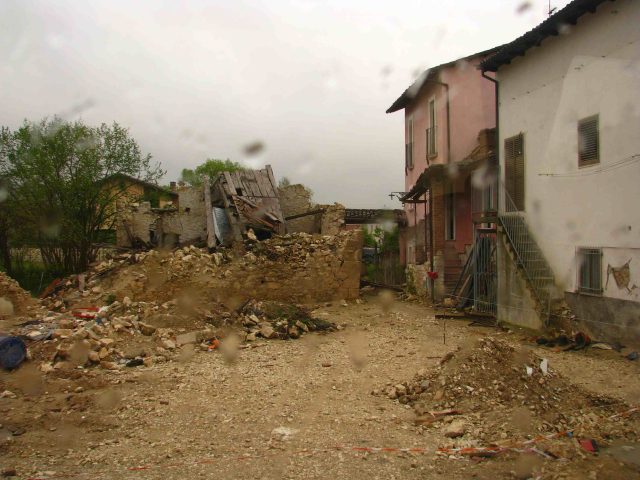
Italian earthquake destruction - from Ars Technica
So Ars Technica reports (as well as others) that several Italian scientists were convicted of manslaughter for not predicting an earthquake.

Now the Ars article talks about the superficial issues related to this but I think there is a lot more to think about.

The basic idea here is that the "government" contract with scientists to create a realistic assessment of danger - in this case an earthquake.  But it could be anything - a dam ready to burst, a faulty airplane part, etc.

No one, as far as I can tell, was asking for a specific time and date.  Instead there are the need for some kind of risk assessment in terms of "should people be evacuated."

This kind of thing happens all the time outside science - airplanes are grounded when "cracks" are found, for example.

Now if you are in a position as an expert I feel its your duty to ensure that, if danger or money is involved, you are as clear about risk as possible.

Its better to err on the side of caution.

So what about science?

Well, if I am in a lab running rats through a maze or spinning quantum quibits around in a vacuum chamber there is little danger, save for the apparatus exploding, of causing anyone harm.  If I publish reports of my findings, say that airplane wings made of spider silk test out well in my lab, its up to others to make realistic industrial tests to determine whether or not such an airplane wing is safe.

But there are other kinds of science for which things are, I think, less clear.

One is the "flu shot" model.

Now flu exists regardless of science and people will get it regardless.  No one knows what flu will strike in any given year so only an educated guess can be used to create a vaccine for the next winter's flu cycle.

Statistically it can be argued that even a bad guess as to what flu will strike might save lives even if the vaccine kills some number of recipients.

In this case victims (those that are harmed by the vaccine) have legal recourse against the maker if it harms them.

Like the earthquake model we have the "potential danger" model.

Here there are two flavors.

One is the "asteroid model" - scientists discover a large object that might impact earth but are unable to precisely calculate its path.  What do we do?

Here science has done "as much as it can" to alert us and has told us that precise knowledge is impossible to obtain.

My view is that these scientists are blameless whether the asteroid hits or not - they've done their best to make it clear that there is a potential danger of an unpredictable sort.

The second flavor is where scientists are asked to "rule" on some sort of public policy - either a specific danger as in the case of the earthquakes or on potential danger, e.g., climate change.

Here there is a specific "cost" associated with the "ruling."  In the case of the earthquake people will die depending on the ruling.  (If I rule there is danger people would flee and be saved.  If rule there is no danger people stay home and get killed.)

But the "cost" could be monetary instead of a life risk, e.g., what is the risk of building a plant near a fault line.

Again here industry and insurance play a role and the scientific advice is built into a larger "risk" model.

But the other side of this is something like "global climate change."

Here science claims there is a specific risk (and cost) associated with something.  Like the asteroid there is a claim that harm will come if "something is not done."

But there is a cost associated "doing something" and no guarantee that the risk is real.

Who bears this cost?

I think science must if it is science that puts out the risk.

For example, if "science" claims asteroid XYZ123 "will" hit the earth on December 21st, 2012 at 12:45 PM and it doesn't then the "science" must be held accountable.  If "science" claims a mere "risk" its different - others make decisions on the validity of the risk.

For too long many quasi-scientific groups from archeologists to climate scientists make claims about things based on "consensus" and not fact.

An asteroid has a trajectory which, if enough information is present, can be calculated precisely.  This is science.

If we can only guess at a trajectory (or whether CO2 is destroying the planet) this is "consensus" and not science.

But if we act as if a "consensus" is concrete science and we fail then I think science must be held accountable - which is what happened in Italy.

If I alone calculate a trajectory for an asteroid and shout "danger danger" I should be liable if the danger is not real.  Instead I should openly share my calculations.  If everyone computes the same results then it becomes a societal risk.

The reverse is also true.  If the "consensus" calculates a risk, not on mathematics but on agreement, and foists this off on society then those creating the "consensus" are responsible for it.

I guess it all comes down to objective facts and reproducibility.

An asteroid's path to hitting the earth is object and can be calculated if enough information is present.  Then the calculations are either right or wrong.  If they calculations are not certain then its not science but merely consensus.

In any case those creating the consensus should be responsible for the cost of their consensus right or wrong.

Which to me says that before you claim the "end of the world" you should be quite certain about it.

Today's science is mostly "consensus" building about things science collectively "feels are important" or are serious "social issues."

But going on TV and making claims is akin to shouting "fire" in a crowded theater.  However well intentioned the claim of "fire" might be there is still a cost to those in the theater if the one shouting "fire" is wrong.

Today's consensus science is given a free pass in this regard.

If we spend trillions of US dollars to stop global warming but it happens anyway will "science" step up and accept the responsibility?

These kinds of science are not "objective" and never can be - no one can know who made cave paintings or, in an open system like the earth's atmosphere, pin down objective specifics about why something is the way that it is.

As long as "'science" has no responsibility we cannot take it seriously.

Monday, October 22, 2012

Vitamins: Live Long or Die Young?

What a surprise.

It turns out that vitamins have an effect in cancer (both pre- and post-) in men (see MedPageToday and WSJ).

According to the WSJ "multivitamin Centrum Silver had an 8% reduction in risk of developing cancer compared with those taking a placebo."  The men in the study were followed for approximately 11.2 years.

According to MedpageToday "men with a history of cancer appeared to derive even more benefit from the multivitamin, as they had a 27% lower cancer rate compared with placebo-treated men with a history of cancer."

Interesting that this goes along with one of my earliest posts "Contrary Thoughts on Health" from 2005.

The key issue is that exercise alone depletes your body of vitamins.

If you don't replace them then there is little point to the exercise.

These studies seem to indicate that vitamins can have a significant effect on cancer.  Note too that this is a multivitamin (Centrum Silver).

There have been many tests of the individual vitamin components in this vitamin but they do not show the same results - only the combination seems to work.

As far as I can see this study is quite remarkable.

I know of no other pill that has the known effect of reducing the rate of cancer.

Note that a good multivitamin cuts the rate of cancer, not the risk.

Now of course there could be other elements as well that people are doing, e.g., exercise, other dietary elements, and so on.

But whatever is going on a 27% rate cut in cancer is significant.

So one would expect medical science to say, "hey, this is important!"  But you can bet they won't.  The reason why is simple: money.  A bottle of Centrum Silver costs about $18 USD at Walmart for 180 pills - maybe $36 USD a year - for a 8% reduction in the risk of cancer (if you've never had it) and a 27% rate cut for those that have had it.

$36 USD a year.

So if vitamins affect cancer is it genetic?

It would seem that, at least directly, its not.  Otherwise how would the vitamins work since they don't affect genetics.

On the other hand there those that say all this is total hogwash: see this.

Vitamin usage is killing people according to this interpretation of the study.

I don't think science has any clue why some people live longer than others - some are healthier than others and so on.

On the other hand, if this study is true, there would be far less need for "big pharma" solutions - little wonder they pooh pooh it as wrong.

Friday, October 19, 2012

Why "Self Esteem" is a Killer: Dumb-ageddon

What if its the educator that's actually deficient?
A little over a month ago I wrote about "Education, Software and Agile Failure."

At the top of the article I supplied an example problem with Apples, Grapes, etc. that required the items to be placed "in order."

I then showed how there were multiple ways to consider the items ordered.

This story came from one of my grandchildren.

The poor child was, early on, "labeled" by the school as "struggling."

Now in today's educational system regardless of your level of intelligence "struggling" means that you are unable to do the work "as prescribed by the teacher."

So, as was the case of the "in order" problem if you understanding of how to display your answer differed from everyone else, even though you had a firm grasp on putting things "in order" you were a failure.

This failure model was compounded because once modern "teachers" discover that you are completely failing to provide the correct answer or show the work in the proper sequence you fall out of the normal educational order.

After all, its too much work for a teacher to figure out what you are doing wrong and work with you to correct it.

Once you are labeled as a "struggling child" the school brings in all sorts of "resources" - school psychologists, special ed teachers, and so on because there is more money in this than simply getting the teacher to work through the understanding issues with the child.

I always thought the idea of being a "teacher" was to solve exactly this kind of problem.

Instead today the solution, which the child's parents where emphatically told was that the child simply needed "self esteem."

"Self esteem," according to Wikipedia, is "overall evaluation or appraisal of his or her own worth."

In this case the child was depressed and miserable.

The teachers gave the child repeated messages, to the contrary of what her parents told her, that her parents were "disappointed" in her work.

From the child's point of view she was providing correct answers, albeit in a form different from what the adults were asking for, but correct none-the-less.

So I imagine the child felt she was living in some sort of "dumb-ageddon" - crouching under an old blanket, living in fear of providing any answers.

She spent four years there.

When the break-through I wrote about a month ago happened the entire world of "dumb-ageddon" was washed away.  (Dumb-ageddon is the place where everyone seems to you to be stupid and unable to understand what you say or do even though what you are saying or doing is right or correct.  So you live by hiding yourself - a la Jurrasic Park - were the stupid (or dinosaurs) cannot find you.)

The child is now happy, works hard, and is accelerating her learning to the point where she will be caught up in short order.

The key, of course, was that her mother discovered that the child could be "right" but merely reporting the results incorrectly.  Far different than not understanding the problem.

The lack of concise direction being the fault of the school, not the child.

So we, as parents, kept encouraging our daughter, the child's parent, to not give up and work hard to help her (the child) as best she could.

And it paid off.

I predict the child will be on her own and caught up very shortly.

From the school's perspective the solution was "self esteem."

"If you simply give the child better self esteem she'll do better in school," they told my daughter.

They, of course, had a collection of "experts" to assist in this.

So the child knows that the answers she creates are "correct" but does not understand why the adults in the school don't see it that way.  (In math she simply wrote down correct answers without showing work - she could not explain how she got the right answer - but she did - so it was marked "wrong" without shown work.)

The child is struggling and depressed.

And the school's answer is to make the child feel better about herself - "say that's a good job even when its wrong."

Basically "feel good because you're stupid."

Now in basically no other societal endeavor do we this:  "Oh doctor, you tried to operate on the right arm but you operated on the left - good job!"  "Oh, you tried to turn the corner in the car but you missed and killed a bus full of kids - great try!"

So the concept that "self esteem" will solve a communication problem is beyond sad.

College educated "teachers" who push this moronic shit instead of teaching.

At the recent open house the teachers expressed shock that the child's "self esteem" had so dramatically improved.  But beyond this they said very, very little.

In my last few posts about voting you can see the impact this type of "education" has on people.

It makes them stupid and unable to cope with reality.  They simply crave boosts to their "self esteem" and care about nothing else.

Creating "Dumb-ageddon..."

In reality once the kid saw that someone was willing to figure out and understand the issues she was happy - she works hard now in school.

The high "self esteem" comes from success.

If the child was truly challenged then still self esteem would only come when the child had done her best.

But to label a smart child as "challenged and needed more self esteem" when in fact the teachers failed to understand that there was more than one "right answer" is beyond sad.

(NOTE: There was other evidence for the "educational establishment as well.  Erratic standardized test scores - very poor in a number of subjects, near gifted in others.  Always a sign of miscommunication.)

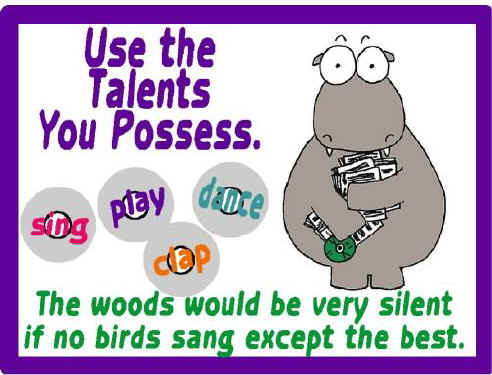
The "poster" at the top of this article is a nice display of the symptom of all this.

Virtually every child can contribute to society.  Its up to society to discover the gifts each child has - not the child to fulfill the society's fantasy about being a "conforming educational star."

To the teachers:  Your books full of stupid formulaic educational steps are garbage.  This is especially true when you cannot perceive the someone could solve the problem by going outside these steps.

Your job is to educate - not simply ape problem solving steps that are the only way you, yourself, can hope to find the answer.

Education of those smarter or brighter than yourself is hard work - something clearly our educational system is not up to.

Much better to get them all dumbed down into "Dumb-ageddon" where everyone has a lot of self esteem about being stupid.

Ultimately this is what they wanted my granddaughter to accept: having high self esteem about being dumb.

Thanks US educational system - its why I can't hire what you produce...

Thursday, October 18, 2012

The Ignorance of One....

This quote really says it all....
Yesterday I posted a link to a Jimmy Kimmel video interviewing people who talked about the election as if it happened the night before it actually did.

This is not the only example of outrageous voter irresponsibility.

For example, a while back Howard Stern posted these interviews with black voters.

Bill Maher did interviews with poor white Mississippi voters as well.

Then there are these interviews with "Obama voters."

What's troubling in each case are those people who have zero knowledge of our political system.

How is it that they are "voting?"

Voting involves making an informed "choice" between multiple people in an election.

If you don't know what those people stand for or what office they are running for how can you in good conscience"vote?"

The answer is you can't.

You can guess - like a multiple choice question which you know nothing about.

And while you are, by the constitution entitled to simply guess in the voting booth you really have to ask yourself if that's a good think for all the other voters out there who are informed.

Does guessing in the voting booth really mean exercising your rights?

Or is it diminishing the value of all the rest of the votes?

You can be told who to pick - as is the case where someone who is otherwise apolitical acts based on encouragement from others looking to influence them.

This is even worse.

The person who votes for someone because someone else tells him to is further diminishing the value of a vote.

If I find someone weak-minded and cajole them into, say giving me money or sex, I would be considered taking "advantage" of that person.

But somehow cajoling a weak-minded person to vote for who you think they should is considered noble.

Further, by telling someone who to vote for rather than giving them facts in order that they can make their own, informed decision, is an even more basic violation - its true deception.


You can vote your own personal best interest - picking someone who will do good for you as opposed to good for all.

This is the saddest case of all: steering society toward the goal of "you" - not your children, not your elderly parents or neighbors, not anyone else but you.

This is simply selfish and wrong.

When the US Constitution was written only "stakeholders" in society could vote - those with land.  As time went on (say by 1850 or so) most white men could vote (though many states allowed blacks to vote as well).

Today anyone can vote - including dead people.

The videos above show what kind of "stake holders" our society values today.

People should ask themselves this:  Would I check random boxes off on my tax return or make random answers (or answers someone gives me) at a drivers test?

If the answer is no then you might want to consider becoming more informed when voting.

Its little wonder our debt is 100% of our GDP and we are falling on hard times.

Wednesday, October 17, 2012

By The Way...

Here is video asking how the debate on 10/16 went shot 4 hours before the debate happened.


It's little wonder our country is in the shape its in.