Search This Blog

Monday, October 8, 2012

Cheap College Degrees - What are They Really Worth?

From the Atlantic article linked below.
A college degree for $10,000.00 USD.

That's what the governor of Texas wants to create according to this WSJ article.  The governor, according to the article, said: "A $10,000 degree provides an opportunity for students to earn a low-cost, high-quality degree that will get them where they want to go in their careers and their lives."

Now this really makes no sense at all.

An average new car comes in, according to Forbes, for 2012 at around $30K USD.

An average college education (by averaging the in and out-of-state rates) is probably around $40K USD.

So if you want a "good" college education for 1/4 the going rate it would be like buying a car for 1/4 the going rate.

According to AutoGuide.com that would be this car.

There's only one problem, the cheapest car is about 1/3 the going rate.

No new cars come in at 25% of the average rate.

Now I imagine that if someone could create the lowest cost product for the auto market they would.

But there is no car in that range.

Why?

More than likely the cost to create a usable, salable, legal car for that price is impossible.

There's another problem.  The car at AutoGuide.com is Nissan Versa Sedan.

Now if you don't need much room or a lot of storage capacity or towing capacity, etc. you might be okay.

But what if you have a large family?

This car is probably too small.

There's another problem as well.  If all new cars cost $1,000 USD then everyone that wanted a new car would buy one, probably several times a year and twice on Sunday.

This would flood the used car market which would have no buyers - why buy used when new is so cheap?

So everyone employed in some way with handling used cars now becomes unemployed.

Now what about employers?

Would you hire the applicant from the "cut rate" school?

How about your get airliner captain?  Would you take the guy from the traditional high-end flight school or from "Bob's-U-Fly'm" down the side road at the county airport?

There are already too many "college educated" people flooding the job market: 53% cannot find jobs according to this.

This is about 1.5 million people.

With no jobs and no prospects.

(Of course, it matters what the degree is in - technical degrees tend to create more hiring opportunities.)

The problem is not the education - its the balance.

Society cannot only have a huge, top-heavy cadre of intellectual elite.  There is no support of for infrastructure: plumbing, building, fixing, repairing, and so on if everyone is busy pushing buttons on a computer somewhere.

It also seems very likely, at least to me, that a college graduate that's unemployed will have a bit of a problem repaying that $40K USD in education loans working at Pizza Hut.

So the current 2009 rate of 13% defaults will likely increase as this problem becomes more acute.

And since today's education does not equal yesterday's experience hiring a recent college grad will likely fall at the bottom of the priority list - if you need someone competent you'll hire someone with experience.

Isn't government "central planning" wonderful?

(Edit: Note that according to this from www.physicsworld.com only about 20% of physics PhD's work in their field and only a few percent work in academia - the vast majority must move outside of their "education" for jobs - and most are ill prepared for this).

Friday, October 5, 2012

Wild Urban Bears: They Don't Fit the Bambi "Narrative"

Happy Dancing Bears! - or dangerous carnivores marking territory?
About 15 years ago Mrs. Wolf was driving along near our home and saw a black bear.

We were new in the rural neighborhood at that time and everyone through she was seeing things.

Then a couple of years ago a local deer hunter using our property showed us a picture his "wildlife camera" took of a small black bear on our property.

Last year I was jogging along about 1/2 mile from our home.  A large (probably 375 - 450 pound) black bear jump out over the guard rail about 20 yards in front of me.  He headed across the road.

I was completely startled but could only think to keep jogging along.

The bear looked over at me.  He must of knew I was coming down the road (I'm there every day and a lot of the other wild life just ignores me even during hunting season).  The other side of the guard rail was a very steep creek bed - maybe three feet deep.  So he had had to come up the almost vertical embankment then jump the two foot guard rail.

I guess he figured if he could do all that I wasn't a potential threat.

In any case he just kept going across the road.

By the time I closed the 20 or so yards he was up the opposite embankment and into the woods.  I could not see him - though I did not stop to look carefully either.

About a month ago my neighbor stopped me as I was going out to jog.

"Did you see him?" he asked.

"No, see who?"

"The bear!" he replied.

He then proceeded to tell me how a "very large" bear (he estimated 400 pounds) had crossed the road in front of his house, came down our mutual driveway past his house and down in front of my house before he turned off into the field.

"What time was this?" I responded.

"About 10:00 AM" he replied.

A week or two later a local teenager shot a 350 pound black bear about a mile from my house with a bow and arrow.

In August a bear entered the local Sears a few miles from my house.  Several other bears were seen in the shopping area in subsequent days.

Though people tell me there are coyotes in the area I have never seen any.

A friend reported bears in her heavily urbanized neighborhood over the last several years.

So our area is overrun by bears.

This is a phenomena that's not just common to my area according to this DiscoveryNews article.

What's troubling is that idiots think have 350 pound carnivores running loose in their neighborhoods is not a bad thing.

For example, in the article an associate professors pontificates that he "...suspect[s] that we're probably going to have to get accustomed to the situation."

Now this is an interesting point of view.

My small (several in weight - say between 30 - 80 pounds) grand children often play outside at my house.

A small child could easily be killed by a 350 pound bear - especially one brazen enough to wander around my property in broad daylight.

According to Wikipedia black bears kill about one person each year.

With their expanding populations we can expect more of this from bears as well as other predators like mountain lions and coyotes.

I personally think that the idea we have to "get accustom" to this will not last once bears start killing small children in urban areas.

Bears in my area have probably multiplied by a factor of six or eight over the last fifteen years.

Personally I am not too worried about a bear harming my grandchildren.  We have several larger dogs which should be able to discourage any bears from carrying off children.

Though I would still be concerned about a bear with cubs.

I have to ask myself why have large, free roaming carnivores running loose in populated areas is acceptable.

The DiscoverNews article mentions that "eradication" is "costly and unpopular."

However, I imagine it would not remain "unpopular" once someone's small child hand be maimed or killed.  (Bears already kill pets and destroy property in urban areas.)

To me this notion that we should allow dangerous predators around our small children smacks of the dogma of stupid or "following the narrative."

We all love Bambi so human's can't kill deer - but its okay to have them hit by semi's or family cars traveling at 80 mph, or to have them destroying property around homes, or starving to death because they are unable to get enough food to eat.

Somehow these means of eliminating Bambi are considered more "humane."

But why?

I think the answer is simple.

Its just a shift of responsibility - I feel good by declaring Bambi should not die.  Bambi is warm and cuddly and makes me feel good.  I can hang calenders with Bambi's picture in my house.  I can feed Bambi in the winder.

But when you think about it those activities do little to ensure Bambi's life will be a decent one.

Feeding Bambi in the winter is great as long as you remember to do it.  If you stop, go out of town, or forget then Bambi simply starves.

But Bambi has the good sense to starve out of sight so no one feels bad.

With bears the situation is far worse.  They are large, dangerous carnivores.  The only reason they are not more dangerous today is that they were driven out of inhabited areas by our parents and grandparents generation.

They saw having dangerous carnivores running loose as a problem - not a benefit.

Human do okay managing large populations of domesticated herbivores like cow, sheep, and so on.

To my knowledge humans don't keep large packs of carnivores for a reason.

They are dangerous and smart.

And now they are smarter and more dangerous that US.

They will are infiltrating our urban areas and eventually will become a serious danger to us.  Will will allow this because we think that all wild animals are like Bambi.

Personally I don't worry too much - my grandchildren are smart and the dogs keep good watch on them.  I live outside the city so there is always somewhere for a dangerous animal to run should they be confronted by humans or dogs.

The problems will come.

Here's a local TV news reporting making fun of 600 pound bear wandering in a suburban back yard.

Why is this funny?  The poor guy texting on his phone clearly doesn't look happy.

I imagine that if the bear were to be let loose in the TV newsroom things would be less "funny."

Here's a video of bears fighting to establish territory in someone's front yard (image above from this video).   The people who's front yard this happens in likes it...???  They want to see more bears.

We used to break English Mastiffs.  Males at 200 pounds would fight.  Unless they were well trained (which they were) they were impossible to stop.  Bears are two or three times bigger and wild.

This will all remain "funny" until it gets out of hand.

They say in the second video that "experts" don't know what to make of it.  Duh!

Either sparing over territory or young males just having fun - in either case they are unlikely to view any human imposition into their business as anything but an annoyance.

When it does, it will happen quickly and everyone will be surprised.

Imagine, wild bears harming someone!

Thursday, October 4, 2012

Modern Medical Ritual


You've got to hand it to medical science - its always moving forward - they've discovered the checklist!

From this link: 

"Which hip is being repaired? Is this the right anesthesia? Do we have all the right surgery tools?

Answering such basic questions from surgery checklists — and involving everyone as a team, even patients — saved lives in Veterans Affairs hospitals, according to one of the most rigorous studies of patient safety in the operating room.

Surgery deaths dropped 18 percent on average over three years in the 74 VA hospitals that used the strategy during the study. Surgery team members all created checklists and discussed them in briefings before, during and after surgery. "


What's not said here is that surgery teams without checklists killed more people with easily preventable mistakes than those with checklists.


Its astonishing that these articles don't outrage people.

What, you're a doctor, one of the most highly educated and trained professionals in the world, and you run your surgical practice without the benefit of a simple checklist?

After all, soccer mom has a checklist when little Johnny goes to camp.  You and I take one to the grocery store.  Why doesn't her surgeon have one?

Read a little further and you'll find this: 

"Teamwork problems are ubiquitous in health care but in operating rooms, they're so problematic because ORs are so hierarchical. They're full of ritual and for so many years it's been the surgeon (who) dictates," Pronovost said.


The VA's program began in 2003 and over time has been adopted at virtually all of its 130 surgery centers. Before sedation, patients identify themselves and the reason for their surgery, hear the checklists being read off, and can speak up if something doesn't sound right. The idea is to give everyone in the operating room an equal voice in helping ensure patient safety."

Ritual? Really?

You mean like this?


It's good to see that all that money we're spending on new health care laws has a good foundation in history.  

Imagine if we simply passed a health care law that required surgeons to use a checklist like the one described in the article.  Imagine a world the patient or a nurse know more about what's going on than the surgeon - like person who's being operated on (no - my left arm!).

I have experience with this.  Several years ago I broke my left wrist.  A trip to the ER left me with an appointment to see a specialist who had to do surgery.

After some consultation the surgeon and I agreed to have him put a metal bracket in and re-set the break.

The morning of the surgery sees me in the giant bullpen of "out patients for surgery" with many dozen of people where there.  Once I am called into the OR prep area I am installed in a bed and set up with IV's and other things.

I joke I need a red marker to write "NO" in big letters on my arm.

No one laughs.

Then someone says "don't do that! Don't write on your arm!"

Eventually the surgeon comes in.  He checks me over a bit and then takes my broken arm and writes mysteriously on it (doctor scrawl I suppose).

"What's that for?" I ask.

"So we operate on the right arm." he says.

"But my left arm is broken" I joke.

He didn't laugh either.

I've read up on this a bit - one day in the Borders - and its not just the VA hospital, either:

"Jauhar feels responsible when he botches the blood pressure check on a patient who later dies during an aortic dissection and when he misses the high blood sodium level of a man who then suffers irreversible brain damage."

Ah!  Medical science also has its own idea of responsibility as well. No doctor ever causes a problem - they merely misidentify or miss characterize one.

Read the part in the book where they handle failures.

I guess that's why they call it practicing medicine.

I'll have to keep all this in mind.

Finance, Debate and the Agile Political "Porn" Narrative Fantasy

MSNBC Commentator Maddow
It seemed quite clear from last nights debate that no one is interested in the real financial problems facing the US.

Only once that I could see in the 90 minute debate did anyone mention the current Euro crisis.

Not once did anyone mention the Federal debt.

The annual budget deficit, though there would have to be an actual budge which there has not for the last three years, is about a trillion US dollars.  The most anyone would say about this was that no one wanted it to get bigger.

Education was mentioned a few times, but the details of paying for it were not.  Massachusetts is indeed rated #1 by SERI (Science and Engineering Research Institute) in this 2011 Hoffington Post article.  However, debt per student in Massachusetts averaged about $25,000 USD per student on graduation.

The trillion dollar educational debt held guaranteed by the US government was not considered.  Nor the current (as of 2009) default rate of about 13% (or supposedly at 13% chance that $130 billion will never be repaid).

No one mentioned that without jobs there is virtually no chance any of the debt currently being incurred will be repaid.

So, Jim Lehrer seemed to do a poor job of asking economic questions in my book.

Another fascinating thing was the narrative of the "five trillion dollars."  It was brought up in the debate numerous times.

Now I study finances daily and I had never heard of it - so I wondered what it was.

Post debate as I switched between the various news channels (Fox, MSNBC, CNN) it became clear.  MSNBC apparently had bought into some narrative that whatever Romney was planning on doing was going to cost five trillion dollars.

Apparently they had forgotten that the US Senate and House of Representatives would also have to be involved.

Apparently they had forgotten that Romney was not yet elected.

Apparently they had not realized that until placed in the position to affect the deficit anything said would have to be pure speculation.

Yet apparently there was a narrative, used by Obama and at least MSNBC (I did not hear it on Fox or CNN), about this "cost" of Romney's economic program.

It was fascinating to see the literal shock on the faces of the commentators like Rachel Maddow that the debate had not followed "the narrative" they expected.

This struck me as related to the "The Porn Fantasy" I wrote about a few weeks back - the idea that the fantasy is so "well used" that the reality is lost or forgotten and the fantasy becomes the only reality.

It would see that this was the case here as well.

There was other examples as well on MSNBC, a bizarre interview with Rudy Guiliani by some "panel" youngster with Buddy Holly glasses that also reflected the idea that his reality was the only one.  Instead of asking about the debate the interviewer ranted about some kind of supposed business arrangement the former mayor had presumably had with the Department of Homeland Security.

There was simply no "news" on the MSNBC program - only a discussion of the delta between what was seen in the debate and the narrative.

No one seemed interested in what was actually said by anyone other than to compare it to the narrative.

This also reminds me of the folks who drive off the cliff into the quarry because the GPS tells them too.

I find all of this dramatically disturbing.

There seems to be little connection between reality and the news and candidates.

There are many problems related to all this.  Even at the level of "Agile Software Development."

If we all "believe" then whatever we want will just "happen" seems to be the model.

Create the "narrative" - a story based on desire and wishes.  The same as a design for software in a domain about which we know nothing.

Then live (or develop) as if that is the reality.

Then plan on discovering the "delta" between the fantasy reality and the truth only when an irreconcilable difference appears.

This model also offers a good explanation as to why research is falsified as well.  Imagining what should happen, the research as if it is true, then falsify the results to ensure that it did even when it didn't.

I guess I would describe this as the "narrative delta."

The idea that "objective reality" is faux and that the story developed (the narrative) is instead the "reality."

Then you simply "believe" in the narrative as if its the truth until you're forced to believe otherwise - basically when the delta between the narrative and the objective reality becomes so great that you cannot continue to fool yourself any longer.

I suppose, like with Agile software, you simply create a new narrative and start over at this point...

Wednesday, October 3, 2012

Katy Perry's Sex Life - Less Speculation than Climate Change

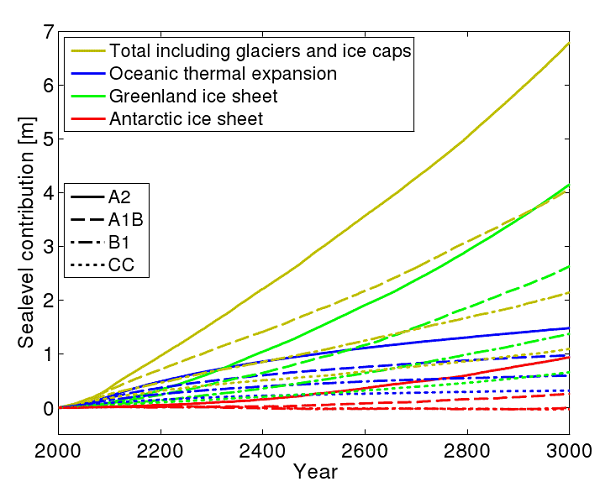
Apparently the eminent flooding of all US coastal cities by "climate change" has been put off a few hundred years.

An article in the UK Register describes many fascinating things about the sea level rise studies.  Since the time of Al Gore showing his movies to the natives the "eminent" destruction keeps moving off into the unforeseeable future.

A while back I wrote "My Island Home is Sinking Into the Sea" which described the destruction of various island homes by "Global Warming."

Sadly this latest UK Register article (and the associated studies) points to all this "sinking into the sea" as complete and utter nonsense.

Will the water levels rise - apparently yes by 3000 or so - a mere 988 years from now - when "all the ice melts."

Of course that presumes man is still around and the planet has not been destroyed by an asteroid.

For many years now, since I wrote "Global Warming Science" in 2005 and "Global Dimming" in 2006 I have been highly critical of the quote-unquote science of "Global Warming" in general.

In the case of "Global Dimming" I pointed out how the termination of all US high-altitude commercial flights in September of 2001 had a dramatic and unforeseen effect on the climate.

Completely unforeseen and unpredicted by the "climate science" literati.

Sadly there are far more problems with this kind of "science" than this and these issues are only the tip of the iceberg.

Yet politicians rely on and make changes to governmental functions based on this "science" which turns out to be simply wrong.

Hence the public policy based on it is also wrong.

The present Administration in the US set out to "save the planet" but, in fact, the planet apparently does not need saving.

Yet still the public policy acts as if it does.

And this is wrong.

This wrong is further compounded because as a nation we are going into further debt to support bad science - both in terms of funding and in terms of implemented public policy around the wrong results.

As I have written before today's generation cannot easily distinguish between fact and fantasy - particularly in science.

Today "policy" and "common knowledge" set the direction of the research and thinking.

Once we know what's wrong, i.e., man in destroying the planet, we simply work to show how this is true.

Here is a good example: Shrinking Fish.  A study in Nature describes how global warming will shrink fish.

Its filled with projections on how oxygen will diminish in the seas and fish will shrink as a result.

Is this kind of study really "science" or merely pointless "speculation?"

The key point for all this can be found several paragraphs down from the top where the researchers say "Assuming that other resources for growth are constant, the anabolic term can be expressed as a function of oxygen supply."

The rest of the paper goes on to describe how limited oxygen will dramatically shrink the size of fish.

But, note that they assume that "other resources for growth are constant" (my underline above).

What are other resources for growth besides oxygen?
  • Food.
  • Temperature of the environment.
  • Predators.
  • Solar output (for the growth of marine plankton which are at the bottom of the food chain).
  • Climate.
  • Pollution.
  • Natural climate functions, e.g., volcanism.
  • Etc. Etc. Etc.
Many of these things are interdependent on "global warming" and interact with water oxygen levels.

All are complete unknowns.

So this "Nature" article is simple, raw speculation.

So how is the original article different than, for example, Googling "Katy Perry sex?"

The results are equally rampant with speculation, what if, faux facts, nonsense, silly videos, wrong information and content free web posts.

I have no idea what or if Katy Perry even has a sex life and I don't care about it if she does.  Its meaningless speculation that serves only to promote the publications which print stuff like this.  But Google reveals there are some 75,000,000 (seventy five million) hits on this subject.

Googling "Global warming sea level rise" yields only some 2,290,000 (two million two hundred ninety thousand) results.

Same results: all speculation.

We don't know any more about Katy Perry's sex life than we do what's happening with our sea level changes in the next 100 years.

Sadly though, in the case of Katy Perry, its at least possible to have some actual facts and knowledge, i.e., apparently she has an ex-husband who could write a sourced "tell-all" book.

Not so with global sea level rising - there is no actual data other than what the climate actually does when it does it in the future.

I guess the natives "My Island Home is Sinking Into the Sea" will find more potential facts Googling about "Katy Perry sex" than watching Al Gore's video.

Tuesday, October 2, 2012

35 Minutes to "Get Married..."

So recently I had an employee get married.

We have the local large-hospital insurance (as opposed to the local Blue Cross plan which we dumped when they got into a fight with the hospital group).

So you think it would be easy to make a change like: an employee got married.

Well, here's what it took:

1) I go to the packet of crap that comes in the mail each month with the bill (this is one of the reasons I don't go all-electronic).  There are "DISENROLLMENT" forms but no forms to add employees.

2) Okay - so let's try the web site.  I go there and find a PDF form.  The form is a one page affair with the  usual healthcaresque fields for "Change of Membership," "Type of Coverage" and "Change of Status."  Of course its totally unclear which of these fields applies in this case because no where in any part of the PDF is how to accomplish things, e.g., change someone's status to "married" is explained.

3) I download the form and email to my newly married employee who fills out everything he can.  He sends it back to me to complete.


I guess this is "Marriage" so is this also a "Qualifying Event?"

"Type of Coverage" - now or after the marriage?

Is this a "Change of Status" - yes but there's not place to fill in ....????

I guess I will have to call and make sure lest I make a mistake.

4) I find a phone number on the form and call it.

The robovoice says are you a "Member" or "Provider"?

I say "Member" and get connected to Idiot #1 - a very pleasant person who asks a lot of questions but is unable to figure out from my explanation that I need help with completing the form for an employee who got married (yes, I did clearly explain this).

After 10 minutes or so on the call she says I need to talk to the "Provider" people and connects me to a black hole of phone nothing so I hang up.

5) I call back and go through the "Provider" sequence.  I get to some guy (Idiot #2) who says - oh, no, you need to call the "Member" line and again connects me to a black hole of phone nothing so I hang up.

6) I call back the third time and go through "Member" and this time get someone who understands (Idiot #3) that I am an employer trying to change the coverage for an employee from single to married.

So I make sure I have all the fields filled in correctly and then I ask "What email do I use for submitting this?"

He gives me a reply - then "oh wait, they just changed that, here use this email..."

7) So I submit the form via email.

A few minutes later I get a reply - I open it thinking good, I'm done.

Nope.

The email is rejected because its not "secure."  No matter that the information was obviously received by them to create the rejection so they got it.  They offered me the email address.

WTF?

I am directed to a web page where I have to upload it.

8) I upload the PDF.

Of course there is no confirmation here - I can get a confirmation of REJECTION but not of acceptance.

The web page just goes back to some random site page.  Did the upload work or not???

9) So now my employee has to call them back in a few days to make sure it got through.

What bullshit!!!

And this is one of the "top" hospital systems in the country.

The forms are stupid and useless.  No directions.  Nothing clearly marked.

I am sure they have hundreds of thousands of members - is this the best they can do?

Then after each call it wants me to waste more time answering a survey about my "experience."

Well my experience was that "it sucked..." but there is no option for that - just one to five...

Not even a zero...

So it took thirty five minutes to do this...

As far as I can tell there is no web page for the same - certainly there doesn't appear to be one on the form.

But I have to pay for three people to do the job a simple web page could do...

Nice!

This is why America is no longer great.

Its all about the bureaucratic process instead of the actually thing I am buying - my mandated health care.

If they cannot manager simple enrollment functions how can I expect them to handle life-or-death medical functions?

The answer is I can't...

Monday, October 1, 2012

"It's a Wonderful Life" - Why You Should Expect a Financial Panic

What needs to concern US lawmakers is an interesting report in Wired called "New Study Blames Greek Debt Crisis on Market's Invisible Herd."

Countries like Greece and the US issue bonds to finance projects or debt.

People, countries and financial institutions like banks buy these bonds. 

For example, suppose the US sells a $500 two year bonds at a 1% interest rate (real amounts are a million times larger but this will keep it simple).

So if I buy the bond for X dollars (whatever the price is but usually around $500) I will get my $500 back in two years plus my 1% interest.  The terms and details vary widely but the idea is you are loaning money to some entity that issues the bonds for a fixed period of time for a fixed amount of interest.

Now usually bonds are very solid investments - or at least they have been.  The idea that a city or state or the federal government would default was simply beyond imagination until recently.  Similarly other countries sell bonds, like Greece.

Now in the case of Greece some interesting things occurred prior to the Greek debt crisis.

First off, if your bonds are considered "risky" by the market typically they ask for a higher interest rate.  The more risk the more return.  Typically bonds are considered "low risk" because they are backed by sovereign national governments, state, etc. which are (or were) mostly immune from default - so they would be "safer" than a bank.  You accept a lower rate because you have a much higher chance of getting all you money back.

Now in the case of Greece the "risk" of a default got larger and larger over time pointing to a default sometime in 2013.  The study cited in the article (see it here) shows what should be obvious to everyone (but apparently not to academics and market-makers):  Instead of the risk simply rising in a linear fashion all of a sudden there was a panic which resulted in the "Greek Crisis" you saw on the news.

So instead of interest rates going nice and smoothly from 1% to 2% and so on up to 20% or more as the authors would have expected based on risk instead all of a sudden there was a panic well before the crisis.

The authors point out that without proper regulation this will happen again and again - perhaps here in the US as well.

So what am I saying here?

Perhaps the most well known example of something similar is the "bank run" in the Jimmy Stewart movie "Its' a Wonderful Life."  Jimmy Stewart's character owns a "Building and Loan" and when the evil "Potter" triggers a crisis those with money in the "Building and Loan" show up demanding the money in their savings accounts.

The only problem is that the money has been loaned out to build houses for others so there is no cash in the bank.

Normally the bank keeps some cash around with the expectation that not everyone at a given time will ask to withdraw their funds.

But in a "run" as shown in the movie things change - people "panic" because they are scared.  And the banks (or governments) don't have the cash available to repay.

Now a bond is not like a savings account because you get your money and interest back on a fixed schedule or at the end.

Instead, in the bond market, once people "panic" they simply stop buying your bonds.

Now if you are using bonds to fund things like roads then the road doesn't get built - which might be an inconvenience but is certainly not fatal to the country.

However, if you are financing debt with bonds - effectively paying Peter by borrowing from the bond holders (Paul) - you have a different problem.

If no one buys your bonds and your bonds are funding debt and you have to make payments, e.g., for Medicare, Social Security, etc. there is a serious problem.

And this is what happened in Greece.

All of a sudden people said "I want no part of these bonds!"  So the Greek government couldn't borrow to fund current obligations and rioting ensued.

Now the academics expected people to simply tolerate more and more risk by simply expecting a higher and higher interest rate.

The Greek problems had been going on for decades so its not like there was a sudden surprise in store... or was there.

Technically no - Greece was going down a linear road to disaster and at a nice predictable rate.

But investors didn't agree...  They saw that at some point soon there would be "too much" risk and decided to bail.

The US is headed down a similar road today.

We can keep borrowing money (we have borrowed about 100% of GDP - basically where Greece was).

Obviously we are a larger country with more resources - but also we have substantially more (and proportionally more debt).

The problem is that no one can predict what sort of information or event will trigger people to panic.

Hard assets like gold reflect this because they hold value independently of the US dollar.

There is no reasonable way to predict when and if panic will occur.  But if it does there will be a similar crisis here.

Printing money, on the other hand, doesn't solve the problem either because it devalues the investment.

The charts above show that several other European countries are on the same track.  The US is not shown but its in a similar state.

The US spends about $3.6 billion dollars a day - with about $1.6 billion borrowed via bonds (or manufactured via currency printing).
 And remember there are those smarter than you who will benefit from the demise of the US financial system.

We can only hope "Potter" doesn't trigger a run on US.