Search This Blog

Wednesday, May 16, 2012

Lone Wolf Philosophy - (part III) - The Declining Return in the Investment in Education

To the right you'll see a chart I linked from SmartMoney.com.

It says that in 2012 the estimated debt for a graduate student leaving (graduating) school is around $43,524 USD.

With some 831,645 estimated graduates this amounts to about $36 billion USD.

We can estimate from this website and this site that there are about 17,565,000 undergraduates enrolled in college carrying an average of about $18,625 USD by the time they graduate.  So if only 60% graduate that means debt is piling on (as of 2009 for these statistics) at about $190 billion a year.

To be blunt these numbers are staggering.

First of all, based on experience with four children 19-25 year olds are not the sharpest when it comes to managing money.  So while they are the ones piling on the debt directly there are more than likely ill equipped to deal with the consequences.

Now, let's think about the philosophy of all this relative to my claims about higher education and academic research.

If you look at who's going to be writing and publishing papers in academic circles its going to be graduate students and professors.  Now to become a professor one must have been a graduate student and undergraduate somewhere.

So combining these numbers we can estimate something on the order of $61,000 USD of debt upon achieving a PhD ($43K + $18K).

This is all for someone without earning their first real paycheck with their education.

Now in the "real world" people will do a lot of crime for $61,000.  Rob banks, steal cars, embezzle money from places they work, run up drug debt, you name it.  A junkie might burn through heroin at the rate of about $10,000 USD per year, for example.

So my first question here is doesn't this debt put an "ethical strain" on these students and graduates?

Obviously you need to make a lot of money to repay this kind of debt - as I have written before $600 USD or more per month in student loan payments - many paying up to $1,000 or more a month.

Given this and the associated "publish or perish" model for associate professors without tenure doesn't it seem likely that beyond basic personal morality there is little to prevent "fudging" of data and results in order to "keep up" with the publish or perish lifestyle?

Now given that if you don't publish your PhD or Master's in a discipline outside the interest of normal business areas, English, climate science, ethnic studies, isn't going to get you a job that covers the "monthly nut" of your loan payment - let alone a reasonable lifestyle.

It seems like you must succeed at publishing or face certain financial disaster.

To me this situation creates a very unpleasant ethical problem: I give you substantial money to acquire an education.  You become indebted to me.  And in turn you promise to use your education in the future to pay down your debt.

But what if the industry you graduate in is overstaffed in four or six years when you graduate?

Or the economy is bad?

What if you simply chose a career without much of a future to earn money, like academics?

The second thing this chart above shows is that the price of education in terms of debt is dropping rapidly.

From 2002 to 2012 it would appear that education's cost at the graduate level increased may 15%.

Yet the number of graduate students would appear to have almost doubled.

So for the same amount of debt ten years ago about half the number of students graduated as do today.

Or to put it another way is the education $50K worth of debt bought in 2002 as good as what $50K worth of debt buys today given that twice the number of graduate students would appear to be graduating.

Or are the institutions of higher learning simply doing less per student in order to make money?

Taken in the context of "science" and our future as a nation and people I think these statistics are very troubling indeed.

My thesis on this is

1) It would appear that the value of a "higher education" in the last ten years in terms of debt was cut in half.

2) This debt creates an ethical nightmare for students ill-equipped to deal with its consequences.

3) The consequences of #1 and #2 are diminishing the quality of education in this country and with it the quality of medicine, science and life in general.

If the value of an investment dropped in half over a decade why would more people invest?

So we've placed our children into a "declining investment" which will hobble them financially and ethically for decades to come.

We've told them they need this "investment" in order to succeed in life, yet at the same time its value is plummeting.

We've place an enormous ethical strain on those in academia to "afford" this debt by "publishing."  Yet outside academia we see that the accuracy of these publications is becoming more and more questionable.

Academia fights back hard when the value of its activities are questioned, to wit the firing of blogger Naomi Schaefer Riley for questioning the academic value of a black studies program in a post.

"In science when you lose the ability to question things science becomes religion." - From my last post.

Aren't then, by this, academic institutions really becoming expensive religious institutions where dogma is dispensed and believed without question?

Aren't academics becoming the pharisees of old-school religion?

Has debt become the price of penance in this new religion?

Tuesday, May 15, 2012

Fall To Earth - an Update

It's been a little over six month's since Fall To Earth, my new CD, was released.

Over the last few months a number of international fans have been purchasing songs on iTunes and CD Baby. 

I am honestly quite surprised by this as I haven't done a whole lot to market it though I am glad people are enjoying the music.

I have spend a few dollars (maybe a third of what it cost to make) on Jango promoting the CD by having songs played in rotation on various on-line radio stations they offer.  When its not pay-to-play the songs do periodically come up in the stations rotation.

Please take some time to check it out.

Jango offers free listening though after a bit you are badgered to "sign up."  Otherwise search for "Fall To Earth" on iTunes or use the links at the left of the blog.

Recursion, Grammar, and Science becoming Religion

A Pirahã village in the jungle of Brazil.
I watched a show on the Smithsonian (or Documentary) Channel the other day called "The Grammar of Happiness."

The premise is related to my past two posts about my philosophy in an oblique way - its also interesting in it own right.

The story documents a man named Daniel Everett.  Everett ends up being a missionary in central Brazil, South America for much of his life living with a people called the Pirahã. 

This is a tribe that lives in a few villages off of a remote (four day boat trip) river.  Everett arrives as a missionary and stays there with his family for many years over a couple of decades.

Two things happen during this time.

One is that Everett learns their language and comes to understand that these people live only in the present.  They have no numbers, cannot count, focus only on truth.  Everett is seduced by the simplicity of this and becomes an atheist in response.

The second thing is Everett learns quite a bit about their language and ends up writing a paper.  The paper describes the language as one without "recursion" (more on this below).  Linguistically recursion works along these lines: I have a sentence "Joe eats chicken."  Recursion is the principle whereby I can always take a sentence and make it part of a larger sentence, i.e., "Mary said Joe eats chicken."  Recursion is unlimited because I can always extend the sentence further: "Frank said Mary said Joe eats chicken."

(There is a readable set of slides from MIT's TedLab available here.)

The story of the Piraha changes at this point.

Everett's paper tick's off Noam Chomsky.  Chomsky is an MIT professor of linguistics and ostensibly leads the field in this area.  Chomsky and others have proposed that "recursion" is a necessary component of human language.

Everett's paper flies in the face of this and Everett begins to receive hate mail.  He is also called a racist.  All by Chomsky supporters.

This "academic debate" filters back to Brazil and Everett's visa's to study the Pirahã are revoked.

During this point in the film Everett ends up in the University of Brazil giving a talk on this.  Because many of the linguists in the world are Chomsky-ites the lecture is poorly attended.

However, they interview a couple of Brazilian linguistic professors and one, a woman, says something along these lines about the Everett/Chomsky recursion "debate:"

"In science when you lose the ability to question things science becomes religion."

The meaning here is, of course, that the "Chomsky" supporters are suppressing the questioning of Chomsky's work through harsh personal attacks designed to debilitate the attacker (as opposed to attack the arguments Everett uses).

Another group, the TedLab at MIT, takes on this debate.  The convert some 1,500 recorded Pirahã statements recorded by Everett and others into a computer code representing the grammar of the spoken language.

They then use computer program to attempt to generate a recursive grammar for those statements.

The computer fails to find such a grammar.  (This does not prove Everett's right, however.)

(As a side note: recursion is also applies to computer languages and computer architectures.  Some computer architectures, e.g., the IBM 360 did not natively support recursive constructs - typically via a stack.  Yet these computers can still be programmed to perform recursive operations.


To me the question here is not whether the Pirahã's language has recursion.  It does not have to for them to function.  But at the same time one wonders if their minds process recursion.  For example, if the Pirahã lived truly "only in the moment" could they interrupt their hunting trip to help an injured companion, i.e., stop hunting, help the companion, and continue hunting?


My guess is that mentally recursion is required for human thought, but not human language.)

In any case the paraphrased quote "In science when you lose the ability to question things science becomes religion"  was the kicker of this whole thing.

In the end the Brazilan government, while blocking Everett's access over the course of a few years, enters the jungle where the Pirahã live and install TV, running water, toilets, and so on.

One imagines this will have impact on their culture and language and probably change their way of life forever.

The larger point here is that Everett is battling dogma.  In this case the dogma of Chomsky and his "recursion" theories.

Who's right?  I don't know.

But what's more troubling is the personal attacks on Everett.

I use this as an illustration of why ethics and morality are so important in science.

Is Everett lying about the information captured on his trips to the jungle?

Are Chomsky's supports seeking to harm Everett in order to protect their status and funding?

Of course, given there is no concrete "theory of language" or "theory of the mind" here all this is merely arguing over supposition and observations.

Monday, May 14, 2012

Lone Wolf Philosophy... (part II)

The last post talked about the model I use to think about science and the direction it headed in this country and around the world.

There are a few "side aspects" that my thoughts lead to which I would like to discuss here.

First off is the concept of "morality" as it applies to science.  (The term "science" here refers to all academic and publicly funded research as well.)

My first thought is that it must apply and in an absolute sense.  So that researcher A and researcher B are guaranteed that each will follow the same concepts and actions with regard to the integrity of some study S.

Suppose that S is related to some form of compensation that A receives.  Can we trust A?  A may trust himself to do a good job but what if while performing his actions vis a vi S he decides to make an adjustment to the data to ensure his next compensation check?

Perhaps B is compensated by A's benefactor's competitor.  So B fudges his results opposite of A.  Where does that leave us?

Similarly what about a study conducted in a country were bribes, for example, are an accepted means of doing business.  Should a study from that country be comparable to one from a country were bribes are not accepted?

Of course I am merely touching the surface with these examples but I think you get the point:  If everyone's moral compass is not pointing in the same direction the results of their "science" must be suspect and, at a minimum, cannot be "comparable."

The reasoning is simple and direct: Science is a human endeavor that involves humans making choices and using moral integrity in terms of bias, competence, and so forth. 

If a human motivations cannot be trusted then their science cannot be trusted.

This also involves the notion of what I call a "public money public results."

Today much of science is funded by public money: grants, NSF, and so on.

My question is why isn't the public entitled to the work product of the activities these funds are used for?

In the commercial software world (and at least in the state I live in) if I hire you to do work for (in this sense I mean work as develop ideas or research) for me then we both own the results of the work equally.

Why doesn't the public own an interest in the research it funds?

Further, why are results of research conducted with public funds published in journals which require the public to pay to access the results?  (Fortunately things are starting to move in this direction already - see this as an example.)

Scientific publishing is a multi-billion dollar industry - one in part funded by US tax payers.

Again why is this not an open process?

It would seem that if all publicly funded research were open, i.e., accessible on the internet for example, I think that there would be more scrutiny.

So today we have closed publicly funded research where results are not available to the public without significant cost (a "paper" might typically cost about $32 USD to download if you are not a subscriber to a journal).

I think this discourages morality with respect to the work because there is less oversight than their might otherwise be.

Without this sort of transparency we see things as I described here in "US Scientific Medical Studies: a 1 in 20 Accuracy Rate?"

Now I have often heard the argument that "character does not matter."  Meaning, of course, that regardless of what you might do in your "personal life" your other actions are somehow separated.

However, an interesting study described here shows that this in fact is not the case: people think differently depending on the context activities are framed in.  In particular people well change their behavior whether the are atheists or non-atheists in a context where religious words are used.

So even the presence or absence of the notion of "religion" in a given context can change the action of people in simple experiments.

It would seem today that there are much stronger reasons than decades ago for researchers to cheat.

Among them academic debt, societal pressure, academic pressure and so on.

At the same time the internet offers people a broader view into research - even if its paid access - than was available before. 

However, this is now a double-edged sword in the sense that this accessibility also makes the discovery of cheating and corruption easier.

The bottom line here is that science and research must be run on some sort of moral ground that is universal so that the resulting science can be trusted.

Scientific research by its very nature requires this in order for scientific results to be consistent.

Friday, May 11, 2012

Lone Wolf Philosophy... (part I)

I have been corresponding with a reader regarding one of my posts.

Its seems clear from the correspondence that I am not making clear what my basic philosophy is in regard to the posts.  The reader suggests that I perceive or attempt to describe science as "conspiracy-driven propaganda" and that I am a "skeptic" of climate change research.

In fact - I am not directly concerned with the later at all and by suggesting that I think there is some sort of scientific conspiracy is sorely missing the point.

What I am questioning is the fundamental fabric of the process of science in today's world.

By process I mean not the basic notion of the scientific method but rather in the sense of of how its practiced today in the 21st century as well as how it got that way.

So let's be clear on the details here.  Things like observations are part of the scientific method.  The method of collection, i.e., whether it done with or without bias, for example, the presentation of the data (rounding errors, etc.) are all process.

The development of the hypothesis is a process as is the process surrounding the creation of any predictions, reasoning, and so on associated with it.

Now ideally we would like to think of the scientific method as something that aims to encapsulate its results in a quanta (or unit) of information about a subject in something like a scientific paper, i.e., here is my data, here is my hypothesis, here are my predictions, results, etc.

Basic, in my mind, to all scientific research is the notion of the validity of each quanta of research.  Since we don't live in an ideal world we expect a certain amount of errors and mistakes in these quanta as they are developed and collected in our overall knowledge base about ourselves and our world.

Now the reason I call them quanta is this:  Each study, whether right or wrong, contributes to the overall knowledge base.  Some represent false branches, some the correct branches, some suggest new branches or draw attention to previously unknown or unexpected results.

Its only over time that an ever growing number of like quanta become data points, if you will, in a larger hypothesis: individual measurements of planet motions lead to elliptical orbits lead to gravity and so on.  Again this is process.

Now in my mind there are some basic, built-in assumptions that are involved in this process:

1) Competence: The "researcher" is able to reliable and accurately collect data, perform calculations, chose correct algorithms, write clearly, not lose or misplace data, and so on.

2) Honesty: The research will not falsify data, alter calculations or results, and so on.

3) Avoid Influence and Bias: The researcher will work hard to remove preconceived notions of specific outcomes and results from their work, i.e., selecting the data to study so that the study reveals what it is the research intends to show.

4) Reproducibility: The work taken as a whole can be taken by someone else and the results, within a certain degree of error, can be reliably reproduced.

Now these four points all involve a very fundamental human element: morality.  Morality, here the distinction between "right" and "wrong" is required to fulfill my built in assumptions.  Without it there is sort of reliability that can be ascribed to the research.
(I am differentiating here between the morality of the researching in being faithful to the scientific method as opposed to, say, the morality of the research which is a different matter.)

You'll also note here I don't have anything related to "consensus."  Consensus is purely an subjective measurement and sciences like anthropology or social sciences don't have a place here.  I think that the rules governing those are far more "squishy" and they lend themselves to the problem outlined below far more easily.

I am going to argue here that without the integrity of these four points on any given scientific endeavor you really have nothing; but that's not to say that there aren't more issues to be concerned with in the overall process:

The first is what I will call "magnitude creep."  To me "magnitude creep" is the "leveraging" of one result into a much larger result without causal linkage.  You might think of this as something like "I studied five dogs and found X therefore all dogs have X" or "we studied five dogs and X did not affect them hence X does not affect dogs."  Its neither dishonest nor a bias yet its a misapplication of research.

Now certainly on the observation side this may make sense: studying a population and making larger conclusions - but my point is that its easy to jump, incorrectly, to far-reaching conclusions.

The second is what I call "the keyhole problem" (see "Through the Keyhole").  The issue here is whether the study and results are consequential with respect to the problem being studied, i.e., does the study provide a meaningful result within the context of the research?

Now let's put all these details aside for the moment and think about this from a different perspective.

If we take all the "scientific studies" over time and assign a value from zero to one to each of my four points above (zero means a total failure of honesty, competence, bias avoidance, and reproducibility, one meaning total success).

Now I am not suggesting here we measure the value of the a given study's results, only the process used to achieve them.  Basically asking is there moral integrity in the process of conducting the research...

We can plot these over time, i.e., as time marches on are we moving toward or away or diagonal to a path along an idealized line running at (1,1,1,1), i.e., total integrity?

So my first observation, the one from which I write many of these articles, is that our scientific "morality vector" is veering off from true and has been so for the last few decades.

Have I actually performed the steps required create such a point plot over time?  No.

Do I think that we as a race of human's and as a society should? Yes.

Its what I see as an observation from perhaps the last decade of anecdotal data points.

My comments regarding all of science I reference in these posts (and I may add often sarcastically) is that our "drift" from a true course is becoming significant.
Now, am I saying every scientist is involved in a conspiracy?  No.

Is there some scientific "conspiracy" in general? No.

But that doesn't mean that what we, as "consumers" if you will of science, do see that things are going off course.

The second sort of "main premise" of my writing is that the lesser elements of "magnitude creep" and "meaningfulness," if plotted similarly, would show that we as the human race are creating science that is less and less in touch with what you might call "right" and "useful."

This is somewhat more difficult to describe given its more subjective nature but let my try an illustrate it with examples:

"Magnitude creep" is best demonstrate by an example of what a failure is.  A good example is Vioxx.  We study a very small number of humans in a trial relative to the full application of the drug.  Magnitude creep allows one to false believe that what is true for the small population will be true for the larger population even though there is no reason to do so and even though the larger population will have a much larger variance in what their bodies will and will not tolerate.

"Meaningfulness" is also best demonstrated by example.  Here we can use "climate change." But the question isn't "is climate change science" meaningful in and of itself.  Instead I argue that picking one form of destruction of humanity over another is foolish without a more meaningful context to tell us how to best use our resources?

Is climate change more important than disease? 

Is resolving disease more important than predicting earthquakes? 

Is hunger more important than climate science?

And so on...

Humanities track record with miracle solutions, e.g., antibiotics, is somewhat questionable for many reasons.

So the bottom line about my posts is this:

A growing body of anecdotal evidence (now appearing even in the non-scientific press) suggests to me (and others) science, through the process with which I measure its quality, i.e., moral and intellectual integrity, is veering significantly and rapidly off course.

Secondly, science as a meaningful and useful tool in assisting humans with their affairs, is failing to deliver - again in the terms with which I am measuring it - and in some cases, e.g., Vioxx as well as many others, even becoming a danger or harmful.

Thursday, May 10, 2012

Google's Waterloo? US Patent 6,061,520

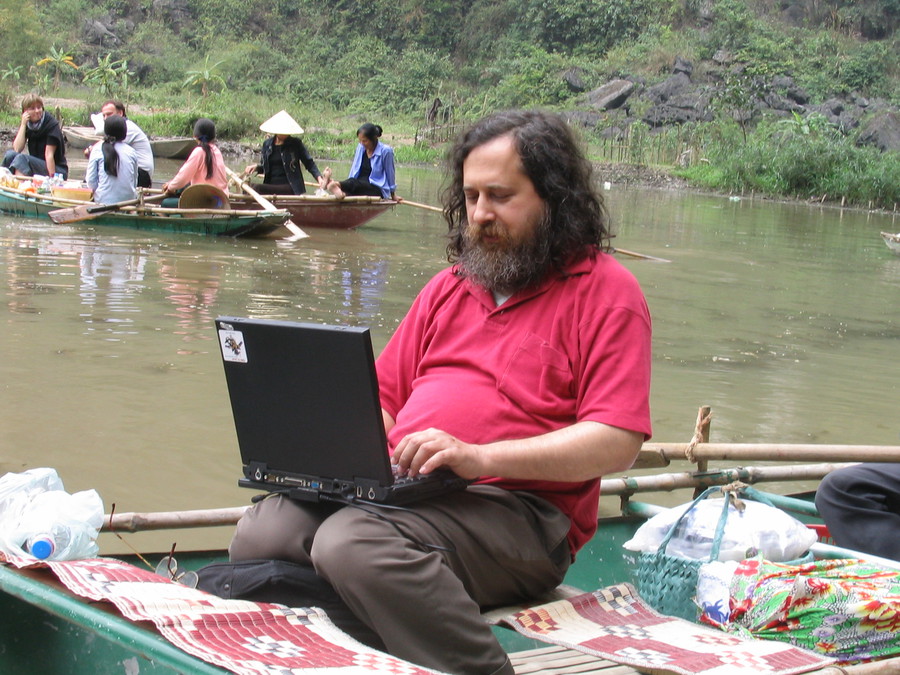
Richard Stallman
There have been a lot of tech articles (see this) regarding the Google/Oracle battle over Java and I have covered it here recently.  So far Oracle is ahead - the jury deciding Google infringed Oracle's patents but deadlock on whether it was "fair use" or not.  Not exactly a win, but moving ahead.

Recent events from yesterday, though, seem, at least to me, to point at more serious trouble ahead for Google.

At issue is whether or not Google "stole" Java by making an exact (infringing) copy of it.

The key Google issue with Java for Android would be to create a Java environment that would work with existing Java code.  Otherwise what's the point?  If you create a Java-like environment and then everyone has to change all their Java code somehow it use it you may as well create a new, different environment.

It seems pretty obvious that Google wanted to tap into the existing code-base of Java apps so they opted to go with a straight, standard Java.

Hence the copying of the Java interfaces.  I can see why a jury might deadlock on this.

More interesting (and a tip of the hat to Oracle's lawyers) is the details of yesterday - in particular the '520 patent (US Patent 6,061,520).

Now Oracle took pains to interview Andy Rubin about whether or not his team looked at Sun's (now Oracle's) patent portfolio while developing the Dalvik Java for Android.  Repeatedly Rubin said no and, at one point, Rubin said "I personally am not responsible for legal reviews of the Android system."

As a geek I have to believe that Rubin would be well aware of patent issues with software - especially software that was targeted to millions or billions of users over the course of a decade.

Next up, though, was the '520 patent.  Now I have written here a great deal about what nonsense most of these patents are - basically rehashing past discoveries and then claiming new ownership (see my post "Googling for Motorola" from a while back).

But '520 is a bit different.

It addresses something you'd normally find out after something like Java was in the field for a while.  Basically it involves noticing that when loading a class you would be repeatedly executing code that would create some static initializations associated with the class, say zeroing out memory, initializing a table, things like that (at least his is my reading of the claims).

This would be, in large Java implementations, something that would stand out.

The '520 patent develops an optimization for this by basically "play" executing the initialization code to see what it would do to memory and then replacing the execution steps to initialize the memory with a copy of the pre-initialized memory.  This makes the start-up time for a class shorter where there are involved static initializations.

So the question now is does the Google Dalvik violate '520, i.e., does it contain a implementation of this specialized initialization code.

If it does, and since this code is not part of the public API's and is also patent protected, Google may have a serious problem on their hands.

Let's go back to Rubin for a moment.

As long as I can remember software patents were a serious part of the business - the earliest known software patent and some detailed history is here.

Subsequently there was a dramatic effort by the GNU folks and Richard Stallman to create a "free unix" (see this).  Now UNIX in its earliest form was a product of Bell Laboratories and covered by license and copyright.

Stallman set out to create a free version and, though he decried software patents, was careful to ensure that all the GNU work was done so as not to violate any copyright or patent claims.  One would think that work like Stallman's would be both legendary to someone like Rubin as well as a clear marker for how to go about something like Google was attempting.  (Later Linux would subsume much of Stallman's efforts.)

Google, in their arrogance I suppose, figured that clearing these sorts of technical hurdles was not important.   Clearly it was not important to Rubin.  (I have to believe that most people in his position would not have said "that wasn't my job".  Long before I became interested in blogging this sort of thing (Stallman, GNU, Linux, etc.) was common knowledge in the industry - as was Stallman's efforts to remain clear of all lawsuits and patent claims.

But again we see Google's culture getting in the way: "we know best" seems to be the motto - regardless of actual facts or ownership.

I have to believe that this cultural nature is in part one based on academia and related to the various posts and links I have created showing that the modern educational system is failing us.

Not properly referencing the "prior art" really does seem to fit in with "US Scientific Medical Studies: a 1 in 20 Accuracy Rate." 

Why worry about the past when you can simply create you own future?

This arrogance has been and will continue to be Google' Achille's Heel (hmmm, the Google spell checker doesn't know that word Achille's).

I predict that if Oracle can show Google's Dalvik contains an infringing implementation of '520 or any of the other patents I listed in my post above they will win and win big.  There's no way for Google to explain away how those implementations would be present save of simply stealing Sun now Oracle's code.

Wednesday, May 9, 2012

Low Cholesterol = Youngsters Craving Food

The epidemic of obesity is looming larger in our collective lives.  So large, in fact, that "experts" are calling for "an intense push by schools, employers, doctors and others" to reverse it (see this WSJ article).

Obesity today I think is caused by some factors that are not so obvious.

One, I think, is the fascination our culture has with nutritional "fakes."  Margarine, for example.  Touted for years as a "better than butter" alternative.  This "better than the real thing" concept has really taken off over the last decades and now our lives are filled with "better alternatives."

Most of them eliminating fat entirely and replacing it with faux fat containing no cholesterol.

The question I am asking today is does eliminating fat from a diet really have the intended effect?

First off, what's the "intended effect?"

Today cholesterol is the "jack the ripper" of nutrition.  No one wants it.  Its evil, its bad and its coming for your children.  So food companies have taken this idea to the extreme and eliminated all cholesterol from many food products.

The "intended effect" being, of course, to save you from consuming cholesterol.

But there are unintended effects: memory loss among them (see this in Scientific American).

I believe that there are other, unintended consequences of the "no cholesterol" policies you find in food these days.

One is that children's bodies know they need cholesterol.  Yet young mothers, their heads filled with "cholesterol is jack the ripper" thinking don't believe it so they deprive their children of it.   No whole milk, no fat cookies and deserts and snacks, and on and on.

Unfortunately the children's bodies are not put off by this and instead their bodies believe that they are merely living in a "cholesterol poor" area and need to compensate by eating more food - particularly food their brains tell them will have more cholesterol: chips, snacks, etc. that trigger responses in their brains.

So the idea is that as you take necessary nutrients out of the available sources of food for children (and adults for that matter) their bodies compensate by overeating in areas where they percieve the missing nutrition will be replaced.

Now I argue that, particularly in children, cholesterol is a necessary nutrient - your brain being the largest collection of cholesterol in your body.

In my own life I have been experimenting with this notion.

Over the last many years I have always been very hungry - hungrier than I thought I should be - but I never really new why.

About a year ago Mrs. Wolf and I began a food journey that tries to eliminate most "man made" things from our shopping cart: if it comes in a box don't buy it basically.  This means that we make things like bread, for example, rather than buy it when we can.  We also make butter, jam, and all sorts of other things.  We grow food in the garden as well.  We cook without salt for the most part.

This also includes consumption of a lot more natural cholesterol in various foods.

Now I have noticed that over the last year my "hunger" has diminished significantly. 

I find that a meal is more satisfying and that I need to eat less.

I also find that I have lost weight - slowly over time - not all at once.

So my theory here is that all these wonderful low calorie, low fat, low this, low that foods are actually having the opposite effect.

They are triggering the body to respond as if its eating something like celery - something that takes more energy to digest than the food contains.

So the bodies craves more food.

I think this is a particular problem with children.

In fact, one of my own children thought that allow their child ice cream was tantamount to poisoning them.

The second problem which I think goes hand-in-hand with the "cholesterol" problem is that most of us in the USA are malnourished.  In particular short of iodine, cholesterol sources like "cod liver oil" and vitamins like C and D.

Without enough of the right vitamins (and the right amounts) we cannot process the food we do eat correctly - so we have build ups of bad things in our bodies: cholesterol, fat and so on.

So even eating the right foods you can still be malnourished if you don't have the necessary vitamins to process the digested result.

Over all I have found that my consumption of food is diminishing to a more reasonable level and the food I eat seems to be far more satisfying.  Now that I eat a diet much higher in cholesterol and take what my research has told me are the right vitamins in the right amounts I am no longer "hungry."  And I think this is my body telling me its getting better nutrition than it was.

I can do more - I can work longer - easily up to 12 hours a day now at 55 - more than I could at 45.  I am less tired.  I have more energy over all.  More focus and mental clarity.

(Exercise is important too, or rather "activity" in general.  I do spend a part of the day sitting on my ass but the rest of the time I am busy.  Of course this is all anecdotal evidence based on me by research conducted by me - your mileage will vary...)

So my guess is that, if I am right, no amount of government, school or employer activity is going to fix this because the problem does not have a single source.

Schools will cut even more fat from children's diets trigger them to hunt further and more actively for replacements.

And without the proper level of vitamins even if they had the right food they could not digest it effectively.

So I think this "intervention" by big everything is doomed to complete failure.

And again I blame the educational system - especially here in the US - because its beholden to the agricultural industries and lobbies. 

No one studies anything but what they can get funding for and no one is going to get funding to study this because it goes against big agriculture and the FDA.

Of course, I might fall over dead tomorrow from all this.

But in the mean time I have my brain back - my energy and all the rest.

I am not sure I'd want to live like I did ten years ago for another forty years - in a mental fog, low energy, etc.

As a nation our "big pharma/big government/big science" infrastructure has failed us.

Its failing our children.

Not until we wake up and get a handle on the real problem will things change.