
Sunday, April 8, 2012

Friday, April 6, 2012
Prometheus, Intelligence, and little dogs...
 |
| Brains of wild pig, dolphin, human (left to right) |
Here are some interesting facts:
- Human brain structure is somewhat unique. Mammals such as the sperm whale have much larger brains but the neuron interconnection internally are not as sophisticated as a human - at least how we measure things.
- Children with autism have more neurons in there heads than those without.
- Your brain is born with as many neurons as it will ever have (roughly). As you grow your brain makes connections between neurons. A typical brain has more than 100 billion neurons. Over you lifetime each brain cell will make some 15,000 or so connection to other brain cells based on input from your environment.
So to a large degree your brain is a product of genetics and your environment. It seems as if its given a fixed limit to its "intellectual horsepower" before your birth.
So in our world we humans are at the top of the "intelligence" food chain.
What does that tell us about ET's and communications with them?
Well, let's turn it around. I have a small dog named "R2." Let's imagine that we are "R2" and that the ET's are us. (From the image above R2's brain is quite a bit smaller than the pig brain.)
Now R2 is very dog like - he knows his name and a few other words: truck, out, toy. He's good on observation and an effective watch dog. He's neat, clean and keeps himself well groomed and in our house he is a good dog citizen.
But in terms of R2's perception of "higher intelligence" things get a little more interesting.
R2 gets "excited" when presented with new situations. For example, we are moving a stairway in our house and he had a very hard time with the new stairs. I think this was because the stairs were "open" at first so you could "see through" to the other side. After we put the backing on the stairs R2 learned them.
So in R2's world stairs are something that, while you can use them, are complex. I do not think R2 capable of creating stairs, or even piling things up to get onto, say, the table. If there is a way to do this without him changing his environment he might figure it out, e.g., climbing on the table via a chair.
With other dogs I've found things like "doggy doors" have the same effect. Dogs struggle to grasp the concept - some for quite a while and some never really get it.
Now we, the "higher intelligence," have created these technologies.
Perhaps like ET's whipping up "worm hole travel" in movies like Contact.
 |
| Prometheus |
But they do not understand them. I would argue R2 is overwhelmed by the concept of leaving the ground - particular under his own power, i.e., waking up the open stairs. He can see himself elevating into the air but he is frightened because he does not understand why.
In fact, I would argue, dogs will never understand how to make stairs or a doggy door.
So in effect these represent an "alien technology" beyond their grasp.
Certainly they can communicate with us to a limited degree. But that's it.
In terms of environment dogs live in exactly the same one, e.g., the Wolf household, as we do. But they do not, for example, decorate the house (at least not with objects they collect), they don't create art, nor music...
So obviously their connection to the house is different than ours.
And if all the humans in the world died off the dogs would revert to semi-wild in as much time as it took them to realize that there were no humans to feed them.
We can easily understand things like dog psychology, dominance, and so on. We can also interact with dogs to a large degree - but we don't read them bedtime stories.
So now imagine we as humans are presented with some ET that represents the same leap from dog to man in terms of brain power.
Our ability to understand them would be about the same as our dog's ability to understand us. Certainly the dog might know if your upset, angry, happy, and so on. It could understand some basic commands and activities, e.g., get into the truck. But beyond that it knows nothing of our world, environment or lives.
Nor can it because it lacks the "intelligence horsepower" to do so.
This is, how I imagine, we would seem to aliens.
Our perception would be diminished compared to theirs.
Our ability to process information would be greatly diminished compared to theirs.
Our ability to "fit" into an environment suited for them might be beyond our ability to grasp.
Like Prometheus we might bring "intelligence" to the dog world (or the fox world) by breeding or genetic engineering but the results might take a long time - if every - to see.
This is why I think things like SETI are stupid.
Like the dog when his owner dies who still returns to the recliner where they both used to sit all we are doing with things like SETI is repeating what we know to do - blasting signals into space and/or listening with giant antenna.
We are not doing anything that shows we are advancing to something new and worthy of notice.
So really SETI is just the anthromorphication of previous human behavior.
Our brain structure limits what we can do in terms of thought just as the dog brain limits R2.
However, we poses the ability to augment our bodies and presumably our own intelligence.
So what if we built a giant AI of some sort to think for us?
I think this is interesting territory. If its just a reflection of us then it would be of no use for it would be like us. On the other hand, if we somehow built one that was truly a quantum leap ahead of us it might simply ignore us a "noise" in its environment.
To build one that was both more sophisticated than us as well as able to "help us" in some way I think requires more knowledge than we have...
So in some sense, like the dog, we are chained to earth by our God-given biological traits.
Instead I think we are much better off understanding ourselves and our consciousness. Not just writing papers and drawing simplistic maps of neurons but actually trying to grasp the true underpinnings of what intelligence and consciousness are.
Thursday, April 5, 2012
Prometheus, SETI, and Alien Messages...
 |
| Russian Fox Domestication |
Tidbit: If you want to own a time-share now is a good time to buy one. According to this blog people are now selling them for $1 USD or even paying others to take them off their hands (though there are monthly maintenance fees).
Tidbit: Then there are the new, three thousand pound feathered dinosaurs recently found in China. The best evidence so far that dinosaurs were feathered rather than scaled.
I recently discovered the new Ridley Scott movie Prometheus. Scott produced the original Alien movie. While tame by today's standards this was a big deal in the late 1970's - particularly with the H. R. Geiger-based artwork. It looks interesting. Here's the official preview:
Then there is Journey. A new video game from Sony.
Link here.
Getting back to Scott and Aliens for a moment, no pun intended, Mrs. Wolf and I were recently watching Contact.
Like "Pop Up Video's" from the 1980's AMC has little "Notes" that appear at the bottom of the screen telling you about the movie. At the end it notes that Jodie Foster invested in keeping SETI alive (the Search for Extra-TerrestrIals).
Now I wonder why SETI is so unsuccessful?
Certainly there must be billions of "beings" in the galaxy - just like sciences tells us. Who can forget the old Carl Sagan "billions and billions."
Yet we don't here a thing.
I've often wondered about this. For me the most likely explanation is, well, unusual...
For one thing, our "science" is telling us where to look - in terms of radio waves, spectrum, kinds of information we might receive (just like in Contact which Sagan wrote). Does it know something we don't? I don't think so...
Instead the "science" of SETI is on our part just "wishful thinking" - aliens communicating with us just as we would communicate with ourselves - via radio waves. This is even worse on some cable TV shows depicting alien contact - giant solar sails (I guess they are eco-friendly aliens...)...
In a limitless universe why would everyone else do exactly what we do?
No, I think here that science has led us all astray.
The movie Contact makes it clear that belief in all things that are not concrete is an act of faith - be it science or religion.
Though some will argue its clear that as humans we rely on comforting systems of belief to organize our world into very human structures.
I ask why this does not blind us from what is really there?
Clearly science, as I have posted here before, does not allow us to understand everything. We can organized it, sometimes predict it, but as often as not, say as in the case of something so common as photosynthesis or consciousness, we have no clue.
Think of it this way. I sit writing this blog surrounded by dogs. Lesser intelligent beings than myself. What can the comprehend of my existence?
While they know I am here and follow me around do they strive to discover more about me or humanity? And what about the dogs relation to, say, ants in an ant hill outside.
While some will argue I claim the dogs are conscious like us. Yet there is a significant gap between us and them. From their perspective we are probably unfathomable. And, though we believe ourselves significantly more "intelligent" what do we really know about what they are thinking?
Similarly, save for occasionally playing with an ant as it crosses the floor what do dogs know of ants? How would we describe ourselves to ants or to dog in terms they could understand?
To me this is the real problem of presented by Contact.
And science, while attempting to quantify all this with numbers and radio telescopes and other geeky stuff fails to grasp the fundamental problem:
If I cannot communicate about myself to a dog why would I expect an advanced alien race to be able to communicate to me about itself?
Quite honestly we are looking in all the wrong places - outward instead of inward.
We take our simple science rules and declare them as the lingua franca of the Universe.
Listen - see - no one is there.
Why would aliens care about us? Certainly I care about my dogs because they are my pets. But what about dogs in general? Do you think they really "care" as a species about humans? If we all vanished would they really notice (save for pets who would forget as soon as they were hungry enough).
We're like ghosts to them - we cross paths but as a race our existence is probably completely meaningless to them.
Yet think about this. In my lifetime man has domesticated foxes (see this). Simple breeding and selection in nine (count'm nine) generations.
When science can tell my why this is so and why there is such a relationship apparently built in and readily accessible between foxes and man (or dogs and man) I will be more interested.
If I were looking for an alien message that might be a good place to start...
Wednesday, April 4, 2012
Great Pyramids, Global Warming, and 3rd Grade Physics

The modern Argo sea temperature data was "matched" (no supporting details available - see this) with the 1870's data.
“The significance of the study is not only that we see a temperature difference that indicates warming on a global scale, but that the magnitude of the temperature change since the 1870s is twice that observed over the past 50 years,” said Roemmich, co-chairman of the International Argo Steering Team. “This implies that the time scale for the warming of the ocean is not just the last 50 years but at least the last 100 years.”
Not surprisingly there has been a steady increase in temperature since the 1870's (details here).
I suppose well before man started destroying the planet with CO2.
More than likely, though, it all may be meaningless for a number of interesting reasons...
First of all the set of data from the 1870's is just that - one set of data. Probably not as precise (for example, the measurements where taken with the Challenger moving so the thermometers were dragging behind the boat at an angle rather than at a precise depth) as you would find today (see this).
So no one knows how accurate the thermometers were back then... Interesting.
I would have imagined that with all the "historical climate research" I hear about (like the Challenger data) someone would have gone to the trouble of doing some serious research into the historical accuracy of temperature measurement.
Yet magically we can extrapolate significant results from this?
Another interesting point in reading all this is that as the ocean heats up it expands.
This means that the ocean level rises - without a single glacier melting - because a warmer ocean occupies more volume (and a colder ocean less).
So how is it possible to sort out how much of the ocean is rising from "melting glaciers" versus simple expansion due to basic physics. We learned this in third grade. The nuns had a small tub that they put on a stove. We took a flask, a stopper and a tube and set it up so that water partially filled the flask and was present in the glass tube (extending from above the stopper down into the water in the flask.
We tied a string around the position of the water in the tube. Then we heated the tub. The water in the flask expanded and it rose in the tube (we tied a red thread around the tube to indicate this). We then cooled the tub by putting ice into it and the water level on the tube dropped (we tied a blue thread there).
Apparently they no longer teach third grade physics so no one knows what's going on nor do they account for it in these kinds of things.
Then we have the satellite data and quantum noise. I wrote about this a while back.
All of which conflict with the ocean temperature data and the conclusions drawn previously.
More than I ever I have to say that none of this seems like real science anymore.
All kinds of money, effort and time put into something which is really not knowable in the first place because its not a closed system - meaning that there are other influences in play which we cannot know, measure or account for (for example, what impact do solar flares have on global climate...?)
In college in the 1970's one of the things I learned was that there was a difference about studying something objectively and subjectively. Subjective study meant that you were just "conjuring up" something without concrete objective data to back it up.
It was easy, at least for me, to be fooled by this sort of thing.
I remember writing a paper and the TA saying "this isn't research" because what I wrote about I acquired from some book (Peter Tomkin's "The Secret of the Great Pyraminds" I think). The book had a lot of mumbo jumbo about pyramids - but nothing to back it up. Certainly the book was interesting to a 16-year-old mind but it wasn't science.
Over the years I have learned that while lots of things "seem cool" that does not mean they are facts or evidence of anything.
(One thing the "pyramid" nonsense of the time claimed was that you could place a dull razor blade (remember those?) inside a pyramid and it would resharpen... I was unable to reproduce this "scientific aspect" of the Pyramid book - which ultimately led me down the road of doubt.)
And further, that the harder you look at something the less you know - almost to the point where you see that simply matching data to equations (as does physics) tells you nothing about why something is so.
Yet it is easy to confuse the equations with the why. And even if we think we know the why at a small scale, say as in the search for the Higgs boson, we again see that knowledge at one scale (quantum reality) does not work at a larger scale (macro reality).
If science were really the "answer" to everything this sort of thing would not be a problem.
Of course, adding "soft science" to all this just makes the objectivity even less clear.
Maybe the Great Pyramids are just yesteryear's idea of "Global Warming."
Tuesday, April 3, 2012
Rocket Science 101
I came upon an interesting site (hopefully this is not a fake site like the birdman site I wrote about a while back).
Cophenhagen Suborbitals.
An open-source, donation funded rocket company attempting to put a man into orbit.
The first video is rocket science at its best. Here's a guy building a rocket engine with his bare hands. Its a straight-forward 1950's design. He goes through a complete explanation of how it works and why. Save for his knowledge and science of how the engine works this is something that any relatively sophisticated machine shop could build.
The coolest part is that if you watch carefully you can see his hands are dirty.
The next two videos show test launches of their rockets.
Not exactly your NASA level organization but they've managed to get a lot done for relatively little money and effort.
I find it interesting that NASA, currently without a shuttle or equivalent, requires tens or hundreds of billions of dollars to do what they do.
In particular the guy in the first video explains that they are basically using Nazi V-2 generation two technology - something you'd see in the 1950's - to build the engine he's working on.
I think they are succeeding because they do not have an institutionalized infrastructure to support.
Today there are a good half dozen rocket companies - including Virgin Galactic - planing to put people and equipment in space for pay. SpaceX has won a significant NASA contract to put equipment into space.
None of them using NASA technology directly.
For a long time NASA has held the focus of spaceflight - probably since putting men on the moon in the late 1960's and early 1970's.
But that has leadership has waned.
Today all over the globe companies are working to create space flight technology without government funding.
Cophenhagen Suborbitals.
An open-source, donation funded rocket company attempting to put a man into orbit.
The first video is rocket science at its best. Here's a guy building a rocket engine with his bare hands. Its a straight-forward 1950's design. He goes through a complete explanation of how it works and why. Save for his knowledge and science of how the engine works this is something that any relatively sophisticated machine shop could build.
The coolest part is that if you watch carefully you can see his hands are dirty.
The next two videos show test launches of their rockets.
Not exactly your NASA level organization but they've managed to get a lot done for relatively little money and effort.
I find it interesting that NASA, currently without a shuttle or equivalent, requires tens or hundreds of billions of dollars to do what they do.
In particular the guy in the first video explains that they are basically using Nazi V-2 generation two technology - something you'd see in the 1950's - to build the engine he's working on.
I think they are succeeding because they do not have an institutionalized infrastructure to support.
Today there are a good half dozen rocket companies - including Virgin Galactic - planing to put people and equipment in space for pay. SpaceX has won a significant NASA contract to put equipment into space.
None of them using NASA technology directly.
For a long time NASA has held the focus of spaceflight - probably since putting men on the moon in the late 1960's and early 1970's.
But that has leadership has waned.
Today all over the globe companies are working to create space flight technology without government funding.
Monday, April 2, 2012
"If Everybody Did" - Thoughts on Modern "Bullying"

Why?
Because they might "invoke unpleasant emotions in the students." (I wonder if tests are bullying under this description? Or paying New York State tax rates at 13% on average?)
Welcome to the new world of modern "bullying."
According to a Department of Health and Human Services website "bullying" as "teasing," "name-calling," "taunting," "leaving someone out on purpose," "telling other children not to be friends with someone," "spreading rumors about someone," "hitting/kicking/pinching," "spitting" and "making mean or rude hand gestures."
What's fascinating to me is that many of these alleged "bullying" activities function in society to constrain "out of the norm" behavior, i.e., act as a governor to prevent or limit societal problems.
In a normal society (unlike the one we live in today) there are limits and constraints necessary to keep the society functioning. For example, their might be a single well in the middle of town (a "limited resource"). So a constraint on the society is the amount of water available: without water people will die.
So to protect this resource societal constraints come into play: don't waste water as an example.
You can hear the children now: "I heard little Suzy dumped a bucket of water out," "don't make friends with little Johnny because he wastes water," and so on.
While these statement may seem cruel isn't it more cruel to waste your societies resources? To leave others without so you can waste? How does the mother with small children feel when she goes to the well and there's not enough water? If little Suzy does dump out a bucket of water as waste what if that's the one bucket of water that would be enough to stop the fire from destroying the entire village?
What if these "bullying comments" are in fact the truth?
We could also imagine little Johnny poised on the garage roof - home-made wings strapped to his back - preparing to leap off in flight.
"You're going to to die, you idiot," shouts Fred, the older neighbor boy from next door.
Is Fred a bully?
Perhaps the Wright brothers were called "crazy" during their efforts to created powered flight. Perhaps such comments spurred them on to success at Kitty Hawk?
Much of what is described as "bullying" is normal, necessary societal behavior. And without it you'd have what I call the "What If Everybody Did" syndrome.
"If Everybody Did" is a book (see this and this) describing a world where you can actually see the consequences of everyone doing something. The classic imagery from the tale was this: "what if everybody picked the cat up in the middle?"
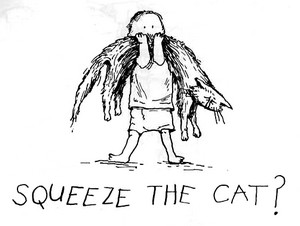
The results would be:
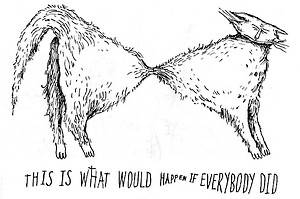
Of course there is the more modern version: What if everybody claimed to need food stamps even when they didn't? You'd have a $15 trillion dollar debt.
Societal pressure is exerted by many of described features of bullying - and don't get me wrong - there is a point at which true "bullying" is really a problem - but its very, very far from what people are today claiming is bullying, e.g., teasing.
And ask yourself what's worse?
A society with no bullying and consequently no societal pressure against any form of "wrong" or a a little bullying and a society that's better for everyone?
Today we live is a world where the "Free Rider Syndrome" reigns supreme (the "free rider syndrome" is a situation where people feel that they can take something, for example a "free" ride on public transportation, and that no one will notice because "what's one free ride amongst millions").
Of course, when enough people take a "free ride" eventually the system breaks.
To my mind "free rider" is the same as "what if everybody did."
So calling someone "lazy" for taking a ride on the public bus without paying makes sense - it protects societies investment in the bus service - because if too many ride for free eventually the bus system will go broke (which its doing today in many towns across the country and world for exactly this reason).
Like most things the path to hell is paved with good intentions and laws and other "bullying" nonsense is no exception.
And of course people will trot out stories of how someone killed themselves because they were "bullied to death." But that is the extreme exception rather than the rule. And there is likely as much chance that someone will take the same situation and turn it into something positive, e.g., a revolution for the good.
Sadly, though, in a twist of irony, "bullied to death" is presented as the consequence of "What If Everybody Did..."
This is kind of like the "free rider" on the bus claiming (or threatening) that the bus driver would lose his job if there were no "free riders" because then there would be no one on the bus for him to drive. These events, are of course, actually unrelated. The bus driver having a job depends on having actual, paying bus riders. If the bus company allows free riders its not the bus driver's problem per se to solve (unless he's the one letting them on). Similarly why does the bus company employ someone to only drive around a bus full of people not paying to ride.
Part of the problem with all of this is that today people are not educated well enough to comprehend the differences between objective fact and subjective belief.
Society may choose to allow some on the bus for free, for example, the elderly. The assumption being that they have contributed all their lives to the betterment of society and are therefore entitled to compensation in their old age.
But some will see this as "discrimination." And perhaps they will take it upon themselves to take a "free ride" as well - even though they have yet to contribute.
Unfortunately we live today in the world predicted by "If Everybody Did."
Everyone assumes that they are entitled to "squeeze the cat" without consequence.
And sadly they are not even smart enough to see the consequence.
Today we are "bullied" into thinking that if the bus is not full of "free riders" then something is wrong. We are not "helping" enough. We are not "kind" enough. All the while driving the "bus company" out of business by jamming more and more "free riders" into the system.
Who are the real bullies here?
Friday, March 30, 2012
The Hunger Games - Link's to Modern Music's Past
There aren't a lot of female electronic music composers from the 1970's (Walter/Wendy Carlos of "Switched on Bach" fame comes to mind, but that was originally recorded in the 1960's). One I had not heard of previous was Laurie Spiegel who composed the track "Sediment" in the 1970's.
"Sediment" is part of the sound scape in the popular movie Hunger Games.

The sounds of "Sediment" were produced with an ElectroComp 200 and reel-to-reel tape decks.

During the early 1970's I amassed a collection of synthesizer brochures from the likes of Moog, ElectroComp, and many others. You could write letters to companies you found the addresses of in magazine articles requesting this. Sadly the cost of actually purchasing this equipment was beyond my means, much less the reel-to-reel tape recorders required to do serious work.
Ms. Spiegel worked in a five-room tenement with a single 15A fuse. The energy required by the refrigerator detuned the oscillators so she had to unplug it while working on her music.
"Sediment" can be heard in the YouTube clip below:
Here is an interview with Laurie from 1984.
Speaking of the 1960's we have Jeff Bezos of Amazon fame attempting to resurrect rocket boosters and F-1 rocket motors from the Apollo moon launches (see his Bezos Expiditions website).
Like me Bezos was apparently inspired by the 1960's efforts of man to do more with himself than sit around watching reruns of Gilligan's Island. In the 1960's there was, at least in my mind, an effort by human's in general to look beyond themselves, i.e., reaching the moon.
I remember in the early 1970's looking at the writings of Bob Moog (of synthesizer fame) in the Electrical Engineering Library at the University of Wisconsin Madison (I was probably about 14 or 15 at the time). In those days his synthesizers were a novelty and he published their schematics in various EE journals of the day (such as ElectroNotes which began publishing in 1972).
I still remember finding the old, green leather bound journal archives and his articles.
His electronic music circuits are remarkably simple - so simple that you could Xerox the pages out of the journal, take them home, and breadboard them on your own - which I attempted to do.
I did not live in Madison at the time but I was fortunate enough to be there for other reasons over the summer. During my spare time I sought out the library on my own and spent many happy hours digging through its electronic music archives.
Today it seems we only look inward and we tend de-inspire ourselves to focus on "group thinking."
For me this is a tragic shift away from a time when everyone was inspired to literally be all they could be. I suppose this was still the pre-Orwellian 1984 state of the world.
The interview's with Laurie Spiegel above are almost thirty years old (and date from around 1984) but clearly they show the way to today's iPad/iPhone and computer-based software synthesis and audio recording.
They show how pioneering her efforts were in electronic music and music in general.
Finally a performance by Laurie Spiegel.
"Sediment" is part of the sound scape in the popular movie Hunger Games.

The sounds of "Sediment" were produced with an ElectroComp 200 and reel-to-reel tape decks.

During the early 1970's I amassed a collection of synthesizer brochures from the likes of Moog, ElectroComp, and many others. You could write letters to companies you found the addresses of in magazine articles requesting this. Sadly the cost of actually purchasing this equipment was beyond my means, much less the reel-to-reel tape recorders required to do serious work.
Ms. Spiegel worked in a five-room tenement with a single 15A fuse. The energy required by the refrigerator detuned the oscillators so she had to unplug it while working on her music.
"Sediment" can be heard in the YouTube clip below:
Here is an interview with Laurie from 1984.
Speaking of the 1960's we have Jeff Bezos of Amazon fame attempting to resurrect rocket boosters and F-1 rocket motors from the Apollo moon launches (see his Bezos Expiditions website).
Like me Bezos was apparently inspired by the 1960's efforts of man to do more with himself than sit around watching reruns of Gilligan's Island. In the 1960's there was, at least in my mind, an effort by human's in general to look beyond themselves, i.e., reaching the moon.
I remember in the early 1970's looking at the writings of Bob Moog (of synthesizer fame) in the Electrical Engineering Library at the University of Wisconsin Madison (I was probably about 14 or 15 at the time). In those days his synthesizers were a novelty and he published their schematics in various EE journals of the day (such as ElectroNotes which began publishing in 1972).
I still remember finding the old, green leather bound journal archives and his articles.
His electronic music circuits are remarkably simple - so simple that you could Xerox the pages out of the journal, take them home, and breadboard them on your own - which I attempted to do.
I did not live in Madison at the time but I was fortunate enough to be there for other reasons over the summer. During my spare time I sought out the library on my own and spent many happy hours digging through its electronic music archives.
Today it seems we only look inward and we tend de-inspire ourselves to focus on "group thinking."
For me this is a tragic shift away from a time when everyone was inspired to literally be all they could be. I suppose this was still the pre-Orwellian 1984 state of the world.
The interview's with Laurie Spiegel above are almost thirty years old (and date from around 1984) but clearly they show the way to today's iPad/iPhone and computer-based software synthesis and audio recording.
They show how pioneering her efforts were in electronic music and music in general.
Finally a performance by Laurie Spiegel.
Subscribe to:
Posts (Atom)