Search This Blog

Thursday, November 1, 2012

Hurricane Sandy - Helping Others by Being Prepared Yourself

About 2005 or so there was another perfect storm.  This one occurred over eastern Ohio, western Pennsylvania and northern West Virginia.

A hurricane blew up from the south and collided with a rainy weather system moving west to east.

The result was an enormous rain storm.

One that dropped some six plus inches on the area over the course of several hours.

This area of the country is relatively mountainous so the significant danger is flash flooding.  (Often entire small communities get washed away when a small river suddenly becomes a raging torrent.)

Even though I live at about 1150 feet above sea level this particular event rendered us somewhat stranded.

Creeks and rivers below us flooded or washed out roads.  Trees fell across roads.  While this was inconvenient chainsaws and ingenuity won over and things went back to normal.

However, there were no "first responders" save for the people this affected.  No police, no fire engines came.

For the people who had built an entire community in the flood plains below things were different.

Massive destruction and flooding.  Homes and business filled with river mud.  Damage to electricity, water and sewer systems much like we see with Sandy today.

What's troubling with Sandy beyond the raw destruction is that many, many people in the path of Sandy have rendered themselves helpless by not being prepared.

Along the New Jersey coast there was massive destruction.  But if you look at the paths of other Atlantic hurricanes (from Wikipedia):


You see that anyone from norther South America to Newfoundland, Canada should expect to be in the path of hurricane at some point.

Yet still people build houses right along the shore line with at most a small sand dune to protect them.

Though hurricanes hitting NYC are rare they are not unheard of and most other cities along the coast from Boston to Key West have been jeopardized in the past.  In many areas homes are built on stilts so that the storm surge simply passes under them.

Perhaps now people won't laugh quite so much at "Doomsday Preppers" and the like.

It seems as if a herd mentality has taken over:  People expecting emergency service workers to fix their problems.  Communities built without thinking ahead about what kind of disasters are common in that area.

Safety in numbers.

The same is true for the "gadget" aspect of life.  Many people today have only a cell phone for communications.  In Sandy about 1/4 of all cell phone towers were disabled.  And with power outages measured in days cell phone batteries will simply run out.

Are we too dependent on these things?

I think we are.

Here in the boondocks everyone must be prepared because no one will come and fix things for them.

Gas leaks are common in old worn-out pipelines; but common sense keeps this from being a problem.

Trees fall in storms and often they are so quickly sawed up for firewood that all you see right after a storm is the sawdust.

People have generators and gas because the power can go off for days.

Yet only a few miles away "in town" there is much less preparedness.

Why?

I think its because people feel "safe" near others - regardless of  whether or not "others" can actually help them in a disaster.

Kind of like domesticated dogs that forgo about 30% of their intelligence as compared to their wild counterparts.  Domestication removes the need to be self reliant and smart about day-to-day life.

The domesticated dog expects the master to feed him - just as the "towny" expects that someone will come and fix the water or electricity when it fails.  When no one shows up right away things go down hill quickly...

One has to ask really basic questions about NYC.

For example, if it were my town I would install water-tight emergency doors on all my critical tunnels.  These doors, while expensive, would be a infinitesimal investment compared to the cost of what's happening today.  When a storm sure was eminent you close and seal the doors.

As for Wall Street and the rest of the city close to sea level I would convince landlords and builders to ensure that all buildings can continue to operate with the loss (in terms of flooding) of the first two floors.  Critical systems could be below be would have to be in water-tight compartments.

Rather than force this on anyone I would simply make aid to those that took the time to be prepared a priority of those that did not.

(While this may sound cruel its not.  Those that are not prepared are in fact jeopardizing everyone else...)

You also have to ask that why, when a storm like Sandy is bearing down, doesn't someone shut off the power in advance?  Particularly to low-lying areas prone to flooding?  Sure, leave the some on on the main drag that's reasonably above the floodable areas, hostpitals, etc.  Shutting it off first would eliminate all those nasty dangling "live wires" everywhere.

Today in many places outside the "big urban areas" you still see regular folks fixing disasters.  Local folks with chainsaws, plumbing trucks, electrical businesses and so on showing up to fix things.
At least as far as they can.

The more urbanized, however, the more "special requirements" there are - imposed by government, unions, and so on - to make things only repairable by those entities.

"Sorry - I don't have have the funky specially shaped wrench to turn off the gas..."

Boom.

Instead the "Shepard" shows up and herds everyone off to where its "safe" - even if it isn't always safe - so experts can handle things.

I say nonsense.

How about instead everyone be prepared on their own? 

If this were the case then there would be far less pressure on the "first responders" to rush in to save the day. 

Social pressure to put some effort into preparations rather than to sit in ignorance.

More than thirty years ago I lived in NYC.  In a giant apartment building with a tiny refrigerator.

Had the power gone off we could have lasted a day or two before the food ran out.  Had there been no water we would have lasted an even shorter time.

I have no doubt things would have reverted quickly to barbarism.

The best way to help those unable to help themselves is for you to be prepared.

Wednesday, October 31, 2012

Sandy: How Good Is Our Weather Prediction Ability?

I have been critical here on numerous occasions about "global warming."

Recently I have been interested in matching the predictions of hurricane Sandy against the actuality.  The site I used for the predictions was the National Hurricane Center.

There isn't a lot of concise, direct prediction, e.g., the path it will take, and so on.

But there is a lot of "probability maps" showing, for example, where the most likely rain fall will be.

The main predictions as I saw it were (I am using "consumer" predictions - not any special weather data):

1) The hurricane will move up and along the coast from the Bahamas (I only really paid attention as the hurricane left the Caribbean).

2) The hurricane will shift inland to mid-Pennsylvania.

3) The hurricane will move off to the north.

(Edit - here is an image from the prediction period...)


The destruction in NYC and NJ were a given as long as the hurricane went inland below New York harbor.

So how did the predictions work out?

Well, at a gross level they were generally accurate in terms of basic direction and movement.

The storm moved up along the coast as predicted.  It moved inland starting Monday morning.

By about 8 PM Monday night the "eye" (rotation center) reached the NJ/Pennsylvania border.

By Tuesday the center reached Pittsburgh.

Today, Wednesday the "eye" has moved to western New York state.

So over all this was what was predicted.

The low-level details, however, were all over the place.  The "eye" reaching NJ from the traversal up the coast was much more rapid than predicted.  There wasn't a lot of precision where the storm would reach the shore.

Once the storm reached the shore a lot of strange things happened (I talked about the "shock wave" yesterday).

The storm changed from a hurricane to something else as it moved inland and its unclear what the path it took was.

The rain and snow levels shifted around and changed dramatically from day to day (the predictions are posted periodically on the site but I checked them once or twice a day).

So in general each event was predicted as something of a probability curve.  The higher the curve the higher the probability.  So the storm followed along within the curve but not always along the highest probability predictions.

The key game changer was a low pressure system which had a front along the western Pennsylvania/Ohio border.  This created a low pressure "trough" that Sandy slipped into as it approached.  Sandy then followed this inland.

The only assessment of all this is that in terms of gross prediction things went well - but in terms of precise detail things were all over the place and there was little correspondence between predictions and actuality.

Now there was talk about how the "low pressure" affected the hurricane model's prediction ability.

The model seemed to work only after the hurricane was on-track to move up the coast, i.e., before that point it was unclear what the hurricane would do exactly (a slight change in course, for example, would have simply sent it out to see as often happens with hurricanes that move up the coast).

So clearly there was a prediction "model" involved which worked at a gross level.

So let's compare this to recent talk we see about global warming (here for example).  This article talks about "improved" models that provide "less certainty."

Advances in computing power, for example, allow models to use more data points, provide more complex and sophisticated modeling, and so on.

However, the "output" of the model shows less certainty about what will happen.  Temperature goes up but what this means is less clear.

Not really much different than what is accomplished for the hurricane.

On the other hand, the hurricane model doesn't work too far in the future, i.e., determining where it will go once it enters the Caribbean.

The question becomes this:

1) If we cannot predict what a major storm system will do over the course of say, two weeks, how can we predict anything more accurately at a larger time scale?

2) How can we be certain about the precision of, for example, small temperature changes from climate models when even within a day or two we cannot precisely predict landfall for something simpler (in terms of climate) like a hurricane?

This is like saying while I cannot predict the precision of each shot in a pool game I can say who will win based on a large collection of such unpredictable shot predictions.

One thing that to me reenforces the foolishness of this "climate modeling" is how nothing available to the public shows the relative accuracy of past weather predictions.

For example, each day sites like AccuWeather show predictions for the next day, week, and so on.

But where is the historic comparison, i.e., we predicted X for next week but Y actually happened?

No industry I know of operates in this way, particularly when public safety is involved.

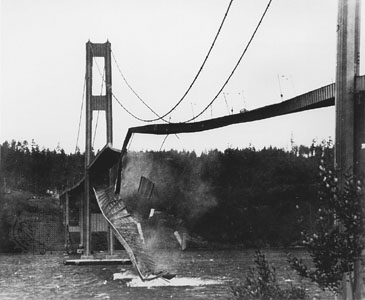
It would be like never analyzing failures.  For example, as suspension bridges were built over the years various bridges failed quite publicly (for example, the Tacoma Narrows bridge below).


Similarly for financial investments and any other human endeavor that involves learning from past mistakes.

But with weather the past weather predictions just seem to vanish.

What I don't understand is why?  How is this science?  Where is the regression comparison of what we predicted in the past and what actually happened?

My guess is that the public would have little confidence in the science of "weather prediction" if they could see the accuracy.

Some science, such as chaos theory, tells us that we cannot accurately predict the weather.

Yet we continue to try?

The real question is more basic: Can we even reliably predict the weather beyond several hours?

I don't think anyone knows the answer.  But from what I know about chaos theory I would say no, its simply impossible to make accurate long term predictions.

Here is a good NY Times article about this very subject: "The Weatherman is not a Moron."

Personally I think of weather prediction, at least at the consumer level, as more of a "comfort food."

I've noticed that radio stations, for example, always try and put a good spin in "weekend weather."

For me, I simply look at the radar.  Is something "green" (for rain) coming?  You can predict fairly accurately (even given the diddling that removes the precision from the radar) when you are going out for the afternoon.

Predicting a full day or a weekend, though, is less simple.

Perhaps as a society we need to think about how our education system, particularly a government-backed one such as we have, can be used to assist us.  Instead of turning out poets with $100K USD in debt perhaps we should look at building a reliable weather prediction system over a decade - as JFK did with the "race to the moon" in the 1960's.

Tuesday, October 30, 2012

Real Zombie Dogs: (Not for the Squeemish)

I am posting this for Halloween.

If it reminds you of a Frankenstein movie don't be surprised.  Its basically the same thing except that A) its real and B) the Soviets (CCCP) got quiet far in their experiments with live animals.  (If you think its not real visit this site, download the PDF and go to page 1141 and read the last line of text).

According to the video the technology displayed formed the basis for blood transfusions used in the war.

Things were different in the 1940's.  You can read more about similarly disturbing things here.

On the one hand all of this is obviously quite disturbing and cruel.  On the other many, many people alive today would not be if it weren't for this line of experimentation.

These videos are real so don't watch it if disturbing videos involving animals will trouble you in any way.

WARNING: VERY DISTURBING VIDEO.
Part I


Part II


More disturbing reality here.

What Kills More World-Wide than AIDS, TB and Malaria Combined?

In order to meet US Environmental Protection Agency requirements more than 13.8 billion gallons of corn ethanol are mixed with the fuels used by US consumers each year.

To accomplish this about two of every five bushels of corn in the US are diverted from food use to ethanol production.

So, instead of the US feeding people world wide, we starve them.

An estimated 192,000 people could die due to food shortages tied to biofuel production.

More than AIDs, TB and malaria combined worldwide.

Of course, other sources of fuel could replace corn ethanol.

But the EPA, so far on its third 90 day "extension" to evaluate this has yet to decide if its policies are killing people.

There is a shortage of corn due to the US drought in 2012.

This will compound the problem. 

I am pretty sure you can't enjoy a cleaner environment if you are dead...

For further details see this article as well as this one.

Hurricane Sandy: Highly Unusual Weather Patterns

10:30 AM EDT Monday - Eye 300 miles off-shore
A number of remarkable weather events happened between the time I wrote my blog entry yesterday morning and this morning.

Yesterday about 10:30 AM hurricane Sandy was about 300 miles off the coast of Delaware/Maryland.  Less than six hours later it was on-shore at Atlantic City, NJ.

What's interesting is that the eye moved so rapidly.   A "low pressure" trough which I have only seen one video about (unfortunately I have no images) showed how the trough extended out into the ocean.

As Sandy moved up the Atlantic coast of the US it literally was shuttled west when it encountered this trough.

By about 4:00 PM yesterday in western Pennsylvania we had the the first of two significant rain bands pass through the area.  Normally in hurricanes that survive to reach our area the bands are very distinct just like in someplace like Virginia or North Caroline in a more traditional hurricane.

Soon after, I believe around 6:00 PM or so the eye, visible in the image above as a small bright-green dot in the lower right, touched Atlantic City.

After that point something I have never seen happened.

What appeared to be almost a shock wave started to move inland from Atlantic City toward western Pennsylvania.  The shock wave looked like a "stalling" of the classic hurricane rain bands.  Almost as if their moisture supply had been shut down.

By about 8:00 PM or so in western PA the second rain band was dumping a lot of rain and wind on the area.

Over the course of the next three or so hours the "shock wave" moved toward the Ohio/PA border.

Here it is (edited in at 1:16 EDT):


The "shock wave" appears as a red bow in the middle of the state.

As it moved it "pushed" the the classic hurricane rain bands west and replaced them with a light wind and drizzle.  By midnight or so the rain band was gone for the western PA area.

The "eye" of the storm - the low pressure point - was only near Philadelphia at this point.

So my first question is what was this "shock wave?"

It moved across the state of PA at about 50 miles per hour literally pushing the hurricane bands out of the way as it moved.

The counter-clockwise motion of the storm, mean while, has brought cold arctic air down from Canada to dump more than three feet of snow on West Virginia and western North Carolina.


The small "pin" at the center of the image is the current rotational center (11:00 AM Tuesday October 30) of Sandy.

I have marked how the cold is being drawn in from Michigan and deposited as a blizzard in WV and western NC.

Meanwhile warmer air is still being drawn in on the back-side of Sandy contributing to the flooding of Manhattan, Long Island and New Jersey.

We can expect Sandy's rotational center to move north and, most likely, draw the colder air into western Pennsylvania.  So I expect some level of snow as this occurs.

I have been carefully following the predictions for this storm.

In general the gross movements appear to match what was predicted.  But beyond that I think things behaved in a unique way - particularly the "shock wave."  The blizzard and snow areas are much larger than predicted as well.

In terms of rain we received far less than the predictions showed.

In general I think that the "hurricane" Sandy lost much of its moisture as it touched land.

The rotation continued but the hurricane was literally starved of moisture.  So the winds kept rotating from inertia but there was no moisture to full the traditional rain bands.  The relatively dry winds created the "shock wave" pushing the traditional bands, created while moisture was still available, out of the way.

Unfortunately these traditional rain bands and their moisture are now being drawn into the cold arctic air being pulled down from Canada further compounding the blizzards.

Monday, October 29, 2012

Sandy: The "Big One" for NYC?

Hurricane Sandy is approaching central New Jersey and is expected to make landfall by this evening.


AccuWeather provides the most interesting set of "loops" that show the storms progress.

There is a classic radar loop:


As well as the enhanced loop shown above.

The "enhanced water vapor loop" shows this:


The more "orange" areas indicate more "dryness" - greens and yellows more moisture.

The "water vapor" loops shows (at 10:15 AM EDT) a distinctive "sharpening" of the eye (it becomes smaller and a more intense green).

If you draw a line from the center through the center of the New Jersey coast this is more or less the track of the storm's landfall.  But of course it may vary up or down depending on winds and the "low" near the coast.

The most destructive aspects of the storm will be north of the eye as the flow is a strong, counter-clockwise one.  This flow is what pushes water into the coast as part of the "storm surge."

The real potential damage will be in the urban coastal areas from landfall north - most likely including all of Long Island and the NYC harbor.  The governor of Connecticut is calling for tremendous damage.


For the global warming enthusiasts you can see here how this store is not an effect of global warming but instead a series of unfortunately coincidences.

I've been in a hurricane or two over the years.  There's little to compare the power and majesty of these store with and, at least at this point, there isn't much humanity can do about them.

Like everything else government funding for weather satellites is part of the larger political football (see this NPR article).   Making liquor, cigarettes, and Twinkees available to those who least need them seems to be a priority over having a consistent country-wide policy on tracking dangerous weather systems.

In any case this will have a big impact on, among other things, voting.

Save for Sandy being (at the time of this writing) only a Category 1 Hurricane this looks like the big one for NYC.

Not that the buildings themselves are structurally in danger from the wind (the World Trade Center was designed to handle the impact of a Boeing 707 at the time it was built).  Its the storm surge that presents the most difficulty.

Much of NYC exists underground - subway, water, power, sewer, and so on.

The "shore" is only a few feet above sea level and a storm surge of just a few feet will severely test these systems.

For the rest of us in the Mid Atlantic this most represents a wet and windy nuisance - unless you live in the higher elevations of Appalachia where upwards of four (4!!) feet of snow has been predicted.

I think that if nothing else this one will go down into the record books as the one that flew down the "harbor" of NYC...

Friday, October 26, 2012

Harassing Geese or Saving Syrians?

I was saddened to read that the task of "harassing geese" - and yes, "harass" in the sense of to make noise, annoy in some way, to have a loose dog, to clank pots and pans, etc. - is a recognized profession.

Apparently a small town has a number (50 to 70) of non-migrating (resident) geese which are nuisance.

One can only imagine the EPA red tape involved in such a difficult decision and profession: "Since the geese are federally protected birds ... you have to be careful what you do in harming any..."

There are lots of nuisance animals, such as black bears which I wrote about a few weeks ago, present in cities and populated areas.

Of course, at least black bears are governed by local hunting regulations, so, like the geese, they cannot be eliminated even if they become a problem or danger.  (Geese can be dangerous in close quarters and are also a significant danger to aircraft.)

Now you have to wonder, given our country's fiscal state if spending a lot of money on regulating the business of "goose harassment" is a good "investment."

For example, I wrote about Syria recently and there's a lot more interesting going on there were the same funds might do humanity more overall good.

For example, the Assad has a significant investment in chemical weapons which he is working on expanding.

Here the problem is that the "Syrian rebel's" have discovered, according to CNN, of these installations.

Like most second rate terrorist states Syria has to use technology far less capable than nuclear weapons - for example, a common, easily-made staple for terror is sarin gas.

Sarin, is made with isopropyl alcohol and DF (Methylphosphonyl difluoride).  Sarin is itself unstable and degrades over a period of weeks so its typically stored in "binary form."

"Binary form" means that the weapon is stored as two parts which do no degrade on their own and, when needed, the parts are mixed to activate the weapon.

In the case of the CNN story the Syrian rebels have discovered sites with these binary forms.

The larger problem here is that Syria initially intended to use these weapons internally but, back in July, sufficient pressure (I suppose there was a break in policing goose harassment) was put on the regime to stop it.

(There is also the question of what exactly Iran is supplying Syria with its "shipments.")

Today Syria claims it will only use these weapons on "external agressors."  (Pulling back from threatening to use it on the "rebels.")

How nice.

Yet this stuff is laying around in numerous locations in the country easily accessible to "rebels."

A guy I know, let's call him "Frank" spent some time explaining "Syria" to me.  Born there he had left about ten or fifteen years ago along with his other family.  Only his sister remained.

He had access to a number of current YouTube videos showing the violence.

It was quite disturbing.

He described genesis of the current violence as various sects of Islam diametrically opposed to each other - nothing new for that region - but for whatever reason had boiled over to affect the government and the people.

Like most middle eastern people I know here in the US he was thankful to be here though greatly concerned for the life and safety of the family left behind.

Of course he viewed the US as a tremendous potential ally to the "Syrian" people.

But, like me, was puzzled by the notion and importance of things like EPA regulated "goose harassment" when literally tens of thousands of his countrymen were dying.

Unlike the Syrian rebels at least geese are harassed on a "regular schedule" - at least according to this site.

I also have to ask myself if I am better off with a few dead geese lying around a lake where no doubt local wildlife or hunters will quickly consume and dispose of them than a large collection of Syrian rebels with unknown intentions wielding sarin gas rockets, mortars and missiles.

Perhaps the Syrian people should claim themselves to be Canadian geese from the US?