Search This Blog

Wednesday, October 17, 2012

One Thing You Didn't See in the Debate Last Night

The US Postal service has a secret.

They need to borrow $800 million US dollars each month to continue operating (see this).

The Postal Service's last quarter ending June 30, 2012 saw a loss of $5.2 billion USD.

Their $15 billion US dollar "credit limit" at the US Treasury is exhausted (they had to borrow the $800 million a month from this to continue to "operate.")

According to the linked article this exhausted credit limit does not include the recently missed $11.1 billion in retiree payments not made in the last few months either.

Mail volume is declining.

I notice that our "junk mail" volume is on a significant decline again.  There's at least one day a week where I receive no mail at all (not that I am a big user but we get a lot of work- and catalog-related mail).

Fewer advertisements.

Even the state department of revenue has taken to use the phone to set up audits.

So here we have a quasi-government agency totally out of control with spending and debt.

Totally.

No one at the helm can do a thing about it apparently - or they don't have the balls or the will.

If the USPS were a train it would be out of control, full of nuclear waste, running at full speed, heading for downtown Chicago.

At the bottom of the USPS website it says that the USPS is a "self-supporting government enterprise."

This must be the new, government-based concept of "self supporting."

Ultimately the USPS cannot survive as it is.

No one below about 65 (or maybe 75) in age writes letters anymore.  Junk mail has converted to pop-up browser and web ads.  Newspapers are either on-line or out of business.  There is still a large newspaper-style add business via the USPS, at least in my area, but how long can this last?

One thing, though, the USPS will have for the next hundred years is more retirees than it can pay for.

No one thinks about the fact that the USPS will now be $25 billion in debt and have only declining business (one which got it into debt in the first place) to supposedly cover the debt.

If it can't cover the debt today how will it in the future with even less revenue?

No one in government has an answer for this.

One of the big problems with government is that there is no accountability.

Sure, at a very low level there is.  As a government employee you could be fired (at least theoretically for theft, etc.)  But most or all government jobs remove the personal responsibility from what goes on.  Run your agency into the ground or spend lavishly on expensive parties - maybe you get caught, fired or disciplined.  Maybe not - because the GAO is run by your coworkers and no one likes to dump on their coworkers.

So as the USPS runs aground there won't be, as there was with the Italian cruise ship disaster a while back, any sort of "trial' to find and punish the guilty because in government no one is every guilty of making a bad decision.

No one is ever held accountable.

Unlike evil business where shareholders, banks, customers and all the rest can inflict punishment, or worse yet, invoke the government to address wrong.

The real problem is that there simply is no accountability in government for cost.

No responsibility what-so-ever for financial accountability.

Unlike business.

I've often heard that in government if you made individuals personally responsible for what they did then no one would want a job in the government.

What a surprise!

Take a job making $60,000 USD a year at company A) where you can get fired for making bad decisions or company B) where making a bad decision isn't an issue for you pesonally.

This is such a systemic problem that its unlikely the US as a country, at least the way we know it today, will survive.

The USPS is just the canary in the coal mine as far as the US budget is concerned.

I think we had all better wake up, and soon...


Tuesday, October 16, 2012

Drug Mules or Drug Decoys?

So the other day I was watching one of these "drug" programs.

This particular one was about JFK US Customs folks who handle drug mules that come off of international flights.

The MO is pretty simple:  Stand around looking for nervous people.  When you find one start questioning them until their story becomes the slightest bit inconsistent.  When it does, search heavily until you find drugs spending a lot of time trying to get the mule not to "lie."  Finally they get shipped off to jail (because each mule usually carries enough illegal drugs to warrant a serious offense).

All this is pretty unremarkable.

That is, until you think about the larger picture.

For each mule there are several folks that "work" on them.  A "boss," various underlings, good cop, bad cop, somebody to check the passports and paper work, computers to check finger prints, walking them from room to room, calling on the phone to verify information, and on and on.

So one "mule" takes up an hour or two of the time of, say, four people, in searching, interviewing, processing, etc.

About 23 million people go through JFK each year according to Wikipedia - that's 65,000 a day so figure about 22,000 are inbound.  JFK is largely an international airport so a significant percentage of these in-bound passengers would be from foreign countries.

What's interesting is the amount of man power and resources spent on the "mules."

None are sent back home to where they came from - virtually all become part of the US on arrival, albeit in jail, but part of the US non-the-less.

All the drugs collected are collected for evidence.

If you collect the person for jail you need evidence to convict them.

Interestingly, in the process of questioning these "mules" phone calls are made to local US folks to ask questions: "is so-and-so your brother-in-law?"  "did you know so-and-so was returning to the US today."  And so on...

What is striking is how inefficient this all is - and no doubt expensive.

Obviously on the inbound side these mules have little trouble getting onto the planes.

Wouldn't it be far simpler to simply confiscate the drugs and put them back onto a plane for where ever they came from?

Instead we let them "touch down" on US soil so all the rules fall into their favor.

Most seem pretty dumb.  They provide completely nonsensical stories about visiting random relatives for silly reasons.  Most use false id's so no one really knows who they are.

It almost seems like a completely well thought out system.

Push X number of dumb mules through each day - the dumb ones will get weeded out and put into US jails - burdening an already overworked US customs system.

The dumb ones seem also to serve as a distraction.  If it takes five customs guys to deal with one dumb one then maybe other, smarter ones, are simply passing on through unnoticed.

Maybe we should be rethinking the big picture on all this...

Monday, October 15, 2012

New World Free Fall Record


Felix Baumgartner fell 24.2 miles before landing safely on earth (NY Times story here).

Video link below:


Used to be people in the US did this sort of thing - now they just come here (Felix is from Austria) to do it...

How sad.

The previous record holder Joe Kittinger, a USAF Captain, had held the record since 1960.

Friday, October 12, 2012

The Sum of the Parts = Zero

A little over a year ago the Wolf household acquired a new refrigerator.  It was a fairly large and fancy one from the local Sears store.

It replaced one which was failing.  The previous one was purchased from a chain store that had subsequently went out of business.

At the time of purchase we received the usual pitch about the extended warranty.

Now normally I am not a fan of these for several reasons:

1) They are expensive.

2) Why doesn't the company stand behind its product?

3) They are often a hassle to utilize.

However, this was an expensive purchase and so I thought - why not - something always breaks after the one year warranty expires.

I signed on for several years.

Sure enough almost to the day one year after the manufacturer's one warranty expired the icemaker stopped making ice.

We awoke to a small pool of water on the floor an no ice.

So we contacted the Sears repair service and scheduled a call.

Sadly this took about ten days of lead time - it would have been a serious problem had we had some sort of catastrophic failure of the freezer.

In the mean time an unordered UPS package arrived addressed to me.  I hadn't ordered anything so I opened up the box.

Inside was an I suppose brand new icemaker.


Hmmm....

Finally the day of the repair arrived and the serviceman showed up.

After thrashing around for some time he decried that the "board" had gone bad and that there was a "slow fan" inside the device.

He quickly disassembled the freezer portion and swapped in the fan which he apparently had on his truck.

He then scheduled a second call in about ten more days to have the board swapped because it was not something he had on his truck.

He closed up the fridge and as he was about to leave I asked "do you want to take the icemaker with you?"

"No," he replied.

"I don't want it and I don't want to have to send it back," I said.

"Oh, don't worry about, we don't need it, maybe you'll need it later."

And he left me standing there with the now unneeded brand new icemaker.

Over the course of the next ten days two more boxes show up.

A "board"


and some sort of panel for holding fans.


The next guy shows up, asks for the board, pulls out the fridge, swaps in the new board and declares the fridge fixed - all in about five minutes.

"What about the old board and this other stuff?" I ask.

"Oh, we don't want it..." he replies.

And leaves us with all this "stuff."

Hmmm...

This stuff can't be worth the cost of driving it back to the repair depot - perhaps a few dollars.

Yet the icemaker and board are significant critical parts of the fridge.  The only other major element (besides the fans) being the compressor.

So what does this say about the actual cost of the fridge.

Its probably very, very low - I'd say sevearl hundred dollars based on the "throw away" value of these items.

My guess is that when they built the fridge they also built a fixed amount of "replacement" devices like the icemaker and board.

Early in the life of these devices they just swap them willy-nilly as needed because they are freely available.  The "bad" parts are actually flawed and can never be fixed (or would be too expensive to fix) so they don't want them back.

As the device ages the good replacement parts pool will become more shrink and once they run out you'll have to buy a new fridge rather than get it fixed cause it won't be possible to swap parts until it works.

This also says the cost of labor, shipping, and the items (boards, etc.) are far outweighed by the device itself.

The repairman is merely a part swapper who substitutes one valueless part for another.

My guess is the real business model is this:

Build a product - if its faulty you don't worry so long as the average burn in time to first failure is a few days more than a year.

You then build devices.  As you discover additional design flaws you build up a supply of better spare parts.

You sell the devices to unwitting consumers.  If they buy warranties they get the better parts under warranty and their device works longer.

The poor shlubs without warranties (or only the "factory" warranty) get crappy "first run" parts and are burned.

The parts in the device are basically worth nothing - so what's the device worth if its component parts are worthless?

Nothing.

Now I will end up storing these things should the need to use them arise again.  So that will cost me time and money.

So actually the parts are worth less than nothing - they have negative value.


Thursday, October 11, 2012

USPS: Live Strong = Live Wrong

"I never failed a drug test" - chant this to keep Tink alive!
I am saddened to see the continuing aftermath of the USPS Cycling Team lead by Lance Armstrong.

The USADA reports in detail how not only did riders use banded substances and practices but also coordinated their use at the team and cross-team level.  (The report, affidavits, and complete details are available at the USADA site.)

At first I am sure many believed Armstrong was merely a "target" because of his success.  I was never a fan but I believe that he should not be treated unfairly.

As this unwinds however, with some dozen statements by various witnesses it would seem that there is little doubt Armstrong at absolute best knew what was wrong and did nothing.

What's interesting is that Armstrong's statements to the effect of "never having failed a drug test" remain true.

Unfortunately it would appear that he ran an organization which in many cases conducted active efforts to ensure that this was always the case, e.g., being injected with saline solutions 20 minutes prior to a test to dilute banned substances sufficiently so the test would be successful.

There's a long and sorry trail of money, affidavits, soigneurs (team assistants), payments, texts, Italian doctors, and so forth that corroborate this state of affairs in excruciating detail.

What sort of message does all this send?

I guess it says, hey win winning means everything we'll cheat right along with everyone else.

Success is no longer built on character and Lance Armstrong and the USPS team are no exception.

In the 1970's, as I have written before, the "GDR" (East German) women's swimming team did the same thing - doped.  The US women could not beat them and, instead of doping as well (as far as I know) rode things out until the dopers were removed from the sport.

But things are much, much different today.

There are no longer "amateurs" in sports - only "soon-to-be professionals" who will stop at no cost to win.

"For evil to triumph its only necessary for good men to do nothing."

This quote pretty much covers it for this topic.

Its sad that our world has come to this and no doubt the cost of funding the USADA comes ultimately from honest tax payers pockets.

I suppose that Lance Armstrong and the USPS team are now just a small footnote in the giant US Treasury debt.

Lance Armstrong himself must still believe in Tinkerbell (to keep things going you just keep chanting "I never failed a drug test...").

This is another example where morality would keep things on the right track.

Its simply immoral to win by cheating - regardless of whether or not you get caught.

And while its human nature to be lured into situations such as the one described in the affidavits where the USPS cyclists are repeatedly beaten by other doping teams its what you choose to do about it that matter.

Wednesday, October 10, 2012

Entropic Cheese: Space Suits and Software Upgade Hell

(This post is REQUIRED reading for software and graphic professionals.)

Like any software professional I am sure that I spend too much time making things "work" as far as "upgrades" are concerned.

iOS and Mac OS X in particular have problems with critical software, e.g., XCode, Adobe products, and so on that are required for day-to-day making a living that conflict with "the latest OS."

The short movie below (note: lots of foul British language) is on person's answer to the misery of upgrading Apple's Final Cut software.


"Kernel Panic" is about what happens when you take the joy of automatic software upgrades, required "feature" upgrades, hardware and software compatibility, and so into the future.

Now this video is set in a time when space travel is common - but really - you have to ask yourself how different this all is from, say a laptop, car, or home entertainment system?

And what about a medical system?

Imagine this same scenario in, say, an emergency room or surgery...

Like everything else humanity is ceding is control in the realm of technology over to various vendors whose only job is to retain you as a customer.

Apple and Final Cut Pro, a professional movie platform, is what this scenario was based on.

As a Apple Logic user I am sure I face the same perils.

You make an investment in time and money over multiple years in a particular software platform only to have it yanked out from under you by the latest OS upgrade.

Its not hard to imagine a day in the not-to-distant future when your Tesla or other hybrid vehicle refuses to start or leave the house without the same level of nonsense as described in this video.  Or perhaps the new fridge or washing machine will simply decide its working conditions no longer warrant its operation without an upgrade.

This is not the first time a video has addressed the notion of humans fighting with technology.

Here's another clip from the 1974 movie called "Dark Star:"


The "bomb" which is about to detonate and destroy the humans in the "Dark Star" spaceship is talked through a philosophical argument by a crew member.  Basically the crew member convinces the bomb that its "sensory input" (the bomb is an intelligent device) may be flawed and there the "detonation order" it received could be false.

Again, even in 1974, it was clear that at least some could see where technology is taking us.

Fortunately or unfortunately for the "Dark Star" the "bomb" at least did not require a "paid upgrade" to reach the point of giving the situation "further thought."

Free software is little better.

Personally I have found that free software is never really free except perhaps when its very old and basically no longer interesting.

When its new its constantly under "change" by the "contributors" who seem to care little about what it does save for their own interests - which is just fine.

After all, they wrote it and they use it.  If I happen to use it as well I should expect nothing less.

Something like FireFox or Apache, though, over time morph into "standards" where the entrenched user base becomes so large it begins to slow and ultimately stalls the development.  Basically users see no need for further changes and so change becomes limited.  Sometimes products stall and sometimes they are simply "branched" into a new and different version.

The bottom line is that eventually the inertia of "new releases" is going to slow down Apple, for example.

Incremental improvement (as well as the business of charging for it) works only so long before people realize that upgrades are being released merely for upgrade's sake.

Lion to me is really the first sign of this failure as I have mentioned before.  Mountain Lion is more of a bad thing.  Both forced me to upgrade a number of software components needlessly.  (And while I understand the need for a company to charge for something like a CS upgrade to match this simply compounds the problem).

From a graphic arts perspective these new upgrades off me very little of value.  I don't need the incremental features they offer and even finding about about them and using them is a pain.

So from what I can see we are reaching the inertia point on Apple OS X.

I don't see iOS as too far behind: Now the changes are to make the devices more acceptable to different user demographics - bigger or smaller screens for example.

Take the demise of the 17" MacBook Pro as a good example.  The more skilled you become the more you can do and the less like everyone else you are.  I can do wonders with multitasking and 17" of display - but I am no longer the norm.

(Think of it this way: I need the highest bandwidth between the device and my brain to be my best.  The new, smaller "retina" displays attempt to do this - but the pixels are smaller than the 17" so while the letter "s" might be sharper this does nothing to improve the bandwidth between the display and my brain.  My eyes (old as they are) and brain can distinguish the letters of the English alphabet just fine.   I need to be able to see literally the "bigger picture" to layout my work.)

The norm today is some youngster watching videos in the coffee shop when he should be working - a smaller, lighter device makes this sort of loafing convenient and free from the physical activity of carrying things about.

We'll see where the inertia of Apple, for example, takes us.

How for is the next Apple or FireFox upgrade from "Entropic Cheese?"

Contrast this with the HAL 9000 of "2001: A Space Odyssey" fame.   He kills because conflicts in his design fail to resolve his need to have his mission succeed versus the need for humans to be kept alive.

We should be so lucky.

I expect a "Kernel Panic" soon.

Tuesday, October 9, 2012

Really "Looking" at Statistics

I have written here about many things related to the countries finances.  Its important for people to be able to visualize these things.

Often there is no means to visualize complex things.  Or, if there, is, we have to know if its an accurate visualization.

I cannot speak to the accuracy of the links below but I can to the nature of how they convey the data the purport to represent.

To start, take a look at this (use the link at the left, not the image).


I provides a visualization of how healthcare has been paid for for the last fifty years.

Here (link left, not image below) is an example of men vs. women in terms of color preferences and names.
I find it interesting that males seem to prefer simple colors and color names, e.g., red and blue, versus the choices of women, e.g., "dusky rose."

In December of 2009 NPR's "All Things Considered" did a segment on why music sounds "worse" today.  One reason is that its mixed to be "louder."  Below is a visualization of this:


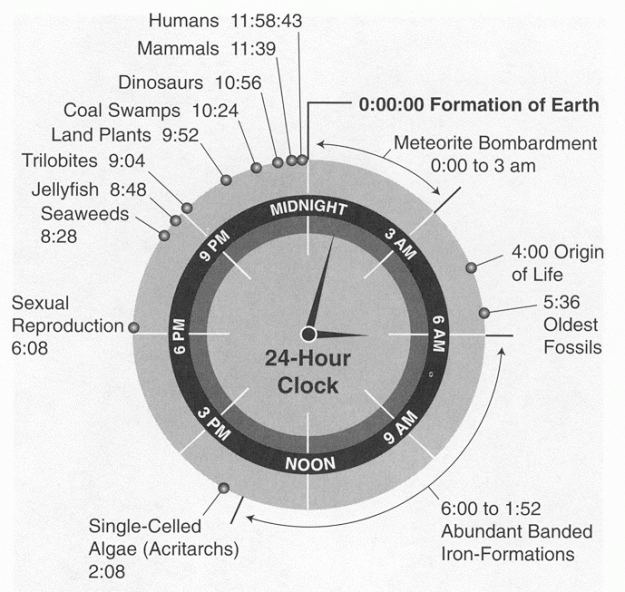
Then there is the history of man on earth (from www.flowingdata.com):


What's interesting to me is how little physical data we have (in terms of fossils, etc.) related to our past.  The vast majority of the earth's history is truly unknown to us yet we infer a tremendous amount from very, very little data relative to the whole.

And finally - here's a guy name Noah whose taken a photo of himself every day for 12 1/2 years.  He's turned it into a video:


Like the "earth clock" above the video we can tell a lot about Noah from the 1-2 seconds he takes each day to snap a picture of himself.

But what can we really know and what does the video really tell us about his life?

You an see various things at different points in the video but what do they mean?

Like science studying the history of the earth we can study the history of Noah - in snapshots of a second or so per day.

I wonder how accurate our inferences would be relative to what actually was happening in his life?

The image Blogger shows me of the video (when stopped) is Noah wearing what looks like a heavy coat?

Can I infer its cold when this picture is taken?

And so on...