Search This Blog

Monday, October 1, 2012

"It's a Wonderful Life" - Why You Should Expect a Financial Panic

What needs to concern US lawmakers is an interesting report in Wired called "New Study Blames Greek Debt Crisis on Market's Invisible Herd."

Countries like Greece and the US issue bonds to finance projects or debt.

People, countries and financial institutions like banks buy these bonds. 

For example, suppose the US sells a $500 two year bonds at a 1% interest rate (real amounts are a million times larger but this will keep it simple).

So if I buy the bond for X dollars (whatever the price is but usually around $500) I will get my $500 back in two years plus my 1% interest.  The terms and details vary widely but the idea is you are loaning money to some entity that issues the bonds for a fixed period of time for a fixed amount of interest.

Now usually bonds are very solid investments - or at least they have been.  The idea that a city or state or the federal government would default was simply beyond imagination until recently.  Similarly other countries sell bonds, like Greece.

Now in the case of Greece some interesting things occurred prior to the Greek debt crisis.

First off, if your bonds are considered "risky" by the market typically they ask for a higher interest rate.  The more risk the more return.  Typically bonds are considered "low risk" because they are backed by sovereign national governments, state, etc. which are (or were) mostly immune from default - so they would be "safer" than a bank.  You accept a lower rate because you have a much higher chance of getting all you money back.

Now in the case of Greece the "risk" of a default got larger and larger over time pointing to a default sometime in 2013.  The study cited in the article (see it here) shows what should be obvious to everyone (but apparently not to academics and market-makers):  Instead of the risk simply rising in a linear fashion all of a sudden there was a panic which resulted in the "Greek Crisis" you saw on the news.

So instead of interest rates going nice and smoothly from 1% to 2% and so on up to 20% or more as the authors would have expected based on risk instead all of a sudden there was a panic well before the crisis.

The authors point out that without proper regulation this will happen again and again - perhaps here in the US as well.

So what am I saying here?

Perhaps the most well known example of something similar is the "bank run" in the Jimmy Stewart movie "Its' a Wonderful Life."  Jimmy Stewart's character owns a "Building and Loan" and when the evil "Potter" triggers a crisis those with money in the "Building and Loan" show up demanding the money in their savings accounts.

The only problem is that the money has been loaned out to build houses for others so there is no cash in the bank.

Normally the bank keeps some cash around with the expectation that not everyone at a given time will ask to withdraw their funds.

But in a "run" as shown in the movie things change - people "panic" because they are scared.  And the banks (or governments) don't have the cash available to repay.

Now a bond is not like a savings account because you get your money and interest back on a fixed schedule or at the end.

Instead, in the bond market, once people "panic" they simply stop buying your bonds.

Now if you are using bonds to fund things like roads then the road doesn't get built - which might be an inconvenience but is certainly not fatal to the country.

However, if you are financing debt with bonds - effectively paying Peter by borrowing from the bond holders (Paul) - you have a different problem.

If no one buys your bonds and your bonds are funding debt and you have to make payments, e.g., for Medicare, Social Security, etc. there is a serious problem.

And this is what happened in Greece.

All of a sudden people said "I want no part of these bonds!"  So the Greek government couldn't borrow to fund current obligations and rioting ensued.

Now the academics expected people to simply tolerate more and more risk by simply expecting a higher and higher interest rate.

The Greek problems had been going on for decades so its not like there was a sudden surprise in store... or was there.

Technically no - Greece was going down a linear road to disaster and at a nice predictable rate.

But investors didn't agree...  They saw that at some point soon there would be "too much" risk and decided to bail.

The US is headed down a similar road today.

We can keep borrowing money (we have borrowed about 100% of GDP - basically where Greece was).

Obviously we are a larger country with more resources - but also we have substantially more (and proportionally more debt).

The problem is that no one can predict what sort of information or event will trigger people to panic.

Hard assets like gold reflect this because they hold value independently of the US dollar.

There is no reasonable way to predict when and if panic will occur.  But if it does there will be a similar crisis here.

Printing money, on the other hand, doesn't solve the problem either because it devalues the investment.

The charts above show that several other European countries are on the same track.  The US is not shown but its in a similar state.

The US spends about $3.6 billion dollars a day - with about $1.6 billion borrowed via bonds (or manufactured via currency printing).
 And remember there are those smarter than you who will benefit from the demise of the US financial system.

We can only hope "Potter" doesn't trigger a run on US.

Friday, September 28, 2012

Bronies, Dekotora, Faedism: Why Incorrect "Facts" Will Never Go Away

An example of Dekotora
The internet is about the quick and effortless propagation of information, right?

I can write in this blog and people literally on the other side of the plant are notified and can read it.

But there is an interesting question about what I write.  Is it correct factually or just some BS I made up?  To address this I always try to include links to sources of information I use.  For example, a few months ago I wrote the popular post "CT Scans - Known Cancer Cause in Children."  In order to show that I did not simply make up that information I included several links to sources of information I used so that readers could do their own followup.

Are the sources I chose accurate?

That's really a good question.

Now, in the case of CT scans there are a number of objective issues as well as any subjective ones.  X-ray's are in fact known to be dangerous.  While you can chose not to believe this there is a reason the X-ray technician puts on a lead apron.

CT scans require the use of multiple X-rays (many hundreds or thousands).

X-ray's can damage DNA in cells.

Many years of study and research have born out these statements.  But that doesn't mean it happens every time you get a CT scan but it increases your chances of being harmed by X-ray's is you use a CT scan.

So a simple "sanity test" tells me that its quite possible the article on CT scans is correct, i.e., it make sense in objective terms.

So even if the paper and/or articles I site are wrong I would still be cautions of CT scans for these reasons and I would hope that with some 85 million a year occurring others would retest any sort of hypothesis regarding their danger.

But much of what is on the internet is not factual or even correct.

Much is simply nonsense, made up, wishful thinking or worse.

But once any kind of information - correct and factual or wrong - escapes into the wilds of the internet it turns out that its very hard to "correct."

There is an interesting article by Samuel Arbesman at Wired on this topic: "Paradox of Hoaxes: How Errors Persist, Even When Corrected."

He points out how incorrect information in all forms persists long after it is identified and corrected on the internet and in other realms such as scientific research.

So what does this say in general?

I think it tells us that the first to publish something in any area of endeavor is going to dominate the thinking about that endeavor even if it is wrong.

Now what factors drive this process of persistent errors?

Certainly the errors themselves have no life - so something must be promoting and maintaining them.

Part of the problem is rooted in today's dearth of analytical thinking.

Kiddies in school are not taught to evaluate what they see and hear analytically or skeptically.  Instead they are fed a steady stream of "gospel fact" and told not to question it.  As they proceed through the educational system their focus and reliance on their own analysis of a situation becomes repressed in favor of raw "facts" promoted by others.

Technology merely serves to enhance the propagation of this incorrect information.

Its one thing to be ignorant in your basement bedroom - its another to blast your ignorance out to dozens or hundreds of social network friends.

In the past entire states liked to promote their independent thinking, i.e., Missouri as the "show me" state.  There are several stories about origination of the "show me" slogan listed here on a State of Missouri site. 

The most popular legend, according to the site "... attributes the phrase to Missouri's U.S. Congressman Willard Duncan Vandiver, who served in the United States House of Representatives from 1897 to 1903. While a member of the U.S. House Committee on Naval Affairs, Vandiver attended an 1899 naval banquet in Philadelphia. In a speech there, he declared, "I come from a state that raises corn and cotton and cockleburs and Democrats, and frothy eloquence neither convinces nor satisfies me. I am from Missouri. You have got to show me [ underline mine ]."

But skepticism today is passe.

Instead it would appear you "elect" an ideology at a young age and simply "live that lifestyle" regardless of any facts or realities to the contrary.

So questionable facts that may come along are simply ignored as something that falls outside your "lifestyle" choice.

Given this its little wonder that erroneous facts escape and cannot be put back in the box.

For example, if an erroneous fact appears that supports your "lifestyle choice" you accept it as true because it solidifies your personal choice.

With social media this means that your like-minded friends will also receive this information.

Any contrary fact, however, are likely to be ignored because they might invalidate your lifestyle choice.  So these are simply ignored.

Let's take the notion of "global warming."

In this regard I am from Missouri - "show me."  And since I wasn't born yesterday I expect, instead of "frothy eloquence" some sort of concrete facts which stand on their own.

I am a skeptic.

But what if I am some sort of "greeny" that simply "knows" as part of my lifestyle that global warming is caused by man and there must be bad?

I will simply process and retain all pro-global warming information and ignore anything that points to the contrary.  So if some fact I, as a global warming "supporter" is invalidated I will, by my nature, not wish to process or accept it.

And therefore wrong information will persist.

I argue it will persist even in the face of overwhelming contrary evidence.  Much like I showed with the study that shows smoking does not cause lung cancer.

The notion that it does, promoted since the 1960's, has no factual basis that I can find other than "doctors" said it was true.  I doubt very much that this meme will ever die.

But I am a skeptic and so are others, at least of my generation.

So what's happening I think is this.  Each little subgroup of society is developing their own fantasy world in which they live that only accepts and processes positive information about their little fantasy world.

For example (I am not kidding), listed here are "Bronies" - male fandom built around "My Little Ponies - Friendship is Magic,"  "Dekotora" - Japanese truck decorating, the "Sect of Gadget Hackwrench" worships Gadget Hackwrench from Chip n' Dale's Rescue Rangers, "Otherkin" are people that act/believe/think they are animals (see this in Second Life), Teen Werewolves, Guro Lolita, Beyonce's Baby is Evil, Xena fandom, and Faedisim (belief in faeries).

Of course, these are the more "fringe elements."  These propagate up as parts of other subcultures, for example atheist song writers, manga art, environmental and political groups, and so forth.

So if I am into Dekotora its unlikely I'll be receptive to information that says automotive lighting is, say, bad for the environment.  But it is likely that I'll be receptive to something that, for example, says its good to get a lot of self worth from material possessions like fancy decorated trucks.

I suppose that skepticism is also a subculture too - a diminishing one in a society filled with this kind of thinking.

Its little wonder our society (and society in general) is heading off the face of a cliff at full throttle.
 

Thursday, September 27, 2012

School Lunch Changes: Too Little, Too Late


I've read a number of articles on school lunch changes.  Basically the old Coke, fried chicken nuggets, fries and some twinkees are out and healthy fare like fruit, vegetables, and so on are replacing them along with calorie limits and curbs on various other things.

The kiddies are not happy according to US Today.

Sadly these dietary changes are the least of the kiddies problems.   And, while the US Government is attempting to change things for the better its more than likely too little too late.

These changes were spawned by the obesity hue and cry - the kiddies eating too much processed sugar and carbs.

But unless there is an across-the-board change in their diet they will simply find what they crave elsewhere.

As I am coming to understand things the real problem is that all the processed food served today is basically nutritionally valueless.

Calories and nothing actually nourishing: no proper vitamins and minerals.

So your body craves more and more in an attempt to consume something helpful nutrition-wise.

The oils (mostly soybean but many others as well) used to make it are bad for you (GMO made) and screw up you ability to have normal sugar levels in your system.

The meats and dairy products are stuffed with antibiotics and hormones.

The problem is actually the kiddies (as well as their moms and dads for the most part) are addicted to junk food quite literally.

Their bodies so polluted with crap that unless they are eating the bad foods they are used to eating they feel dissatisfied.

Hence the YouTube protests and "black market" twinkees.

My how things have changed since the early 1970's when I was in highschool.

Back then they made actual meals with honest-to-God local food.  You could eat as much as you liked.

There were no soda machines and only a single candy bar machine which was rarely used.

There was no food when you arrived or after you left - only food for lunch.

Food made by actual human cooks right there at the school in a regular sort of kitchen.

Lunch cost something like a quarter or fifty cents.  You could eat as many as you purchased.

Today I think the diabetic shock of what kids eat would kill me.

Sadly I would estimate that some 80% or more of today's health problems: obesity, heart disease, diabetes, and on and on are all caused by what we eat.

Healthy foreigners who come to the US have drastic changes for the worse within a year after coming here.

While I applaud the US Government's effort to push a decent meal for school lunch I think far more drastic changes are in order for success.

I am quite certain no one has the balls to make the needed changes.

Given a rational diet the calorie limits shown at the front of the video are quite reasonable but depend on what else the kiddies are eating during the day: school breakfast and dinner for example.

Wednesday, September 26, 2012

Horny Teens, Driverless Cars, and Forgottonia

Last night on the news a banner headline scrolled across the screen: Google driverless vehicle travels 300,000 miles without an accident (er, well, there was an accident but it was while the human tender hand taken over control of the vehicle).

According to this federal site passenger vehicles traveled about 2 trillion miles in 2009.

With about 40,000 traffic deaths a year we expect a death every 50,000,000 (50 million) miles driven.

So in order to see how well a driverless car performs we need to see a lot more miles of testing: 166 times more than 300,000 in order to get to the average number per highway death.

But good old California can't wait for this kind of testing and recently signed into law a driverless car law (see this).

Driverless cars have all sorts of hightech gadgetry like radar, computers, GPS, live internet connections, and so on to make them work.

Many dozens or thousands of additional "points of failure" in addition to things like wheel lug nuts and tires which can fatally fail.  (The car "constantly scans Google Maps" for updates while driving according to the article - let's hope there's no mistake on the road leading along the quarry.)

I wrote "Death by GPS" a couple of years ago.  It covered a couple that followed a GPS right off a cliff into a quarry where they died.

Perhaps there are more than a couple of thousand points of failure to consider???

So by 2015 California will have a set of regulations for driverless cars.

I expect that the California Bar Association is rubbing their hands together in delight over this.

You have to understand that each year 250,000,000 cars drive a couple of trillion miles.  During that time there is a relatively low fatality rate with humans at the controls.

No doubt when the driverless car is working well it too will have a low fatality rate.

But that's not really an issue.  Its getting to that point that I see problematic.

What happens when the engineers at Google (the service provider for this blog) make mistakes?

Agile development will no doubt come into play and I am quite sure there will be details that no on will think of.

Nails on the road blowing out multiple tires on a tight, busy, rainy road.

Solenoids, radars, Google maps and mechanical contrivances sticking, failing to work as designed, or reporting incorrect values.

What will happen should the car lose "connectivity" on a busy highway?  Will the couple in the back seat have time to get dressed and take control? 

Once horny teenagers discover these cars there will be no need for "parking" any longer - simple tell the car to drive in a big wide loop around town and hop into the back seat.

No doubt there will be "Law and Order" episodes about sabotage - the jealous husband or wife tinkering with the autopilot to kill the unwanted spouse.

For kidnapping you'll just have to tie up your victim, program the car and set it off running around the city - that way the police dogs won't be able to find them...

Of course there will be accidents.

Whose fault will those be?  Google's?  Your's?  The car's?

What if your car is out driving without you?  Will you be at fault?

You can bet that Google will never take any blame for software or hardware failures.

It will likely take the insurance industry and the court systems twenty or thirty years per state to sort out.  And, like gay marriage, some states will have more forgiving laws than others.

Then there will be the terrorists.

Want to screw the entire city?  Just jam the GPS or internet signal and all the cars will come to a stop.

Or just send out "bent" GPS information that makes a giant loop out of everything.

Generations of children will grow up not knowing how to drive or take life-and-death responsibility for their own or their friends and families lives.

 Need to get rover to the groomer - just stick him in the car and program it to take him there.

Place unknown to Google maps will simply be forgotten: Like Forgottenia - a section of western central Illinois which was bypassed by the Interstate road system.  If your street isn't on Google maps there won't be any "going home" either.


Tuesday, September 25, 2012

US Medicine and Education: The Odds Favor Failure

Whose fault is this?
Before going to a new restaurant people will often use a guide like Zagat to determine what sort of experience they are likely to have.  Perhaps you might spend fifty or even a hundred dollars on such a meal.

When people go to a hospital or enroll in a university - something which will easily cost tens or hundreds of thousands of dollars typically there is not actual guide to help make the decision.

Certainly everyone knows that such-and-such a school is the "best," or that XYZ hospital is "the best" but what is this based on?

According to this article hospitals kill about a thousand people a week in the US via medical errors, mistakes and so on - or about 50,000 people a year.  I think this number is low compared to other statistics I have seen - but its hard to say exactly what kind of specific errors, e.g., drug mistakes, etc. are included in this number.  One average I think that, over all, due to medical "mistakes" of all kinds some 300,000 people a year die.

You might go to a "good" university.  But what's your success versus debt ratio?  Are you going to get a degree that really a job that will allow you to repay you college debt?

If you are willing to consult something like Zagat why do most people simply go by "word of mouth" on far more important activities such as a hospital stay or selecting a school?

In the case of medicine there is a culture that prevents people from calling out problem physicians or processes.  Younger interns may see things like surgeons with incredibly high problem rates enjoy fantastic reputations and wonder why.  But calling out such a scenario would almost certainly prevent that intern from getting a job at the hospital in the future.

Similarly there is an "alumni" culture at many schools.  Successful leaders in business or academia that have graduated and succeeded.  They promote the school heavily and look for money from other alumni in order to further the schools reputation.

As a highschool kid what do you or your parents, on the other hand, know about the success rate of students.  How many graduate?  How much debt to they carry?  How successful are they in later life at paying off their debts?

Sadly information about doctors, hospitals and college success rates is not something readily availabe to consumers.

These institutions have a vested interest in keeping you in the dark because, armed with detailed information, you might not view their particular institution or school so highly.

People often choose a college, doctor or hospital based on reputation.

In reality there is little else to go on.

But would you eat somewhere new without being able to see a menu?

You might, based on the recommendations of a friend.  But if the genre of food was not something you were familiar with or the recommendation was from someone you barely knew you might not be so inclined.

Across all food sources in the US, according to this NY Times article and this CDC web page between 3,000 and 5,000 people die each year.

Would you eat at the local Wendy's or McDonald's chain restaurant if you knew 50,000 people died there each year?

In Pittsburgh in 2003 the Mexican chain Chi-Chi's was hit with a Hepatitis A outbreak that killed at least four people and made some 660 others sick (see this).

The chain went bankrupt and disappeared from the restaurant scene forever within a few months.

Hospitals kill 12,500 times more people each year.

No one cares.

Universities crank out folks with massive debt each year - hundreds of thousands (see this previous post).

But parents and students are blinded by the "reputation" of the school - fabulous football or credentials.

No one asks "what's the success to debt ratio?"

Imagine if I had an independent survey of graduates and drop outs.

Let's imagine that 60% of the students graduate.

Let''s imagine that of those who graduate 20% make enough money to afford paying off their student debt (this means having a life and enough extra money beyond a debt payment to, say, buy a car or home).

Let's imagine that it costs $50,000 USD to graduate.

So your "chance" of success is .6 x .4 or .24 (about one in four).

So effectively you are going to gamble four to five years of your life and $50,000 on a one-in-four shot of breaking even over the next ten years (the least amount of time to pay off a $50,000 student loan).  So school plus debt payoff equals about fifteen years total.

I say "breaking even" because you might get a job as plumber or electrician in that same time frame, complete your apprentice-ship and afford a decent life as well in your own business.

Its only in the very long run that you might come out ahead if the education you pay for and live to pay off offers more than some other opportunity.

Good thing kids today don't learn how to calculate odds.

Good think potential patients don't either.

If we were educated in this regard we wouldn't tolerate this kind of abject nonsense.

In the end you might do better in Las Vegas if your lucky.

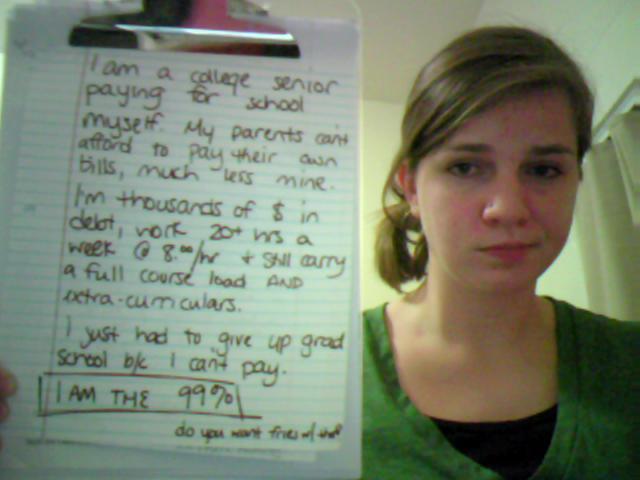
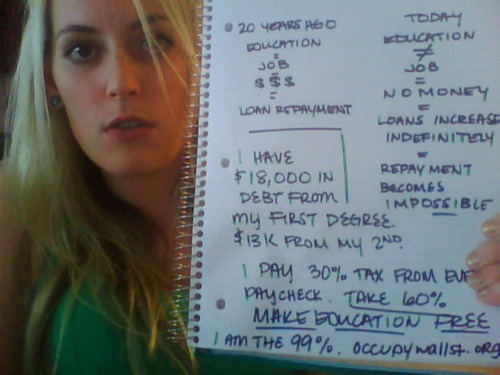
The image at the top was taken from an "Occupy Wall Street"-type web page about "we are the 99%."

Who told these fools to borrow money for an education which had no prospects in the current economy?  Who told them to borrow more money than the average annual wage where they lived for an education they could not use?

Why their government job and highschool guidance counselors.  People with no real world experience at all in making a living on their own.


Yet these people seem oblivious that they themselves made the choice to follow this advice (they are, for the most part, students on this page).

Like following the pied piper.

Maybe "college" is not the answer.

Maybe hard work and common sense are.

College debt is like kicking a dead whale along the beach.

Imagine...

Monday, September 24, 2012

Legal Coercion - How the Government Invalidates Your Sixth Amendment Rights

The Sixth Amendment to the US Constitution says: "In all criminal prosecutions, the accused shall enjoy the right to a speedy and public trial, by an impartial jury of the State and district wherein the crime shall have been committed, which district shall have been previously ascertained by law, and to be informed of the nature and cause of the accusation; to be confronted with the witnesses against him; to have compulsory process for obtaining witnesses in his favor, and to have the Assistance of Counsel for his defense."

Plea bargains, however, have come to take a far more prominent role in recent years.

So prominent, in fact, that 97% (according to this source) of all criminal cases are resolved by plea bargains.

That's with an "average" conviction rate outside the federal system at a rate of around 75%.

So are that many more federal defendants guilty?  Or is this just some trick by the federal government to bypass the Sixth Amendment.

In this area an academic study revealed that college students, placed in a situation (rules, consequences, etc.) similar to what federal criminal defendants see, plead guilty 55% of the time even when innocent.

That's right, the federal government's model likely coerces defendants into pleading guilty at a similar rate even when innocent.  (See this as a recent example.)

Trials are expensive, so are lawyers, investigators, experts, and so on and so forth.

And, as illustrated by the popular TV program "The Closer" morphing into a plea-bargain-based "Major Crimes" we see what the focus of law enforcement is becoming.

Conviction at the lowest cost.  Get the defendant to do the minimum acceptable time for the crime without a trial via a plea bargain.

Clearly in the 1700's when the Constitution was penned the model for crime and conviction was far different.

But today, with governments going bankrupt there is tremendous pressure to save money.

Save money by cutting corners for those least in a position to deal with it.

So though you many enjoy the "right" to a trial it seems like the chances of you getting one are diminishing.

How can this be?

Quite simply by getting to to agree to your own guilt before the trial.

Problem solved for the state.

However, as the academic study points out, people will, in fear, confess to crimes they did not commit in order to obtain what they see as the "lesser of several evils."

So how is this different than a half an hour in closed room with a big cop and black jack?

Answer: It's not.

So its taken a few centuries but those in "governmental power" have again found a way to achieve what they had achieved in England before our forefathers left: a way to have absolute power over citizens.

In the past the motivation was purely power, in the case of England the power of the Crown.

But today, its the power of money, er, well, the power of cost savings and bureaucratic laziness.

Basically it boils down to either

A) Spend a couple of hundred thousand USD for a lawyer and maybe be acquitted.  Probably lose your house, your spouse, go bankrupt, etc.

B) Take the plea on a couple of years in prison regardless of your guilt.  At least you'll have a chance of not losing everything.

Can you say intimidation?

With today's economic crisis this will only get worse.

Its already moving down to the state and local level.

Sadly, this would seem to beg for fighting back with a trial that looked, at least to the government, as vastly expensive.

Forcing them to offer a lower plea rather than pay the big bucks to prosecutors, investigators, experts, etc.

Isn't the US justice system fair and fun?

Friday, September 21, 2012

Posting on Facebook = Accessory to a Crime

A hostage situation in downtown Pittsburgh, PA USA has just ended.  Single alleged perp in a private downtown office building.  Swat team, streets cleared for blocks.

During the turmoil the alleged perp posted several messages on Facebook (see this Reuters article).

According to the Reuters article:


"Several people responded to Thaxton on Facebook saying they were praying for him and encouraging him to cooperate with police.

But others urged him to continue his standoff, Harper said. Police were monitoring those Facebook messages and those people could face criminal charges as accessories, he said."

So what does the underlined part mean?

Commenting on Facebook may make you an accessory to a crime.

What happened to free speech?

What if the man had been previously robbed by his victim, or his child injured?

Would commenting still be a crime?

Perhaps the police should sweep the bystanders for sympathizers and arrest them?

Little wonder Facebook stock is in the toilet.