Search This Blog

Thursday, August 30, 2012

TSA Body Scanners: A Billion Dollar Boondoggle

Do I feel safer knowing these machines are checking in passengers"
Score another victory for the good old Department of Homeland Security (DHS).

After spending billions on "body scanners' Wired reports that the current generation (only two years old) of scanners is on the way out as DHS taps the Pentagon and DARPA to create a new design.

I wrote "Dogma of Stupid: TSA Body Scanners" back in March of this year.

I described how a kid figured out that you could put something on your side in such a way as the color of the "thing" matched the background of the scan and viola - you were through the scanner with something bad.

(The TSA said all this anti-body scanner stuff was nonsense at the time - but now that we know they are looking for alternatives I guess it probably wasn't....)

I want to say each scanner costs over a million dollars and there are 700 of them currently deployed.  So with all the training, installation, overhead, etc., involved we probably talking about pitching one billion USD of technology down the crapper because the TSA screwed up.

Of course this is only a 1/000th of a trillion USD - but its hard not to imagine that there aren't a lot more stupid, silly or useless government programs like this - hundreds of not thousands.

The former Israel Airport security chief I quoted in my original post agrees that these things are junk and claims he could easily walk right through with enough explosives to "take down a 747."

So why do we have these and many other US government boondoggles?

One reason is that there is no "intellectual check" on what people who specify and buy these types of technologies do.

Long ago in the Pentagon they realized that you needed something like DARPA to help figure out what to do technologically at a small scale before you spent tens or hundreds of billions at a large scale on a total failure.  So they do small-scale experiments to prove concepts.

Here is where I think something like crowd-sourcing would be a good idea.

Don't let people submit crowd source designs - instead put professionally submitted designs out for critique via crowd source.

Do the same for the initial idea, e.g., body scanners, as well.  People will be happy to find flaws - after all it will be their grandmother that dies if they don't.

Let people have at the concept.  If someone can hack around it their ego will likely allow them to crow about it.

(I am sure you could develop statistical models to analyze the results as well to help ensure no one is trying to pull a fast one on the analysis side.)

Give the guy who finds the biggest flaw $10,000 USD as a prize.

So $10,000 USD versus $1 billion USD.

Seems like a smarter model for me.

(But no, some bureaucratic idiot might feel bad that his vaunted idea using technology from his brother-in-law's company...)

The reason this is not done, I am sure, is because there are many big-ego types at DHS who want to control this and think that they can keep the techy secrets out of the hands of evil foreigners.

But obviously this is nonsense as the original post I wrote shows.  Some kid with a bright idea and $20 for sewing equipment beats a billion dollar security system.

There are many ways create secure airports - but giving one individual or committee billions of dollars to spend unchecked by free global technical analysis is just stupid

So what about the bad guys?

Won't they benefit from this in some way?

I think that, if you are careful about how and what you crowd source, no.

Its not a secret that airports are looking for weapons on people's bodies.

And there is a clear body of at least Israeli evidence that all you have to do is know who to question to stop terrorists.

So US air carriers, in response, come up with the "Self Service" airline check in (see this WSJ article).

Okay - so body scanners are a failure.

Israeli's have a 100% success rate when they look people in the eye and question them.  (And no, I don't think this is unconstitutional because its WAR.  When the goal is indiscriminate killing of innocent women and children its a war situation - not a domestic Constitutional one.  Yes I know the ACLU would like the Constitution to apply to those attacking the US as well as to US citizens but that's another blog entry...)

SO what do WE do?

Eliminate the human element entirely to save money.

Now even happy Airline Check-in Host Bob won't have the chance to call the TSA to say that Achmed just paid cash for a one-way ticket, looked away every time he spoke to him and checked no luggage.

But don't worry - the airline and TSA will be saving a few bucks.

This is what's known as a "false economy."

Penny-wise and pound-foolish.

Driving forty miles to save $.02 USD per gallon on a ten gallon fill-up.

Apparently no one realizes that more people will fly if the security measures are more effective and less invasive.

Wednesday, August 29, 2012

Agile Educational Failure

I have recently written a number of popular posts on the Agile programming model mostly decrying it as nonsense.

Today I came across this article on parents and teaching children mathematics.  The US is, of course, falling behind many third world countries in mathematics.

I wrote "I Hate Algebra" last year.  In this post I talk about Nobel Laureate Richard Feynman's take on teaching mathematics.

In light of all this I recently had a chance to observe some grandchildren who, by the teachers, were claimed to be lacking educationally.  Not surprisingly it seems that children do quite well with basic concepts outside the class room.  Yet when placed in a "classic" educational model their progress seems to stall or fail.

So then I started to wonder: Does the lack of mathematical ability affect programming?

Over the years of have apprenticed a number of programmers.  To me "apprenticing" means that they learn how to make a living at it, either as a job on their own or as someone a customer will pay to support doing tasks.

Competent programming involves all sorts of complex mathematics: virtually all of it well beyond what you might get in highschool.  Virtually every one of my "apprentices" thought they were "bad" in math - failures.  Yet with experience they became effective programmers and were able to grasp all sorts of complex mathematical ideas: statistics, performance comparison, efficient design, and so on.

Fortunately all of them could at least add and subtract when they started - but that was about it.

Fractions?  Forget it...

Yet today they use these concepts without even realizing that they are:

"How much disk is free?"

"75 percent"

So though they were "math failures" in the academic world in the real world they are not.

When I learned to program the idea was more closely tied directly to mathematics.  Books such as "The Art of Programming" by Donald Knuth (1962) were rife with complex mathematical formulas showing how algorithm A was faster than algorithm B.  This was rough going coming from a highschool where all you could learn in mathematics was trigonometry as a senior.

So while I was not a complete math failure I did struggle in college - I failed dropped calculus the first time and it took a while to become comfortable with all those concepts.

Eventually I got as far as Advanced Calculus.

Over the years since then (which was the late 1970's) I have come to realize that much of the mathematics that you use in your daily life (if you use them at all) are intuitive.  Its only the formalistic written forms that people struggle with.

Back to the grandchildren...

It seems that today those that teach mathematics are not mathematicians - particularly in elementary, middle and high school.

In fact I would say that mostly they are mathematically dysfunctional.

Now their bosses realize this and, rather than pay someone who really understands it to teach it, they create formulaic teaching aid (and I mean "teaching aids" for the teachers) so that these mathematically inept folks can teach children mindless algorithm's to accomplish the obvious.

(Watch the Feynman video in "I Hate Algebra.")

So any child with an alert mind (at least more alert than the teachers mathematically) is quickly stymied with boredom.  To the point in some cases where children actually mock the teachers.

"Okay class, we are teaching rounding today.  Let's round to the nearest ten.  Andrew, pick a number between one and a hundred."

Andrew: "Ninety"

"Ah, Andrew, let's try another number."

Andrew: "Twenty"

"Okay class, let's try rounding to the nearest five.  Jr, pick a number..."

Jr: "Fifteen"

Worse, those that are successful in this model go on to college.  And in college today they are present the same model.

So the best and the brightest are actually not.

So when they land in the world of business where someone is trying to get something done programmatically they literally don't know what to do.  They have no "model" to work in.

So they have to guess.

Which is intellectually what Agile programming is.

Guessing at what's wanted - creating a prototype - and iterating.

(BTW, I wonder what Agile does with things that take a long time to do just to build the basic framework...?)

So I am saying that the whole concept of "Agile Programming" is derived from a body of individuals that are evolutionarily selected in the educational system for a lack of true mathematical understanding.

(In today's school world even more so than in the past bright children are simply bored into dropping out...)

So Agile Programming is symptomatic of a failed mathematical (and scientific) educational model.

Which means that our leadership in these areas of IT is in jeopardy as well.

The rest of the world does not pretend that everyone has equal ability in all areas.  Even the old Soviet Union understood that some children had more talent in some areas than others.

And they used the true ability of their countries elite in those disciplines to help those children along.

Not US.

That wouldn't be "fair."

So we drag everyone down to the (math warning) Lowest Common Denominator (LCD) - basically treating the most gifted as if they are a true math incompetent.  (And there's nothing wrong with being incompetent at math because its likely you're simply good at other things.  In my life I've found that there virtually everyone has some sort of unique skill that they can use to make a living.  The problem is often that they are told they are stupid or a failure rather than being encouraged in an area where they can excel.)

Most of those in my generation who are skilled in these areas of mathematics and programming are nearing retirement - our knowledge will be lost and the next generation will have to relearn what we have done.

In the mean time the results of Agile programming are everywhere.  So pervasive is this that my eighty two year old mother complains:

"Why is the phone system so stupid?"

"Why does my new iron not make steam when I fill it with water and set the knob to steam?"

"Why can't I just make a phone call on my cell phone?"

Agile product development, Agile big pharma, Agile everything.

A total and, for the most part, complete failure.

Perhaps this is the advent of Agile Failure...?

The second point on the image above is most telling: "Working Software over comprehensive documentation."

If you don't have a comprehensive idea of what you are doing how do you know the software is working?

This takes you right back to US grade school.

Teach the kid a process designed to make the teachers job of teaching math easy and the kid learns nothing about doing the "hard work."

Tuesday, August 28, 2012

Patent Battles and the Future

Apple and Samsung Phones
I find it interesting that, in the wake of Apple's court victory over Samsung, that mighty Google is considered a potential next target.

The target would be the Android operating system, or at least any "infringing" Android software that stepped into Apple territory.

Oracle already tried this (see "Google's Waterloo,  US Patent 6,061,520" I wrote in May).  I thought it would be Google's downfall as it was a straightforward case of copying.  And while the court agreed the damages were set to zero - so in the end I was wrong.


So to me Apple would have a tough, up-hill battle.


Another point: Google does not sell Android software.  It gives it away free.


So it will be hard for Apple to directly claim that Google's software is damaging Apple's business.


Today's Samsung phones don't even have the features Apple sued over so the industry is still very nimble when reacting to patent law.

So in the end I think that things will shake out for a while more and then it will be over.

Kodak, for example, with its supposedly valuable trove of patents, was passed by both Google and Apple.  So they must feel that a weakened Kodak won't be able to mount an offense against either of them with regard to its imaging patent portfolio.

At the end of the day you have to believe that the market for "smart phones" is bounded by a couple of things:  3G/4G data access, basic consumer finances, the replacement of home PC's and cable with phones and Netflix, things like that.

So as the phone industry expands it now starts to eat away at the basic infrastructure that built it - home internet and home computers.

Why have an expensive home computer when your phone does everything it does?

There is a good argument for this today - especially with tablet computers.  As more Zynga games move to tablets home computers will simply die off in most cases as obsolete.

Similarly for internet access.

The only reason for most homes to have it is that it provides an easy access to Netflix or DirecTV download services.

Broadband cable is still expensive - about $70 USD per month for the minimum package where I live.

Its not hard to imagine that eventually this will be taken over by some form of wireless.

But here I don't see it happening right away.

There's a lot of bandwidth in a cable signal.  A lot more than packet-switched cellphone towers are likely to be able to deliver any time soon.

Plus wireless phone bandwidth is still expensive.

So this will change, but more slowly, at least in rural areas.

In cities where someone, like Google, can install free Wifi this will be a game changer.  Cable will simply go away.

Why pay for it at $70 or more USD per month when you can have Netflix for $8 USD (at least according to the advertising beaver).

Phones are the next home computers and all these patent wars are just part of the paradigm shift.

Just like anything else - black and white TV to color, simple razors to blade razors, and so on.

Smart phones are the current "Big Thing" - but the next "big thing" is out there - lurking in the bushes - waiting for Apple's time to be over.

What it is no one knows...

Monday, August 27, 2012

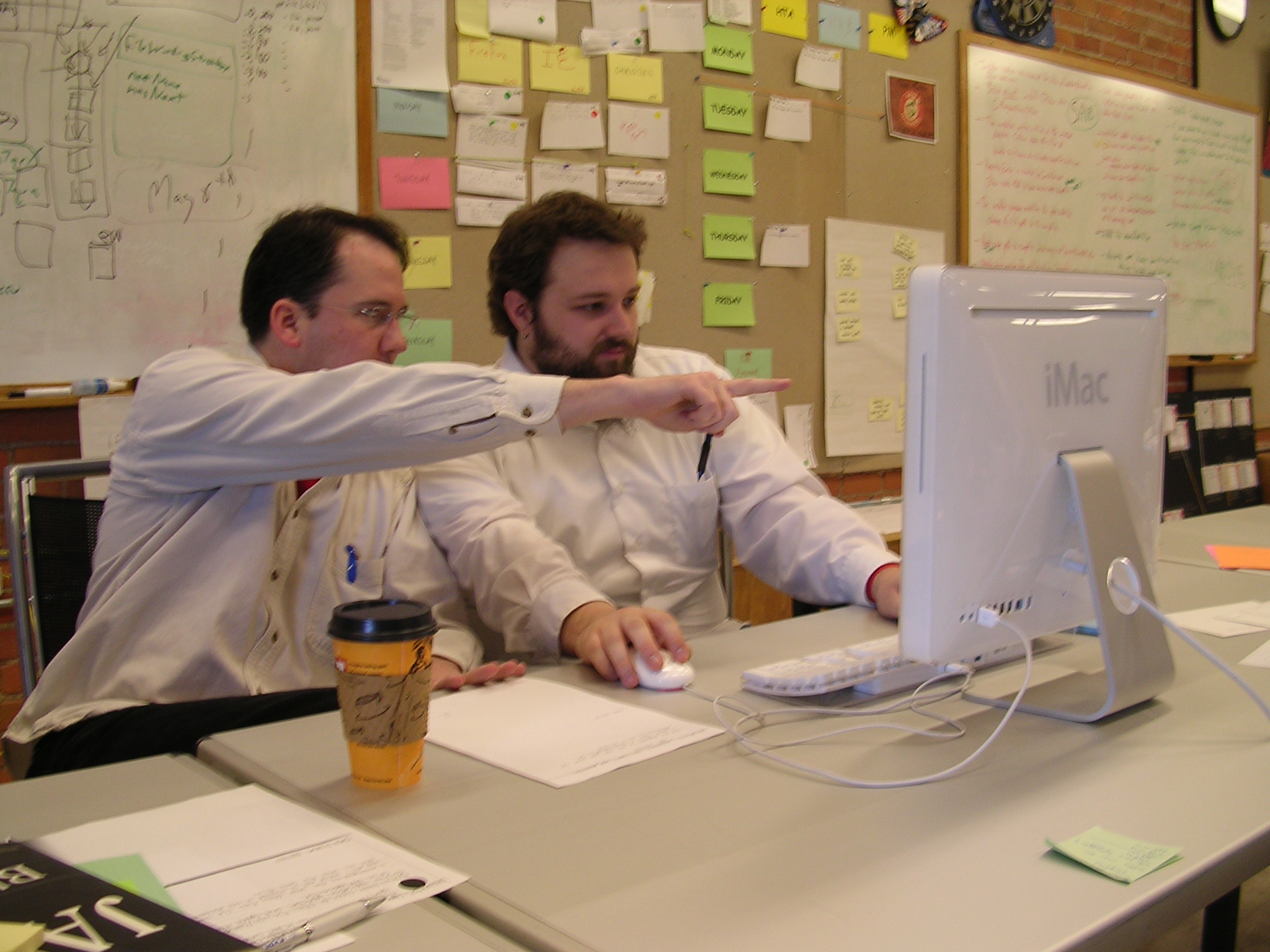
Pair Programming: Failure at Twice the Average Rate

From Wikipedia: Pair Programming
I came upon an interesting article on "paired programming" (WSJ).

Its described in the article as "two people sharing one desk and computer."

Now I can imagine why someone might think this is a good idea.  One of the two is lost in some way - perhaps s/he has poor communications skills, is young, less experienced on a given project, etc.

Pairing this person up with someone more experienced would bring them up to speed faster.

Ars Technica also has a recent article on a similar topic (see this): managing a developer with poor communication skills. Maybe paired programming would be a solution?

Let's look a bit below the surface here before we adopt foolish solutions like "paired programming."

What's wrong with little Johnny and his skills as a programmer?  Why does he need some sort of boost in the first place?

To understand this you have to understand what the notion programming is really about - which to some degree takes us back to my article on Agile Programming.

At its most basic level programming is the art of writing down a series of statements in some language that causes the computer to perform a specific task.

Let's for the moment assume this is happening naively and in a vacuum, i.e., no other programmers around.

To do this a programmer must understand quite a number of things:

- The computer language s/he is using to do the job.

- The problem to be solved.

- How the computer language can best be used to represent the problem and solution.

So in a general sense we can formulate a strategy: give the problem to the programmer, make sure he understands it, let him have at it.

But what happens in this simple model when he's "done?"

How does his boss or whoever provided the problem to solve know that he solved it and solved it correctly?

Today this is often accomplished via "unit testing" - some sort of predefined tests based on a description of the problem and the solution.  The tests have precomputed answers so we can simply apply them to the code little Johnny wrote and get a "go/no-go" result.

But think about this.  To write the tests one has to understand the problem better than the coder writing the code because to write a good test you have to think of "end case" scenarios were problems with data could tickle bugs in the written code.

Pretty hard if you haven't really looked at the code.

You have other problems as well - a tester and coder may understand the problem slightly differently in which case either the tests or code may be useless.

So what does "pair programming" add to this mix?

Not much that I can see - except doubling the cost.

The bottom line is that building a piece of software requires that before a single line of code is committed the entire concept of the total application being built must be completely understood.

Now notice I did not say completely "designed" or "specified."

And this is a key point.

If the collective "I" (the programming team) has a true understanding of the task at hand then its possible to create self contained consistent code because not portion of the task is unknown.

For example, if I am a builder adding an addition onto a house I can estimate what's involved but until I look inside the walls and at the roof rafters I am not going to know for sure whether the estimate I supply is good because I don't have a complete picture of what's needed.

What does looking in the walls accomplish - it removes unknowns and makes the entire project understood.

"Understood" does not mean completely specified.  For example, I might need a database with some specific properties - handle a billion 50K records, retrieve elements in less than 2 milliseconds, whatever.

Now I can understand that - but understanding that does not say if that is even possible to do.

So its possible for the "boss" to have supplied a project with is in fact not doable at all - understandable yes, doable no.

If you think of each project a programmer works on as a recursive set of subprojects, i.e., the top level project is to accomplish X.  X has five parts, X.1, X.2, ..., X.5.  Each of these is treated as a project.  Each may be made up of subprojects, and so on, and so on, ...., forever until you get to the bottom.

Now depending on the application there can be understanding at various levels of subprojects, i.e., reusing technology, etc.

Again, you have to work both from the top down - do I have all the understanding that I need.

And from the bottom up - is everything I understand to need doing doable at all?  And, if so, how?  From the bottom looking up you need to see that each thing is doable in a coding sense and technological sense and that, from above, you have 100% of the understanding you need.

Adding people to the mix doesn't in my opinion fix anything - in fact it makes it more expensive and complicated.

And then there is the notion of "preventing internet surfing."

The problem here is this assumes that a "programmer" has a complete list of totally thought out and fully understood things to do and therefore should always be just "writing code."

This is a problem though because it is virtually never the case that this is true.  There are always unknowns: boundary conditions, incorrect test cases, etc.

Sometimes a programmer needs "idle time" to think about this.

So let's take that away... what happens - probably even less gets done.

Without a well thought out and fully understood solution its likely the code will be bad or incorrect.

But if there's no time to think then there's a strong likelihood it will be wrong...

The bottom line here is that there are very few people who know how to effectively run projects and teams and complete software on time so that it works correctly.

Sadly as far as I can see its not taught in school.

So people invent solutions like "paired programming."

Personally I have always believed that the only effect model for managing programming is to promote the most able programmers to managers.  Of course, this requires that the programmer is ready and able to become a manager.

Again this does not happen.  Programmers should be taught that as you age your skill as a programmer is amplified as a manager.

But management requires both aptitude and training - again newly minted programmers from schools don't learn these skills.

Of course, most programmers have some geeky aspects to them.  But that doesn't mean they cannot manage.  It just means that they have to be "brought along" to do so.  But this is hard in a world where everyone changes jobs every year or two for more money.  In fact they are limiting their futures by doing this and hobbling employers with a very stratified development staff.

Like everything else in the country today the programming train is going off the track - if two programmers work well, why not three?

My experience with modern IT is that is basically an ass covering model.  No one wants to address real problems or, in many cases, even admit they exist (no one wants co-workers to "feel bad").  Then they spend endless time on justifying anything they do - to the point of silliness - in one case a company had a very poor product offering - to the point of receiving legal threats from unhappy customers.

Their response.

Diddling around for six months and not solving the problem.

What do they think their customers are doing in the mean time?  (Looking at competing products.)

All this is a consequence of making everything "fair" and "the same."

The emperor is not wearing any clothes...


Friday, August 24, 2012

TNT's "Major Crimes" Norwegian Style

 So I have to say I am impressed with Norwegian justice.  Anders Behring Breivik, an admitted right-wing terrorist who admits killing 77 people and bombing a government building got a whopping twenty one (21) years in prison.  When he gets out he'll be younger than I am today.

The conviction was by a five judge panel (which was unanimous).  He could have been found "insane" but was not in this case.  Had that been the case he would have had his sentence "delayed" until he was "sane."

Now I like some things that go on in Norway - troll hunting for example.


But this sentencing seems a bit light for my taste.

So is this a new trend in the justice systems around the world?

For many years I was a fan of the TNT show "The Closer."  The point of this show was that the "closing" in a given situation was a confession to the police by the murder (at least usually it was a murderer).  The protagonist, Brenda Lee Johnson, pushed the envelope on many occasions to get confessions - not by beating suspects - but by being more clever than they were and manipulating the law to her advantage.

Ultimately she becomes the target of an outside "lawyer" whose job it is to prove she unjustly treated various suspects via a lawsuit against the city.

As the final season of the show closes it morphs into a new show called "Major Crimes."

The idea with this show is that in order to prevent lawsuits like the one Brenda becomes involved with we need to have a team of lawyers and cops on the job when arresting suspects.  The idea is to "save the city money" by getting the suspect to admit their crimes in the presence of a city attorney.  They then go straight to jail without parole or other options they might otherwise end up with had they gone through a trial.

But this new model requires making "deals" to get the suspect turned into a criminal.

The old Brenda shows required the team of detectives to find evidence and close all the loop holes.

The new show has everyone cutting corners in order to get the suspect into the "interview room" with their lawyer so they can be "convinced" to accept a plea bargain.

So rather than having a suspect admit to, say, murder one the new show has them taking a plea bargain maximum on, say, manslaughter.  So instead of life they get eleven years.

Needless to say this does not sit well with the "older" detectives - the murders are getting "off" relative to the respective "proper punishment."

The bureaucrats running the city and police department, on the other hand, like this because its cheap and fast - no trials, no parole, straight to prison.

Now when you kill 77 people one might imagine you'd get life in prison - 77 lives for one life.

I can understand that Norway is not into the death penalty and I have no problem with that.

But to let the guy out after only twenty one years seems rather odd.

Charles Manson got more years and he didn't personally even kill anyone.

This new arrest to interview room to prison model does also kind of seem like a circumvention of the whole idea of a justice system.

So perhaps the "Major Crimes" model (and I know its only a TV show) has already made its way into Norway for Anders Behring Breivik.

Breivik admits what he did and really doesn't seem like the thinks there was a problem with it.

So instead of some reasonable sentence we just get him into the slammer ASAP with a sentence everyone including his lawyer will like.

I doubt, given twenty one years in a Norwegian prison suite (it has three rooms: exercise, sleeping and one for reading and writing), he will change his mind much.

But hey, its a new season...

The only question is "Is this justice?"

Thursday, August 23, 2012

US Economic Collapse - Coming Soon to Your Neighborhood

In 1971 Richard "Tricky Dick" Nixon disconnected the US dollar from gold.  Previous to that (since the 1940's) the US dollar was linked gold as $35 USD per ounce of gold.

This meant that the amount of gold held by the US limited the amount of dollars the US could create (since the US had a relatively fixed amount of gold).

More importantly the Federal Reserve was bound to this as well.  So if the US government wanted to borrow dollars it had to have gold above and beyond that which backed the US dollars in circulation at the time.

In the 1940's after the war the gold backed US dollar was set as the reserve currency for the world.   This meant that all countries could peg their currency to the US dollar and exchange their currencies for gold at any time.

By 1971 the US was borrowing money for the Vietnam war.  In addition, countries such as France where interested in swapping currency for gold.  The US had run up trade deficits as well.  The US had been printing "extra" money to compensate which drove the real value of the dollar (and all the currencies tied to it) down.

To address this issue Nixon "temporarily" (though its still in effect today) decoupled gold from the dollar via the Nixon Shock.

This meant that the US could print as many dollars as it liked.

So it did...

This turned the US dollar into a fiat currency.  "Fiat" meaning that instead of an asset, say gold, backing the dollar government regulation and law back it.

How well is government regulation and law working out for us at this point?

And very soon the consequences of this after some forty or so years will, as they say, come home to roost.

Since the time of Nixon there has been steady inflation of US prices - let's say an average of two or three percent each year.

Now, without the US currency tied to anything prices simple creep upward.

So imagine Joe in 1965.  Joe is a carpenter.  His wife Mary has four kids at home.  They get buy on Joe's wages.

Over time Joe's work output - say the amount of doors or shelves he can make in a day - is fixed.  But each year the cost of everything Joe needs for his life goes up 2% or 3%.

So after ten or fifteen years Mary needs to work to make up for the deficit in Joe's ability to earn a living.  (No problem, now the kids are grown...)

But in another ten or fifteen years prices have increased another 25% or 30%.

Now Joe and Mary as grandparents have to help their children and grandchildren.

The reason is simple.  Joe's children's marriages have to support two working people to earn enought to buy what they need because of this inflation.

So savings are depleted to "invest" in the future.

Then houses are mortgaged because another ten or fifteen years go by and now to maintain even a basic standard of living there is simply not enough buying power left.

Today we have some $15 trillion in debt in addition to the vast pool of fiat US dollar currency.

Making the dollars relatively worthless.

While all this is going on the US government has used its gold resources to create a "paper" market for gold.

That is a market where you can buy "shares" in gold - but not own the gold itself.

Only after some forty years of this there is another problem.  Only about 2.5% of the paper shares of gold are backed by actual gold.  (For every 45 "shares" equal to a single gold bar I sell I would normally have to have 45 gold bars.  But in today's world I only need one.)

This means that the value of gold is diluted by some 45 times.

So we have the US Treasury borrowing trillions of dollars from the Federal Reserve Bank with I.O.U. backed by the full "Faith and Credit of the US Government."

But what does that mean?  There's nothing to back it up any longer.

Its not like the borrowed money is being used to buy assets that will appreciate in value, bridges, roads, land, islands, etc. 

Its being spent on big screen TV's and food stamps - basically day-to-day bills.

The bottom line is that the quadruple witching hour is upon US:

1) Gold is "devalued" (whether on purpose - see GATA -  or via greed) by some 45 times leaving bullion banks and governments open to a "run" on gold.

2) Dollars have been inflated to the point where a family simply cannot afford to live without financial help from relatives or the US Government even with no savings and both adults working.

3) The US government, all the states, and most municipal governments haave generated Federal Reserve and other debt equal to the US GDP for which it has no backing assets AND it has another 50 trillion in debt for unfunded future promises (Social Security, etc.) for which it has no resources.

4) The current administration is selling short term US Treasury's (with only a few years to maturity) which makes our ability to finance, manage and control the current debt dependent on low interest rates.

Now no amount of "Obama" taxing is going to fix this problem.

Nor is any sort of "Romney or Ryan" social security fix.

The reason is that the magnitude of the debt and devaluation is simply beyond comprehension.

And the rest of the world has followed the US over the cliff by purchasing US Treasury notes.  These are sold by the US Treasury to "fund" the printing of dollars by the Federal Reserve.  We can borrow a lot of money when the cost of financing is low (under 1%). 

But that will change too...

Fiat currency has a long and sordid history of failure.

In fact I am not aware of any case where things turned out well for a country with a fiat currency going back to Roman times and the Roman dinarius.

Wednesday, August 22, 2012

Cyber War: "Sharing" Our Way to Destruction

I've been reading about (and have written about) cyber war over the last months.

STUXNET is perhaps the most widely known about cyber weapon targeted at Iranian nuclear centrifuges.   Basically this is a virus that was specifically created to attack the PC-based Siemens controllers attached to the actual centrifuge.  It was supposedly jointly developed by Israel and the US for the express purpose of stopping the Iranian nuclear program.

The virus basically caused the machines to run in a way that would destroy them while reporting on via the PC controller that everything was working normally.

The end result?  Physically damaged and useless machines.

Now let's compare this to what you might call traditional war.  In this case someone (the US or Israel for example) develops some sort of explosive weapon that can destroy the centrifuges.

In this case there may be a lot of collateral damage - civilians killed (though are they civilians if they are building nuclear weapons?), buildings destroyed, infrastructure damaged, etc.

So cyber weapons do damage, just less than conventional weapons.  And while STUXNET was not targeted at human life its certainly plausible that it could infect something that would in the end physically harm a human.

So it seems that cyber war isn't really all that different than "traditional war" - its just a "more focused" attack with less collateral damage.  Kind of like the neutron bomb of the cold war - a device designed to emit a massive amount of radiation to kill rather than simply destroying physical structures.

Yet cyber war seems to be portrayed in press quite matter-of-factly.

I suppose this is in part because the same name, cyber war, is often used to describe the battle between law enforcement and hackers for passwords and private information.

But this is not really war - its more of a cat-and-mouse game between those in corporate IT who are defending data and those on the outside who wish to access it.

Typically no one is "hurt" physically - only their private information and finances are taken or exploited.

But let's think about what will happen with cyber war over time.

Today its focused on strategic infrastructure - Iranian nuclear centrifuges.  Or, I suppose, on pentagon or CIA computers.

Things that are of some vital (or supposed vital) nation interest.

But I don't imagine that foreign cyber warriors will stop there - why should they?

Instead I imagine that some evil foreign agent will write the most popular iPhone game ever.  Except that it will be a Trojan weapon that, on command, will burn up or "brick" the iPhone via some mischievous misuse of the Apple programming standards.

There are probably at least 230 million iPhones in the world.  This represents easily $10 billion USD for each fifty dollars of iPhone value.  Multiply that by a $100 USD internet/cellphone bill and you see that the destruction of massive amounts of iPhones could represent a trillion USD in damages.

And iPhones are just one example of thousand of daily use devices connected to the internet.

There are of course servers, home PC's, routers, wifi's, home entertainment devices of all sorts.

And there are commercial computers of other sorts in trains, planes, and automobiles.

There are financial institutions rife with computer devices that virtually define our culture.

Of course, at least from the perspective of the Middle-East where there is no where near the dependency on an installed base of computers, its a one sided effort.  We cannot attack their installed base of cellphones because they have far fewer.

What does this all mean?

I think that we here in the US are "hanging out" very, very far in the sense of our technological susceptibility to cyber attack.  Western Europe is probably in the same boat as well.

And all our advanced infrastructure is basically "open" to anyone with a PC and a clever mind.

So a trillion dollar "bricking" of all iPhones would be about the same "cost" to US society as a direct nuclear strike on New York City.

In the past to accomplish a direct nuclear stricke (or even in the case of Iran today) billions of dollars of development for missiles, guidance, computers, nuclear production was required over many, many years.  As in the case of Pakistan or India, relatively recent members of the nuclear "club" this was an effort and investment by the entire society within a country.

A cyber attack on financial institutions or cellphones, on the other hand, could be accomplished by a single determined person using nothing more than a decent PC and an internet connection.

In the US our cyber infrastructure has become some convoluted and fraught with "holes" (see this article as an example) that it seems this sort of attack is inevitable.

Stepping back it seems that there is an interesting antithesis here.

In the US at least, we love to "share" on Facebook and through endless cellphone and other apps - pictures, email, life in general.

We foolishly believe that the rest of world is of the same mindset.

I think that yes, they do want to share, but more than likely share something evil in the form of a virus or other problem in order to harm us.

Yet we dance around singing Kumbia in hopes of "world peace" in complete ignorance of this potential for destruction.

As if our very nature for "sharing" is the window through which we will allow the destruction of our way of life...